The thing nobody tells you about Aruba is that the island only really makes sense once you get on the water. I spent my first trip treating the sea like a backdrop — something pretty to look at from a beach chair. Then a catamaran captain talked me into rolling off the back of his boat above the Antilla shipwreck, and twenty minutes later, hovering over a coral-draped freighter full of parrotfish, I finally understood why Aruba water sports are the real reason to visit. The island is built for it: the water is warm, clear, and on the right side glass-calm, with more to do in it than you could fit into a two-week trip.
This is my complete, honest guide to Aruba water sports and boat tours: every activity worth your time, where to do it, what it actually costs, who each one suits, and the mistakes I see first-timers make. I’ve snorkeled the wrecks, blown the budget on a sunset sail, been thoroughly humbled trying to windsurf at Fisherman’s Huts, and put my non-swimming in-laws on a submarine that made them converts. Whether you’re a nervous first-timer, a certified diver, a family with little kids, or a cruise passenger with eight hours and a long wish list, there’s a section below written for you.
Aruba water sports at a glance
If you only skim one thing, skim this. Here’s how the island’s main on-the-water activities stack up — what each is best for, roughly what you’ll pay per person, and whether you need to book ahead. Prices are 2026 ballpark figures in US dollars (the currency every operator quotes and accepts); always confirm the latest when you book.
| Activity | Best for | Where | Typical price (pp) | Book ahead? |
|---|---|---|---|---|
| Snorkeling (from shore) | Free, DIY, families | Boca Catalina, Malmok, Arashi | $0 (own gear) | No |
| Snorkel boat tour | First-timers, the Antilla wreck | NW coast / Palm Beach | ~$45–75 | A day or two |
| Scuba diving (2-tank) | Certified divers, wrecks | Antilla, Pedernales, reefs | ~$90–120 | Yes |
| Discover Scuba (no cert) | Curious beginners | Calm reef sites | ~$120–140 | Yes |
| Catamaran sunset cruise | Couples, groups, the view | Palm Beach departures | ~$75–95 | Yes (sells out) |
| Catamaran snorkel sail | Best all-rounder | NW coast | ~$65–90 | Yes |
| Windsurfing rental/lesson | Wind chasers, learners | Hadicurari (Fisherman’s Huts) | ~$50–80/hr | Lessons yes |
| Kitesurfing course | Adventurous travelers | Boca Grandi, Hadicurari | ~$350–450 (3 days) | Yes |
| Stand-up paddleboard | Calm-water cruisers | Palm/Eagle, Mangel Halto | ~$25–40/hr | No (tours yes) |
| Kayaking (mangroves) | Nature lovers, families | Mangel Halto / Spanish Lagoon | ~$20–35/hr | Tours yes |
| Parasailing | Thrill with no skill | Palm Beach | ~$70–90 | Same day OK |
| Jet ski / tubing | Adrenaline, teens | Palm Beach | ~$60–80/30 min | Same day OK |
| Glass-bottom / semi-sub | Non-swimmers, toddlers | Palm Beach / Oranjestad | ~$35–50 | Recommended |
| Atlantis submarine | Non-swimmers, real depth | Oranjestad harbor | ~$109 adult / $69 child | Yes |
| Deep-sea fishing charter | Anglers, groups (private) | Renaissance Marina, Hadicurari | ~$400–600 half-day (boat) | Yes |
My one-line answer if you’re in a hurry: book one catamaran snorkel-and-sail trip for the shared joy of it, do the rest of your snorkeling for free from the beach, and add one “splurge” experience — a dive, a sunset sail, or the submarine — depending on who you’re traveling with. Everything below is the long version.

How Aruba water sports actually work (read this first)
Aruba is shaped like a fish, and which side of it you’re on changes everything. The entire west and south coast — Palm Beach, Eagle Beach, Manchebo, Druif, down through the Spanish Lagoon to Baby Beach — sits in the lee of the island. The water there is warm (78–84°F year-round), often startlingly clear, and on a good morning as calm as a swimming pool. That’s where 95% of the water sports happen.
The north and east coast is the opposite: wild, wind-hammered surf, rip currents, and rocky shoreline. It’s spectacular to look at and genuinely dangerous to swim. Locals will tell you flatly — do not get in the water on the wild side. The one exception adventurers seek out is the southeast tip around Boca Grandi, where the wind and chop are exactly what advanced kitesurfers want.
That same relentless trade wind is the island’s secret. It blows from the east almost every day, 15 to 28 knots, which is why Aruba is a world-class windsurfing and kitesurfing destination and also why your afternoon snorkel can get choppier than your morning one. The practical takeaway: do calm-water activities (snorkeling, paddleboarding, glass-bottom boats) in the morning before the wind builds, and save the wind sports for the breezy afternoon. It’s the single best piece of timing advice on this page.
A few more ground rules before we get into specifics. The US dollar is accepted everywhere, so there’s no need to convert florins for a tour. Most beach operators cluster on Palm Beach, which is the de facto water-sports hub; if doing a lot on the water is your priority, it’s worth weighing when you decide where to stay in Aruba. Almost everything can be booked through your hotel’s activities desk, but you’ll usually pay less booking the operator directly. And tipping crews 15–20% is customary and, honestly, deserved — these people work hard to make your day.
Snorkeling in Aruba: the best spots and tours
Snorkeling in Aruba is the easiest, cheapest, and arguably most rewarding thing you can do in the water here, and it’s where I tell every first-timer to start. The reefs aren’t as dense as Bonaire’s next door, but the water clarity is excellent, the entry is gentle, and you can do a surprising amount of it for free with nothing but a $20 mask from a beach shop.
The best shore snorkeling (free, no boat needed)
Boca Catalina is my top pick for beginners. It’s a small, calm cove on the northwest coast where the water is shallow, protected, and absolutely full of fish — sergeant majors, blue tang, the occasional barracuda hanging in the distance. Park, walk in, and you’re snorkeling within a minute. Malmok Beach, just south of it, has rockier entry but rewards you with bigger fish and is the launch point closest to the Antilla wreck. Arashi Beach, near the California Lighthouse, is sandier and family-friendly with reef toward the rocks at the north end.
Two more worth the drive: Mangel Halto on the south coast is a local favorite, a mangrove-fringed spot with a channel that drops into surprisingly vivid reef — bring water shoes for the entry. And Baby Beach at the island’s southern tip is a shallow, bathtub-calm lagoon that’s perfect for nervous swimmers and kids, with snorkeling along the eastern edge (mind the current where the lagoon opens to the sea). All of these are detailed in our full guide to Aruba’s beaches, which is worth reading alongside this one.
Snorkel boat tours and the Antilla shipwreck
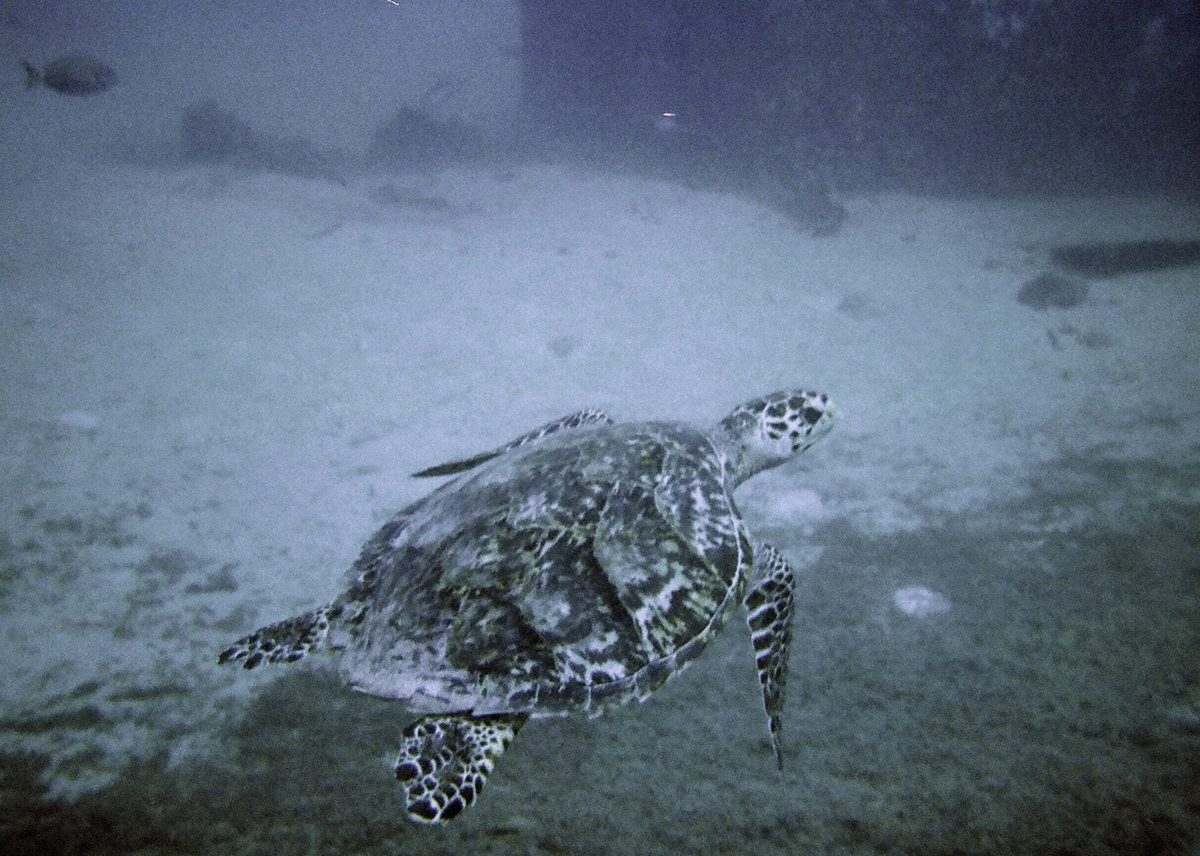
The one snorkel experience I’d actually pay for is a boat trip to the Antilla. It’s the largest shipwreck in the Caribbean — a 400-foot German freighter scuttled by her own crew in 1940 — and the top of the hull sits shallow enough that snorkelers, not just divers, can float right over it. Around it you’ll see schools of fish, fan coral, and often a sea turtle or two. Most tours pair the Antilla with a second stop at Boca Catalina or Malmok reef.
A standard half-day snorkel tour runs about $45–75 per person and includes gear, instruction, two or three stops, and usually drinks (often an open bar on the sail back). The big catamaran operators — De Palm, Red Sail Sports, Jolly Pirates, Pelican — all run versions of this, and they’re genuinely fun, social mornings. If you want the wreck without getting in deep, this is the move. (More on choosing between operators in the catamaran section below.)
A word of honesty: midday snorkel tours on the big boats can be crowded and a bit conveyor-belt, with 40–60 people rolling in at once. If that’s not your thing, go early, choose a smaller boat, or just snorkel Boca Catalina yourself and save the cash for a dive.
Scuba diving in Aruba: wrecks, reefs, and your first breath underwater
Aruba is, first and foremost, a wreck-diving destination, and that’s what makes it special. Where some islands sell you reef after reef, Aruba’s signature dives are sunken ships you can swim through, with reef as the supporting act. Visibility commonly runs 50 to 90 feet, the water is bath-warm, and the dive infrastructure is professional and easygoing.
The dive sites worth knowing
The Antilla headlines again, but for divers it’s a different animal — you can drop to 60 feet and explore the holds, swim-throughs, and coral-crusted hull. The Pedernales is a shallower wreck (around 30 feet), a WWII oil tanker that’s perfect for beginners and a great second dive. Beyond the wrecks, Boca Catalina and Mangel Halto offer easy reef dives, the Spanish Lagoon and Barcadera Reef hold soft corals and critters, and the more advanced Commandeurs Baai rewards experienced divers. There’s also a small but growing fleet of purpose-sunk wrecks and an artificial-reef plane that operators love to show off.
Prices and what to book
A two-tank boat dive for certified divers runs about $90–120; a single dive $60–80. If you’ve never dived, a Discover Scuba session — a pool-then-shallow-reef intro with an instructor, no certification needed — is around $120–140 and is the single best way to find out whether you love it. If you’re ready to commit, a full PADI Open Water certification course runs roughly $400–550 over three to four days and leaves you certified to dive anywhere in the world. Reputable operators include JADS Dive Center (great for the south side and shore dives), Native Divers, Aruba Watersports Center, and Red Sail Sports. Book dives ahead — boats fill, and certification courses need scheduling.
Not sure about scuba? Try SNUBA or SeaTrek
If full scuba feels like too much but snorkeling feels like too little, Aruba has the in-between options. SNUBA tethers you to an air supply on a floating raft so you can descend 20 feet or so with no tank on your back and no certification. SeaTrek (helmet diving) lets you walk along the seabed breathing normally inside a clear helmet, with your hair barely getting wet — weirdly delightful and brilliant for people who panic with a regulator. Both run roughly $90–130 and are popular family and cruise-day picks.
Catamaran cruises and sailing: the one tour everyone loves
If I could send a first-timer on exactly one paid activity, it would be a catamaran cruise. An Aruba catamaran cruise is the island’s signature experience for a reason: you get the sailing, the snorkeling, the open bar, and — on the sunset version — the kind of golden-hour light that makes people quietly decide to come back next year. It’s social, it’s easy, and it works for almost everyone.
Sunset cruise vs. snorkel sail vs. private charter
There are three flavors. A sunset cruise (about $75–95 per person, roughly two hours) is the romantic one — drinks, music, the sun dropping into the sea, usually no snorkeling. A snorkel sail (about $65–90, half a day) is the all-rounder: two or three snorkel stops including the Antilla, lunch or snacks, and an open bar on the way home. And a private charter (from around $400 for a small group, up into four figures for a big yacht) buys you the boat, the route, and the pace for your own party — the honeymoon or special-occasion move.
Which operator? An honest take
The big names each have a personality. Jolly Pirates is the fun, rowdy, rope-swing-off-the-boat crowd — great for groups and 20-somethings, less so if you want quiet. Red Sail Sports is the polished, do-everything operator with a premium feel and a higher price to match. Pelican and De Palm sit comfortably in the middle, reliable and well-run. Monforte and the smaller luxury catamarans lean upscale and adults-oriented. None of them are bad; pick by vibe, not by fear of choosing wrong.
What to bring: reef-safe sunscreen (apply before boarding — some boats ban spray sunscreen on deck), a towel, a light layer for the breeze, and seasickness tablets if you’re prone, because even Aruba’s calm water has a swell. Cruises genuinely sell out in high season, so book a few days ahead. If you’re costing out your trip, a cruise is one of the bigger single-day line items — our Aruba vacation cost guide can help you slot it into a realistic budget.
Windsurfing and kitesurfing: why the pros come here
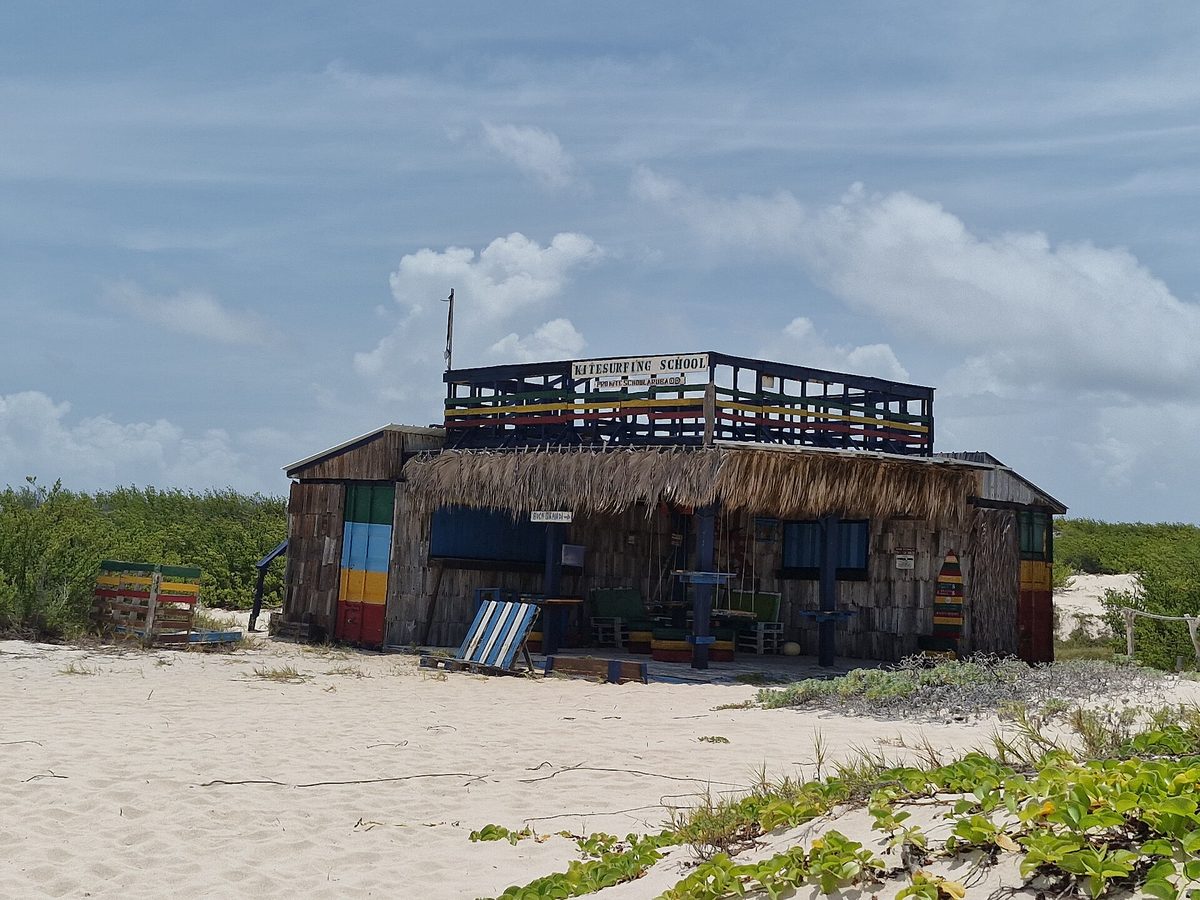
Here’s where Aruba quietly out-punches every island around it. Those constant east trade winds — 15 to 28 knots, blowing nearly every single day — combined with flat, shallow, warm water make this one of the best places on earth to windsurf, and the island has produced world-champion sailors to prove it. If you’ve ever wanted to learn, or you already rip and want a guaranteed-wind holiday, build a trip around it.
Windsurfing: where and how much
The epicenter is Hadicurari Beach, better known as Fisherman’s Huts, just north of the Palm Beach high-rises. The shallows go out a long way, so beginners can stand up and learn without being swept off to sea, while experts blast around just beyond. Rentals run about $50–80 per hour (cheaper for half- and full-day or weekly packages), and a beginner lesson is around $60–80 an hour. Schools like Aruba Active Vacations and Vela Sports kit you out and teach you. The famous Hi-Winds amateur windsurfing and kiteboarding festival takes over Fisherman’s Huts each summer and is a blast to watch even if you never touch a board.
Kitesurfing: beginner-friendly and expert-only spots
Kitesurfing splits by skill. Beginners learn at Hadicurari, where the water’s flatter and IKO-certified schools run lessons. Advanced kiters head for Boca Grandi on the southeast coast, where side-offshore wind and real waves make for a serious session (and no place for novices). A three-day beginner course that gets you up and riding runs roughly $350–450. Wind is strongest and most reliable from around May through July — if wind sports are the whole point of your trip, check our month-by-month guide to the best time to visit Aruba before you book flights.
Paddleboarding and kayaking: the calm-water option
Not everything has to be an adrenaline hit. On a still morning, stand-up paddleboarding along Palm Beach or Eagle Beach is pure meditation — flat water, sunrise light, maybe a turtle surfacing beside you. Boards rent for about $25–40 an hour right off the beach, and it takes most people about ten minutes to find their balance.
The more memorable version is a guided mangrove tour at Mangel Halto or through the Spanish Lagoon, where you paddle (on a SUP or in a kayak) through narrow mangrove channels and out to clear reef, often with sea turtles visible right through the water. Clear-bottom kayaks are a fun twist for families. Guided mangrove tours run about $65–90 for SUP and $20–35 an hour for simple kayak rentals. It’s low-effort, high-reward, and a lovely change of pace from the busy Palm Beach strip.
Adrenaline on the water: jet skis, parasailing, tubing and more
If your idea of a good time involves a motor and a bit of a scream, Palm Beach is your strip. Every morning a row of operators sets up on the sand selling the high-octane stuff, and most of it requires zero skill — just a signature and a credit card.
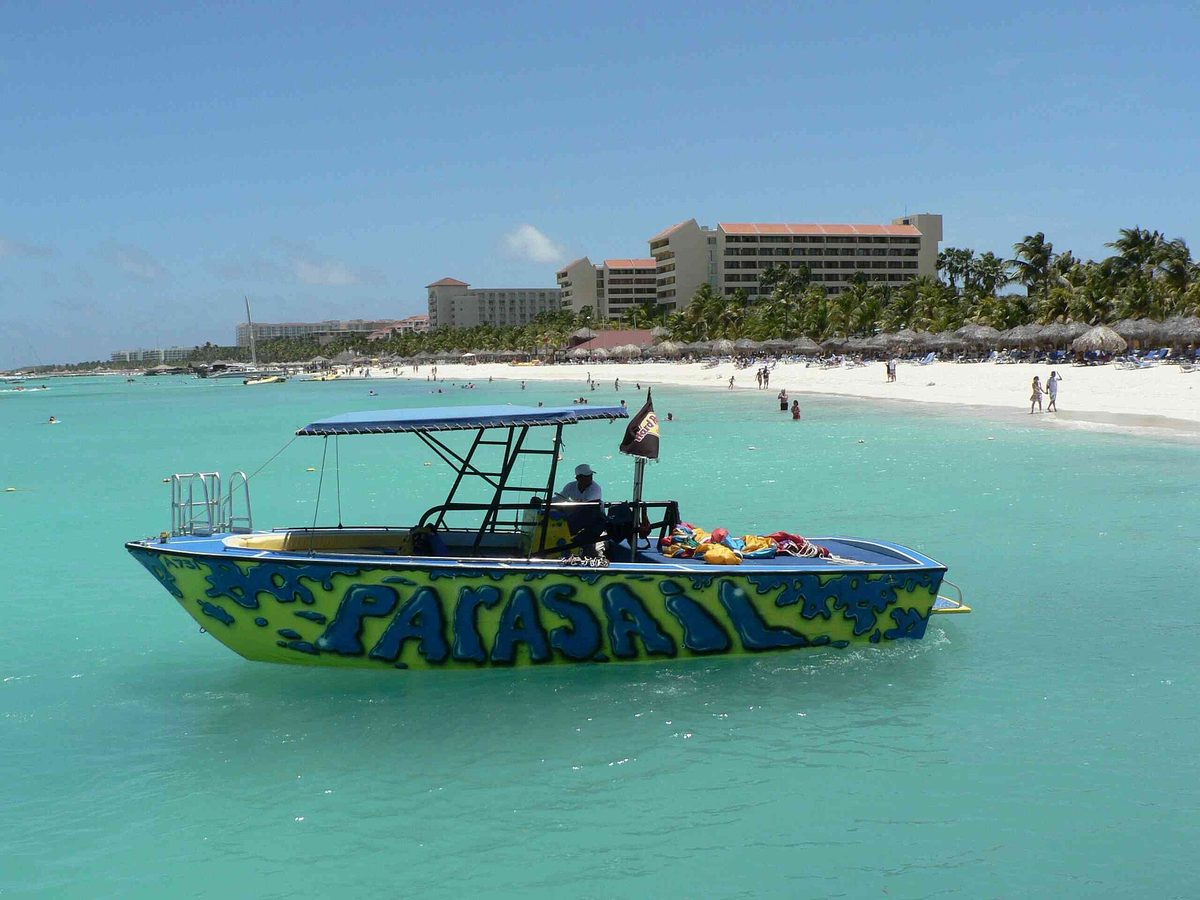
Parasailing is the gateway thrill: they strap you into a harness, the speedboat accelerates, and you rise 300–500 feet over the Caribbean for an oddly peaceful eight-to-twelve-minute flight with a postcard view of the whole coastline. It’s about $70–90 solo or $110–140 tandem, needs no fitness, and is tamer than it looks — great for nervous thrill-seekers. Jet skis rent for roughly $60–80 per half hour. Tubing and banana boats are the cheap, giggly group option where the only goal is to get bounced off into the sea. And for the truly extra, some operators offer flyboarding (water-jet boots that hover you above the surface) and the Seabob, a powerful underwater scooter that pulls you along like a torpedo. Most of this you can book same-day right on the beach — no need to plan ahead.
Staying dry: submarines, semi-subs and glass-bottom boats
Some of the best water experiences in Aruba don’t require you to get wet at all, and these are lifesavers for non-swimmers, young kids, grandparents, and anyone who wants the reef without the snorkel.
The standout is the Atlantis Submarine, a real submarine that descends well over 100 feet on a roughly 45-minute dive past reefs, fish, and a shipwreck visible through the portholes. It’s around $109 for adults and $69 for children, departs from the Oranjestad harbor, and genuinely impresses — I’ve watched skeptics come up grinning. For a cheaper, on-the-surface version, the Seaworld Explorer semi-submarine keeps you in an air-conditioned hull with windows below the waterline (about $45–55), and classic glass-bottom boat tours run around $35–50. All three are ideal for the family member who wants to come along but isn’t getting in the ocean — and they’re a smart rainy-hour backup, too.

Deep-sea fishing charters
The water drops off fast just offshore, which means you don’t have to motor for hours to reach big game. Aruba’s deep-sea fishing charters target mahi-mahi, wahoo, kingfish, barracuda, amberjack, and — in season — blue and white marlin and yellowfin tuna. Boats leave from the Renaissance Marina downtown and the Hadicurari Pier at Palm Beach.
Charters are priced by the boat, not per person, so they’re best split among a group. A half-day (four hours) runs roughly $400–600 and a full day $700–1,000, typically including gear, bait, crew, and drinks. Reputable names include Teaser Charters, Driftwood, and a fleet of family-run boats. Even if you don’t keep your catch, many restaurants will cook what you bring — a fun way to connect a charter to dinner; see our Aruba restaurants guide for spots that do “hook and cook.”
Private islands and the flamingos
Two offshore “islands” deserve a mention because they package water sports with a full day out. De Palm Island is an all-inclusive day trip — snuba, a small reef, water park, food and drinks included — that’s hugely popular with families and cruise passengers who want everything in one paid ticket. Renaissance Island is the famous one: a private island with the Instagram-famous flamingos wading right up to you on the beach. Access is reserved for Renaissance hotel guests or via a day pass when available, and yes, it’s as photogenic as it looks. Neither is “water sports” in the strict sense, but both are easy, high-satisfaction days on the water.
The best Aruba water sports by type of traveler
The “best” activity depends entirely on who you are and who you’re with. Here’s how I’d point each kind of traveler — think of it as a shortcut past the overwhelm.
Families with kids
Start with free shore snorkeling at Baby Beach or Boca Catalina where the water’s shallow and calm. Add the Atlantis submarine or a glass-bottom boat for younger kids who can’t snorkel yet, a gentle kayak or clear-bottom paddle at Mangel Halto, and one banana-boat ride for the squeals. De Palm Island is the easy all-in-one day. Skip the open-bar party catamarans. For dry-land ideas to balance the trip, our things to do in Aruba guide has plenty for kids.
Couples and honeymooners
A sunset catamaran cruise is the obvious winner, and it earns it. Upgrade to a small private charter if the budget allows — just the two of you, a bottle of something cold, and the coastline sliding by. A guided sunrise paddle and a leisurely snorkel at a quiet cove round out a romantic, low-stress water itinerary.
Adventure seekers and active travelers
This is your island. Get certified or dive the Antilla and Pedernales, take a kitesurfing course at Boca Grandi, chase wind at Fisherman’s Huts, and add a Seabob or flyboard session. You could fill a week without repeating yourself.
Cruise passengers (one day, big wish list)
You’re docked in Oranjestad with limited hours, so prioritize. The Atlantis submarine leaves right from the harbor. A morning snorkel catamaran to the Antilla is doable if it’s a longer port day. Book a ship excursion or a reputable operator in advance, and don’t wander to the far south — keep activities close to town so you’re never racing the all-aboard horn.
Budget travelers
Snorkeling is free if you bring or buy cheap gear — Boca Catalina, Malmok, and Arashi cost nothing but the drive. Paddleboard and kayak rentals are cheap by the hour. Skip the pricey private charters and motorized toys, and put your one splurge into a shared snorkel sail for the open-bar value. A little planning stretches a water-sports budget a long way; pair it with our Aruba itinerary guide to sequence free and paid days sensibly.
When to go: the best time for water sports in Aruba
Aruba’s huge advantage is consistency. It sits below the hurricane belt, so it’s a reliable year-round destination with warm water (78–84°F) every month and far less rain than most of the Caribbean. That said, there are nuances worth timing around.
For snorkeling and diving, visibility is best on calmer days, which tend to be the morning hours and the slightly less windy stretch of late summer and fall. For windsurfing and kitesurfing, you want the opposite — the windy season peaks roughly May through July, which is also when the Hi-Winds festival runs. The brief rainy season (around October to December) brings short passing showers, not washouts, and is still very doable. High season (mid-December to April) means the best weather but the biggest crowds and the highest prices, and catamaran cruises sell out fastest then. For the full breakdown, see our best time to visit Aruba guide.
Planning your water-sports days: costs, logistics and what to skip
A few practical things I wish I’d known sooner, so your days on the water go smoothly.
How to get around to the water
If you’re basing on Palm Beach, most beach operators are walkable. But the best snorkeling (Boca Catalina, Mangel Halto, Baby Beach) and the wind spots are spread around the island, so a rental car or jeep makes a real difference for a water-focused trip — our getting around Aruba guide covers the options. The free arterial bus runs the hotel strip into town but won’t get you to the quiet coves.
What to book ahead vs. show up for
Book ahead: catamaran cruises, scuba dives and courses, the Atlantis submarine, fishing charters, and kitesurf/windsurf lessons — these have limited capacity. Show up same-day: jet skis, parasailing, tubing, and beach SUP/kayak rentals, which run on rolling availability. In high season, push your “book ahead” reservations to a week out.
What to bring and a note on safety
Pack (or buy) reef-safe sunscreen — the sun here is stronger than it feels in the breeze, and some boats require it. Bring water shoes for rocky entries, a rash guard for sun protection, and motion-sickness tablets for any boat trip. Drink more water than you think you need. And respect the wild side: the north and east coasts are not for swimming, no matter how inviting a tucked-away cove looks. Many resorts include basic non-motorized gear; if you’re at one of the all-inclusive resorts, check what’s already covered before you pay twice.
A few honest mistakes to avoid
Don’t book every paid activity before you arrive — leave room to read the wind and the weather. Don’t save snorkeling for a windy afternoon and then conclude “Aruba snorkeling is bad” (it isn’t; you just went at the wrong time). Don’t over-apply spray sunscreen right before snorkeling — it slicks the water and harms the reef. Don’t assume the cheapest big-boat tour will be quiet. And don’t, under any circumstances, swim on the north shore because a photo looked tempting.
Frequently asked questions about Aruba water sports
What water sports can you do in Aruba?
Just about everything. Aruba offers snorkeling, scuba diving, catamaran and sailing cruises, windsurfing, kitesurfing, stand-up paddleboarding, kayaking, parasailing, jet skiing, tubing, flyboarding, Seabob scooters, deep-sea fishing, and stay-dry options like a real submarine, semi-submarine, and glass-bottom boats. The calm, clear west coast suits most activities, while the windy southeast is for advanced kitesurfers.
What is the best water activity in Aruba?
For most people, a catamaran snorkel-and-sail or sunset cruise is the best single activity — it combines sailing, snorkeling, an open bar, and the view, and suits almost everyone. For adventure travelers, diving the Antilla shipwreck wins; for families and non-swimmers, the Atlantis submarine is the crowd-pleaser.
Is Aruba good for snorkeling?
Yes, with realistic expectations. The water clarity is excellent and entry is gentle, with great free shore spots at Boca Catalina, Malmok, and Arashi, plus the famous Antilla shipwreck by boat. The reefs are less dense than Bonaire’s nearby, but the variety of fish, easy access, and warm water make it very beginner-friendly.
Is Aruba good for scuba diving?
Aruba is one of the Caribbean’s best wreck-diving destinations. The Antilla — the largest shipwreck in the Caribbean — anchors a lineup that includes the beginner-friendly Pedernales wreck and several reefs. Visibility runs 50–90 feet, water is warm year-round, and the dive operators are professional, making it great for both new and certified divers.
How much do water sports cost in Aruba?
It ranges widely. Shore snorkeling is free with your own gear. Snorkel boat tours run about $45–75, a two-tank dive $90–120, a catamaran cruise $75–95, parasailing $70–90, and the Atlantis submarine about $109. Private charters and fishing trips are priced per boat from $400 up. Booking operators directly usually beats hotel-desk prices.
What is the best month for water sports in Aruba?
Any month works thanks to year-round warm water and little rain. For calm-water snorkeling and diving, the slightly less windy late summer and fall offer the best visibility. For windsurfing and kitesurfing, the windy May-to-July season is prime, coinciding with the Hi-Winds festival. High season (December–April) has the best overall weather but the biggest crowds.
Do you need to book water sports in advance in Aruba?
For limited-capacity activities — catamaran cruises, scuba dives and courses, the submarine, fishing charters, and wind/kite lessons — yes, book a few days ahead, or a week in high season. For beach-based jet skis, parasailing, tubing, and SUP or kayak rentals, you can usually just show up the same day.
Where is the best snorkeling in Aruba from shore?
Boca Catalina is the top pick — a calm, shallow, fish-filled cove with easy entry. Malmok is rockier but closer to the Antilla, Arashi is sandy and family-friendly, and Mangel Halto and Baby Beach on the south coast reward the drive. Go in the morning before the trade wind picks up and stirs the surface.
Can non-swimmers do water activities in Aruba?
Absolutely. The Atlantis submarine, semi-submarine, and glass-bottom boats let you see the reef and shipwrecks without getting wet. SeaTrek helmet diving lets you walk the seabed breathing normally, and shallow lagoons like Baby Beach are calm enough for cautious waders. Non-swimmers have plenty of memorable, low-stress options here.
Are Aruba’s waters rough or calm?
It depends entirely on the coast. The west and south (Palm Beach, Eagle Beach, Malmok, Baby Beach) are calm and protected — ideal for water sports. The north and east coasts are rough, with strong currents and surf, and are not safe for swimming. The trade wind also builds through the day, so mornings are calmest.
What should I bring on an Aruba catamaran cruise?
Reef-safe sunscreen (applied before boarding, as some boats ban spray on deck), a towel, sunglasses, a light layer for the breeze, and motion-sickness tablets if you’re prone. Most cruises provide snorkel gear, drinks, and snacks or a meal. Leave valuables at the hotel and bring a little cash to tip the crew.
Is Aruba safe for diving and snorkeling?
Yes, when you stick to the calm leeward side and reputable operators. Dive shops follow professional safety standards, and the protected west-coast sites are gentle. The main rule is to never swim or snorkel on the wild north and east coasts, and to respect currents at spots like Baby Beach where the lagoon meets open sea.
Final thoughts
Aruba rewards getting in. The beaches are gorgeous, but the island’s real magic is offshore — floating over a coral-wrapped shipwreck, leaning into the trade wind on a board, or clinking glasses on a catamaran as the sun melts into the Caribbean. You don’t need to be an athlete or spend a fortune; some of the best moments here cost nothing but a cheap mask and a calm morning at Boca Catalina. Book one or two experiences that excite you, leave room to read the wind, and let the water do the rest. That’s how Aruba goes from a nice beach trip to the one you keep talking about.
Photo credits
Images via Wikimedia Commons unless noted. See each image’s source page for full license details. Catamaran and sailing off Aruba’s coast; snorkeler over a reef; windsurfers at Hadicurari (Fisherman’s Huts); flamingos on Renaissance Island. Each photographer is credited on the image’s Wikimedia Commons file page; all images are used under their respective Creative Commons or public-domain licenses. Parasail boat at Palm Beach by David Stanley (CC BY 2.0).