Category: Aruba with Kids & Family Travel

  • Aruba with Kids: The Complete Family Travel Guide

    Aruba with Kids: The Complete Family Travel Guide

    The first time we took our kids to Aruba, I braced myself for the usual island-with-children chaos: the long transfer, the nap meltdowns, the “I’m bored” chorus by day two. None of it happened. We cleared US pre-clearance, the airport was tiny and friendly, our rental car was waiting, and within forty minutes the kids were ankle-deep in water so calm and clear it looked photoshopped. That was the trip that turned me into an Aruba evangelist for families — and we’ve been back, with kids of different ages, ever since.

    Aruba with kids is about as easy as Caribbean travel gets: the island is famously safe, almost everyone speaks English, the swimmable beaches on the west coast are shallow and calm, it sits outside the hurricane belt so the weather behaves year-round, and distances are tiny. Add family-friendly resorts, gentle attractions like the Butterfly Farm and Donkey Sanctuary, and you have a low-stress first Caribbean trip for any age.

    This is the guide I wish someone had handed me before that first trip — written by parents who have actually wrangled toddlers through airport security, talked teenagers off their phones and into a 4×4, and learned (the sunburned way) which beaches little kids love and which ones to skip. I’ll walk you through the best beaches for children, the top things to do in Aruba with kids by age, the best family resorts, what it all costs, a sample itinerary, and the practical stuff — car seats, the ED card for kids, packing — that the listicles gloss over. Whether you’re traveling with a toddler or trying to impress a hard-to-impress teen, here’s everything that matters.

    Aruba with kids at a glance

    If you only skim one thing, make it this. Here’s the cheat sheet I’d tape to the fridge while planning a family trip — the calm beaches, the can’t-miss kid activities, and the honest “good to know” notes.

    For your family Top pick Where Good to know
    Best beach for little kids Baby Beach Far south, near San Nicolas Shallow, calm lagoon; bring shade
    Easiest beach near resorts Palm Beach High-rise hotel strip Calm water, food, water sports on tap
    Prettiest wide beach Eagle Beach Low-rise area Space for sandcastles; less crowded
    Gentle animal outing Butterfly Farm / Donkey Sanctuary Palm Beach / island interior Shaded, cheap or free; toddler-friendly
    Big-kid adventure Natural Pool 4×4 + Arikok caves Arikok National Park (east) Usually ages 6+; bumpy, bring water shoes
    Rainy/midday escape Aruba Aloe museum, bowling, pool Various Air-conditioned; quick and easy
    Best family base Palm Beach (lively) or Eagle Beach (calm) West coast Condo with a kitchen saves a fortune
    How long 5–7 nights Enough for beaches + a couple of adventures
    When to go Any month works Late spring & fall = fewer crowds, better rates
    Getting around Rent a car No Uber; bring/borrow a car seat
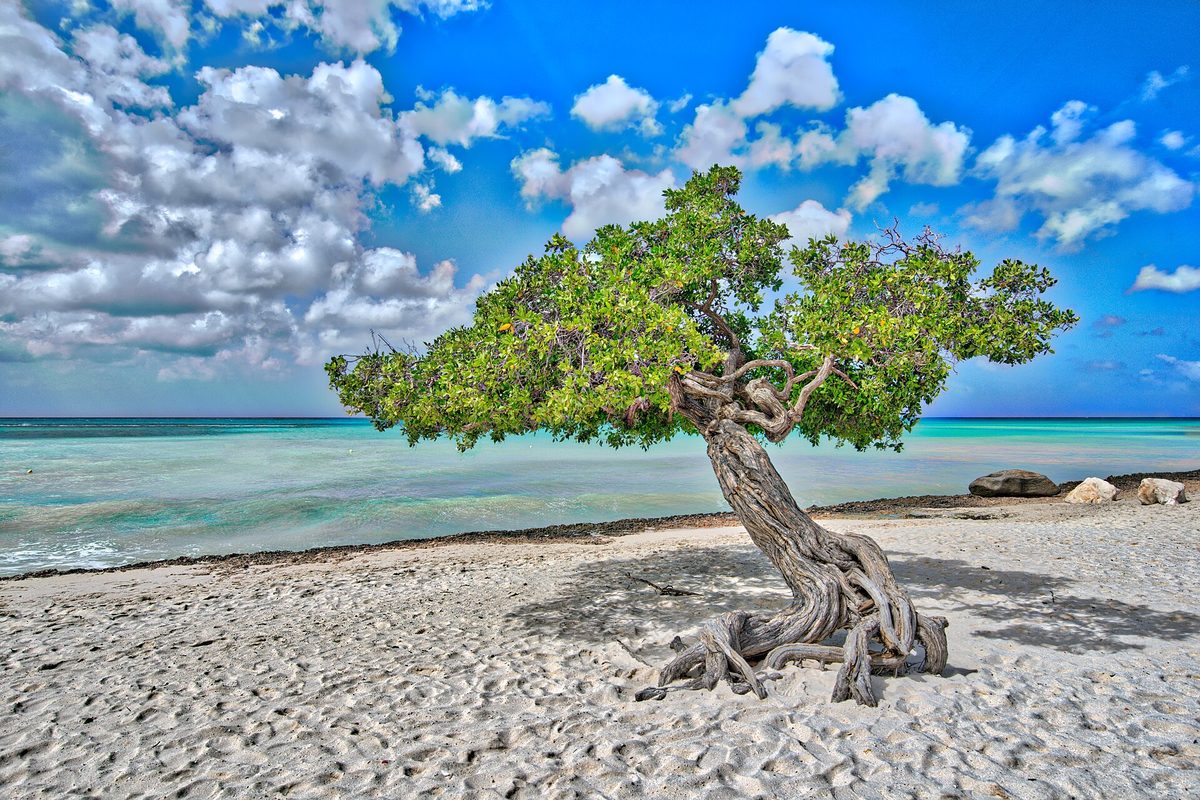
    Aruba with kids: the iconic divi-divi tree and calm turquoise water at Eagle Beach

    Why Aruba is one of the easiest Caribbean islands with kids

    Plenty of islands are beautiful. What makes Aruba special for families is how little it fights you. After years of Caribbean trips with children, these are the things that genuinely lower the stress level — and they’re the reason I recommend it as a first tropical trip for nervous first-timers.

    It’s safe, friendly, and low-drama

    Aruba is consistently ranked among the safest islands in the Caribbean, with low crime and a stable, tourism-focused economy. Locals are warm and genuinely family-oriented — you’ll see Aruban families out together across generations, and your kids will be welcomed rather than tolerated in most restaurants. English is spoken essentially everywhere (alongside Dutch, Papiamento and Spanish), so there’s no language barrier to navigate with tired children in tow. For the full rundown on safety, money and entry rules, our Aruba travel tips guide covers it in depth, but the headline is reassuring: this is an easy, gentle place to land with a family.

    The water is calm on the right side of the island

    This is the single most important thing for parents to understand. Aruba has two very different coasts. The west and south (leeward) coast — where all the resorts and famous beaches are — is protected, with calm, shallow, clear water that’s perfect for little ones. The north and east (windward) coast is wild and rugged, with powerful surf and rip currents that are genuinely dangerous for swimming. The good news: every family beach you’ll actually use is on the calm side. Just teach the kids the rule early — we swim on the west, we look but don’t swim on the wild side — and you can relax. Our complete guide to Aruba’s beaches breaks down exactly which is which.

    Short distances, easy logistics, and weather you can count on

    Aruba is tiny — roughly 20 miles long and 6 miles wide — so nothing is far. The drive from the airport to the Palm Beach resorts is about 15–20 minutes; the longest schlep on the island (to Baby Beach in the far south) is well under an hour. That means short car rides, fewer “are we there yet?” miles, and the freedom to come back to the room for a midday nap and head out again. The weather cooperates too: warm, dry and breezy nearly year-round (highs around 82–88°F / 28–31°C), low humidity, and a position outside the hurricane belt that the storm-prone islands farther north can only envy. For a month-by-month breakdown, see the best time to visit Aruba. The practical upshot for families: you can book around school holidays and airfares without sweating the forecast.

    A couple of honest caveats

    It’s not flawless. Aruba is not cheap — prices feel closer to an expensive US city than a budget beach getaway, so a family of four needs to plan a real budget (more on that below). The sun is deceptively strong; the constant trade winds hide the burn, and I’ve watched careful parents and pale kids alike turn lobster-red on day one. And the island’s “wow” adventures — the Natural Pool, the off-road safaris — usually have minimum ages (often 6 or 8) and involve teeth-rattling 4×4 rides, so they suit bigger kids better than babies. None of this is a dealbreaker; it’s just the stuff I’d want a friend to tell me straight.

    The best beaches in Aruba for kids

    Beaches are the whole point for most families, and Aruba’s west coast is a parade of them. They’re all public (even the ones fronting glitzy resorts), so you can spread your towel anywhere. Here are the ones that actually work with children, in the order I’d prioritize them.

    Baby Beach — the best for toddlers and little kids

    If you have small children, this is the one. Baby Beach is a half-moon-shaped lagoon on the island’s far southern tip, protected from the open sea by a rocky breakwater, so the water is shallow, warm and almost pool-calm — you can wade out a long way and it barely reaches a toddler’s waist. The sand is fine and moldable, which makes it sandcastle heaven. It’s about a 45-minute drive from the Palm Beach hotels (near San Nicolas), so I treat it as a half-day outing rather than a quick dip: pack snacks, rent a palapa for shade, and make a morning of it. There’s a snack bar and snorkel rentals on-site. One honest note: there’s an old refinery visible in the distance, so it’s not the most postcard-pretty backdrop — but for safe, easy water with young kids, nothing beats it.

    Shallow, calm lagoon at Baby Beach in Aruba, ideal for young children

    Palm Beach — the most convenient family base

    Palm Beach is the two-mile strip of soft sand fronting the high-rise resorts, and it’s the easiest beach to build a family trip around. The water is calm and clear, the sand gentle, and everything a parent could need is within steps: restaurants, bathrooms, beach-chair and floatie rentals, ice cream, snorkel and kayak hire, and the boardwalk for an evening stroll. It can get busy and the vibe is lively rather than serene, but for families that value convenience — snacks, shade and a bathroom never far away — it’s hard to beat. Plenty of things to do in Aruba launch right from this stretch, including snorkeling cruises and banana-boat rides.

    Eagle Beach — wide, calm and uncrowded

    Eagle Beach, just south of Palm Beach in the low-rise area, is the one the locals brag about — consistently rated among the most beautiful beaches in the world. It’s exceptionally wide, so even on a busy day there’s room to run, dig and cartwheel without crowding a neighbor. The water is calm and great for little kids, and the famous wind-bent Fofoti trees make the obligatory family photo. Because the hotels here are low-rise and spaced out, it feels calmer and more relaxed than Palm Beach. If your family prioritizes space and serenity over a buzzy boardwalk, base yourselves here.

    Arashi Beach & Boca Catalina — easy snorkeling

    Toward the island’s northwest tip, Arashi Beach offers calm, clear water, gentle entry, some shade, a beach bar, and rentals — a relaxed spot that’s great for a family snorkel and famous for its sunsets. A little south, Boca Catalina is a small, tranquil cove with calm water and lots of fish right off the shore, making it one of the best easy snorkel spots for kids who can manage a mask. Both are quieter than the main strip; bring your own snacks as facilities are limited.

    Calm, clear water at Arashi Beach in Aruba

    Mangel Halto — for confident snorkelers

    On the calmer southeast coast, Mangel Halto is a mangrove-fringed lagoon that’s a local favorite for snorkeling. The protected inner lagoon is shallow and calm — lovely for paddling — while the reef drop-off beyond suits stronger, older swimmers. It’s more of an adventure-snorkel spot than a sandcastle beach, so I save it for kids who are comfortable in a mask and fins. Reef shoes help with the rocky entry.

    The best things to do in Aruba with kids

    Aruba packs a startling amount into 70 square miles. The trick with kids is to mix easy wins (animals, beaches, an air-conditioned museum) with one or two bigger adventures, and not to over-schedule — this is a beach vacation, not a death march. Here are the family activities that earned their place, grouped by the kind of day they make.

    Meet the animals (the easy, universal crowd-pleasers)

    Animal outings are the great equalizer — they work for toddlers and tweens alike, they’re shaded, and they’re cheap. The Butterfly Farm near Palm Beach is the gentlest: a lush, netted garden where hundreds of butterflies land on little arms during a short guided tour, and your ticket usually includes free return visits for the rest of your stay (go early when they’re most active). The Donkey Sanctuary in the island’s interior is a genuine favorite — it’s free (donations welcome), and kids can feed and pet the roughly 100 rescued donkeys that roam the grounds. The Aruba Ostrich Farm offers guided tours and the slightly chaotic thrill of feeding ostriches and emus (fair warning: the big birds are pushy, which delights some kids and spooks others). Philip’s Animal Garden is a rescue with a hands-on petting area, and the Bubali Bird Sanctuary near Palm Beach has an observation tower for a quick, free wildlife stop.

    Donkeys at the Aruba Donkey Sanctuary, a free family attraction

    Get on (and under) the water

    Even young kids can experience Aruba’s marine life without being strong swimmers. A snorkeling or catamaran cruise is the quintessential family outing — most depart from the Palm/Eagle Beach area, provide gear and flotation, and stop at calm, shallow reef sites; many boats have a rope swing or slide that kids beg to use on repeat. For non-swimmers and nervous parents, the Atlantis Submarine dives to around 130 feet so you can see reefs and fish through big portholes in air-conditioned comfort — pricey, but a sure-fire hit on a hot afternoon or for a child who won’t put their face in the water. And then there’s De Palm Island, a private islet a short ferry ride offshore that runs like a kid’s dream day pass: water park with slides, easy snorkeling among friendly blue parrotfish, banana-boat rides, zip lines, and unlimited food and drink. It’s the closest thing Aruba has to a one-stop family water park. For the full menu of options, see our guide to Aruba water sports and boat tours.

    Explore Aruba’s wild side (best for ages 6 and up)

    The eastern half of the island is a desert wilderness, and it’s where the bigger kids’ jaws drop. Arikok National Park covers about a fifth of Aruba — cacti, lizards, wind-carved cliffs, and a “wait, this is the same island?” landscape. The headline family adventure is the Conchi Natural Pool, a sheltered cove ringed by volcanic rock where you can swim while waves crash safely on the far side. You can’t drive a normal car there; you either hike or take a bouncy 4×4/ATV tour, and most operators set a minimum age (often 6 or 8) because the road is genuinely rough. Pair it with the park’s caves — Fontein, with its Arawak petroglyphs, and Quadirikiri, where sunbeams pour through holes in the ceiling like a natural skylight. Bring water shoes, hats, and far more water than you think you need; there’s no shade out there. Plan it all with our complete Arikok National Park guide.

    The Conchi Natural Pool ringed by volcanic rock in Arikok National Park, Aruba

    If the full safari feels like too much for your crew, the gentler version is a self-drive to the Casibari and Ayo rock formations — giant boulders kids can scramble over (with supervision) on easy marked paths, plus more petroglyphs. They’re reachable in a regular car and make a great hour-long stop.

    Rugged limestone cliffs near the caves in Arikok National Park, Aruba

    Town days, landmarks and culture

    When you need a break from sand, Aruba’s towns deliver. In the capital, Oranjestad, kids love riding the free open-air trolley through the colorful Dutch colonial streets, and the waterfront Linear Park is perfect for a stroll or bike with an ice cream. At the northern tip, the California Lighthouse rewards the climb (and the drive up) with sweeping views — a quick, satisfying landmark. Down south, the murals of San Nicolas turn a walk into a scavenger hunt: let each kid pick a favorite and defend it. The Aruba Aloe factory and museum offers short, free, air-conditioned tours (a lifesaver at midday), and on Tuesday evenings the Bon Bini Festival at Fort Zoutman in Oranjestad is a friendly street party of music, dance and local food — a gentle, early-evening culture hit that won’t blow past bedtime.

    The California Lighthouse on Aruba's northern tip

    Can you see flamingos in Aruba with kids? The honest answer

    Those dreamy photos of pink flamingos on a white-sand beach come from one place: Renaissance Island (Flamingo Beach), a private island owned by the Renaissance Wind Creek resort. It’s gorgeous — and it’s the question I get from families more than any other — so here’s the straight version, because a lot of blogs leave out the catch.

    The flamingos live on the resort’s adults-only side, called Flamingo Beach, which is normally restricted to guests 18 and over. The family-friendly side, Iguana Beach, is right next door and lovely (resident iguanas, calm water, a kids’ splash area), but the famous flamingos aren’t there. The workaround: the resort typically allows children onto Flamingo Beach for a limited morning window (often around 9–10 a.m.) for photos, after which it’s adults-only again. Access requires either staying at the Renaissance or buying a day pass (around US$125 per person when available, and they sell out), which includes the boat over. My honest take: if seeing the flamingos is a bucket-list moment for your family, book a Renaissance stay or snag a day pass early and aim for that morning window — otherwise, manage expectations, because you can’t just show up at a public beach and find flamingos. For where this fits among the island’s stays, see where to stay in Aruba.

    A group of pink flamingos wading in the shallows at Renaissance Island, Aruba

    Best family resorts in Aruba

    Where you stay shapes a family trip more than anything else, and Aruba’s resorts range from full-blown water-park complexes to roomy condos with kitchens. The best family resorts in Aruba cluster on Palm Beach and Eagle Beach, on the calm west coast. Here’s how I’d think about it — and remember to cross-check current rates and reviews, since properties and prices change.

    For the full water-park experience

    If your kids measure a hotel by its pool, look at Marriott’s Aruba Surf Club on Palm Beach, whose lazy river and waterslide are legendary with children (it also has spacious one- and two-bedroom units — more on that below). The Hyatt Regency Aruba has a multi-level pool with a popular waterslide plus Camp Hyatt, a supervised kids’ club that buys parents a few hours off. The Aruba Marriott Resort & Stellaris Casino brings a big pool with a waterfall, a little play area, and a gelato shop, with the casino discreetly tucked away. The Hilton Aruba Caribbean rounds out the big-pool, kids’-club category nicely.

    High-rise family resorts lining calm Palm Beach in Aruba

    All-inclusive for families

    Aruba has fewer all-inclusives than islands like Punta Cana, but they exist and they simplify life enormously with kids — no tallying every smoothie and chicken-finger basket. The Holiday Inn Resort Aruba on Palm Beach is the classic family all-inclusive, with a kids’ pool and waterslide and meals included (a sanity-saver with a toddler). The Divi & Tamarijn Aruba All Inclusive on a quieter southern beach runs the Sea Turtles Club for ages 4–12 and has a relaxed, spread-out feel. To weigh whether the all-inclusive math works for your family, read our honest Aruba all-inclusive resorts guide — for some families it’s pure convenience, for others a vacation rental wins.

    Roomy condos and suites (my pick for most families)

    Honestly, for anything longer than a few nights, my family is happiest in a unit with a kitchen and a separate bedroom. Being able to feed the kids breakfast on the balcony, stash snacks, and not whisper-tiptoe around a sleeping toddler at 7 p.m. is worth more than any kids’ club. Playa Linda Beach Resort (two-bedroom units, a waterfall family pool and a kids’ club) and the Marriott Surf Club condos are purpose-built for this, and the Embassy Suites Aruba offers all-suite layouts with a free evening reception and breakfast. Independent vacation rentals and condos near Eagle Beach are often the best value of all for larger families. For the full lay of the land, our where to stay in Aruba guide compares every area and style.

    Where to base yourself: Palm Beach vs Eagle Beach

    It usually comes down to these two. Palm Beach is lively and convenient — high-rise resorts, restaurants and water sports within walking distance, plus a buzzy boardwalk; ideal if you want everything on tap and don’t mind crowds. Eagle Beach is calmer and more spread out — low-rise hotels, a wider, quieter beach, and a more relaxed pace; ideal for families who want to decompress. Both have excellent, calm water for kids. We’ve stayed on both and loved each for different trips; with very young children I lean Eagle for the quiet, with older kids I lean Palm for the action.

    Aruba with kids by age

    The “best” Aruba trip looks different depending on whether you’re traveling with a baby or a teenager. Here’s how I’d tailor it, because the island genuinely delivers for every stage — you just emphasize different things.

    Aruba with a baby or toddler

    For the under-fives, lean into the easy stuff and don’t over-plan. Pick a calm beach — Baby Beach or the gentle stretches of Eagle and Palm — and a resort or rental with a kitchen, a crib and ideally laundry. Schedule around naps (mornings on the sand, afternoons back at the room while the sun is fiercest), and bring or rent a beach tent or use a rented palapa for shade, because the sun is no joke on baby skin. The Butterfly Farm, Donkey Sanctuary and a stroll through Oranjestad are perfect low-key outings; skip the rough 4×4 adventures entirely. Strollers work fine on the boardwalks and in town but are useless on sand, so pack a carrier too. A grocery run to a supermarket like Super Food for diapers, snacks and familiar foods will save your budget and your sanity.

    Aruba with younger kids (about 5–9)

    This is arguably the sweet spot. Kids this age are thrilled by sandcastles at Baby Beach, their first snorkel in the calm shallows, the animal farms, De Palm Island’s slides, and the Atlantis Submarine. They can usually handle a gentle catamaran cruise and the easier rock-formation scrambles at Casibari. Some will meet the minimum age for a Natural Pool tour; ask the operator. Keep days half-structured — one “activity” plus plenty of pool and beach time — and you’ll have a crew of very happy little adventurers.

    Aruba with teenagers

    The island is a quietly brilliant teen destination, as long as you let them choose some of the adrenaline. This is the age to say yes to the 4×4 safari to the Natural Pool, snorkeling the Antilla shipwreck, learning to windsurf or kitesurf in the world-class trade winds, paddleboarding, parasailing, or the rope swing off the catamaran. Teens also appreciate the social buzz of Palm Beach, the San Nicolas street-art walk (very Instagram-friendly), and a little independence to roam the boardwalk. The trick is co-planning: hand them this list, let them pick two big adventures, and the eye-rolling tends to evaporate.

    Where to eat in Aruba with kids

    Dining out is easy here — kids are welcome almost everywhere, portions are generous, and the local food is approachable. A few family favorites that consistently work:

    • The Dutch Pancakehouse / Linda’s Dutch Pancakes: thanks to the Dutch heritage, pancakes (sweet or savory, dozens of varieties) and mini poffertjes are everywhere — basically a kid-approved meal at any time of day.
    • Eduardo’s Beach Shack (Palm Beach boardwalk): smoothies, acai bowls, fruit cups and healthy grab-and-go — great for a quick, no-fuss breakfast or beach lunch.
    • The West Deck (near Oranjestad): beachfront tables with a sandy, shady garden where kids can play while parents linger over a drink and local dishes like pan bati and keshi yena.
    • Zeerovers (Savaneta): a beloved dockside fish shack where you order baskets of fresh fried fish and fries and eat at picnic tables over the water — casual, cheap-ish, and an adventure in itself.
    • Atardi or Passions on the Beach: toes-in-the-sand sunset dinners that still have kids’ menus — splurge-worthy for one special night while the kids run on the shoreline.

    My biggest money-and-meltdown tip: self-cater breakfast from a supermarket and eat your big meal at lunch (often cheaper than dinner). For a full rundown of where and what to eat across the island, see our Aruba restaurants guide.

    How many days do you need, and a sample family itinerary

    For a family, I think five to seven nights is the sweet spot: enough to settle into beach rhythm, do a couple of adventures, and still have lazy pool days, without the cost of a longer haul. Three or four nights can work for a quick hit, but you’ll feel rushed; more than a week is blissful if the budget allows. Here’s a relaxed five-day skeleton that has worked well for us — adjust to your kids’ ages and stamina.

    • Day 1 — Land & settle: arrive, grab groceries, and let everyone decompress on your home beach (Palm or Eagle). Easy dinner nearby.
    • Day 2 — Beach & boardwalk: a full beach-and-pool day to bank some relaxation, plus the Butterfly Farm in the late afternoon and an ice cream on the boardwalk.
    • Day 3 — On the water: a morning snorkeling or catamaran cruise (or De Palm Island for younger kids), then a quiet afternoon.
    • Day 4 — Aruba’s wild side: a Natural Pool 4×4 tour and caves for ages 6+ (or the Casibari rock formations and Donkey Sanctuary for littler ones), then early to bed.
    • Day 5 — Explore & wind down: Baby Beach in the morning for the calmest water and best sandcastles, or an Oranjestad town morning, then your sunset splurge dinner.

    Want it mapped out by the day for your exact trip length? Our Aruba itinerary guide has detailed day-by-day plans for everything from a long weekend to a full week.

    What does an Aruba family vacation cost?

    Let’s talk money honestly, because Aruba surprises people. It’s one of the pricier Caribbean islands — comparable to an expensive US city — so a little planning goes a long way. As rough, hedge-them-yourself ballparks for a family of four (always verify current prices when you book):

    Expense Budget-ish Comfortable Tips to save
    Lodging / night ~US$200–300 (condo) ~US$450–700+ (resort) Condo with kitchen; shoulder season
    Rental car / day ~US$45–70 ~US$80–120 (4×4) Book early; skip 4×4 if no off-road
    Food / day ~US$90–140 ~US$200–300 Self-cater breakfast; lunch over dinner
    Activities (one-off) Donkey Sanctuary free; Butterfly Farm modest Catamaran/De Palm/sub: US$50–120+ pp Pick 2–3 paid highlights, not daily
    Entry ED card + US$20 sustainability fee per visitor (some kids exempt) Do it at edcardaruba.aw only

    The single biggest lever is lodging and food: a vacation rental with a kitchen and a couple of self-catered meals a day can cut a family’s costs dramatically versus three restaurant meals at a resort. Every beach is free, much of the island’s beauty (rock formations, lighthouse, town strolls, the Donkey Sanctuary) is free or cheap, and you can have a wonderful trip without booking a paid excursion every day. For a full, itemized breakdown and money-saving strategies, see our Aruba vacation cost guide.

    Getting there and around with kids

    The logistics of reaching and navigating Aruba are refreshingly simple, but a few details matter more when you’re traveling with children.

    The ED card — yes, kids need one too

    Every traveler to Aruba, including infants and children of every age, must complete the online Embarkation/Disembarkation (ED) card before arrival, at the official portal edcardaruba.aw, within seven days of your trip. You’ll also pay a US$20 sustainability fee per visitor as part of the process — though younger children (commonly under 8) are typically exempt, so check the current rules as you fill it out. Crucially, you can’t check in for your flight without it, so do it for the whole family from home a few days before, not in a panic at the gate with a toddler on your hip. Save each QR-code confirmation offline.

    US pre-clearance — build in extra time going home

    Here’s a family-specific gotcha worth planning around: Aruba’s airport has US Customs and Border Protection pre-clearance, meaning you clear US immigration before you fly home and arrive Stateside as a domestic passenger (lovely — no customs scramble with tired kids after a red-eye). The catch is you must arrive early; I budget a full three hours for US departures, because the pre-clearance hall backs up and herding a family through it takes longer than you think.

    Renting a car, car seats, and the no-Uber reality

    There is no Uber or Lyft in Aruba, so don’t plan to summon rides. For families, I almost always recommend renting a car: it frees you from fixed-rate taxi costs (which add up fast for four), lets you reach Baby Beach and the quieter spots, and means you can leave on nap schedule rather than a tour’s. Arubans drive on the right (familiar for North Americans), roads in the tourist areas are good, and the main quirk is roundabouts. One important note: car-seat enforcement is lax and rentals don’t always supply them reliably, so I strongly suggest reserving one in advance or bringing your own — the roads are busy enough near the resorts that I wouldn’t wing it with little ones. If you’d rather not drive, fixed-rate taxis and the cheap Arubus along the hotel strip cover the basics. Our full guide to getting to and around Aruba covers car rental, taxis and transfers in detail.

    What to pack for Aruba with kids

    Aruba is casual, so packing is easy — but a few items are genuinely make-or-break with children, and one or two are hard to buy well on the island:

    • Reef-safe sunscreen (SPF 50+), lots of it: sunscreens with oxybenzone are banned to protect the reefs, and reef-safe versions are pricey and limited locally. Buy plenty before you fly. The breeze hides the burn — reapply relentlessly.
    • Rash guards / UPF swim shirts and wide-brim hats for every kid: far more reliable than chasing toddlers with a sunscreen bottle.
    • Water shoes: several snorkel spots and the Natural Pool have rocky entries; little feet will thank you.
    • A baby carrier (strollers die in sand) and, if relevant, your own car seat.
    • A small beach tent or sun shade for babies, plus a refillable water bottle each — the tap water is desalinated and safe to drink.
    • Any familiar snacks and a basic first-aid kit with aloe and motion-sickness remedy (handy for bumpy boat or 4×4 trips).

    For the complete, non-kid-specific list — documents, electronics (Aruba uses US-style plugs and voltage), and what not to bother bringing — see our Aruba travel tips and essentials guide.

    Practical tips and mistakes to avoid

    A handful of hard-won lessons that make a family trip noticeably smoother:

    • Respect the sun and the schedule. Do beaches and adventures in the morning, retreat to shade or the pool from roughly 11 a.m. to 3 p.m. Sunburned, overheated kids end a vacation early.
    • Teach the two-coast rule on day one. Swim only on the calm west/south beaches; the wild north and east coasts are for looking, not swimming.
    • Book the bucket-list stuff ahead. Renaissance/Flamingo Beach day passes, popular dinners, and Natural Pool tours sell out in high season.
    • Don’t over-schedule. One activity a day plus beach/pool is plenty. This is a vacation, not a checklist.
    • Mind minimum ages. Many 4×4 and adventure tours require kids to be 6 or 8; confirm before you book to avoid disappointment.
    • Carry small US bills. Dollars are accepted everywhere; you don’t need to exchange money for florins.
    • Start the ED card early and screenshot everyone’s confirmation — the number-one airport headache, easily avoided.

    Frequently asked questions about Aruba with kids

    Is Aruba good for families with kids?

    Yes — it’s one of the best Caribbean islands for families. It’s very safe, English is spoken everywhere, the west-coast beaches are calm and shallow, distances are short, and the weather is reliable year-round. There’s plenty for every age, from gentle animal farms and calm beaches for toddlers to 4×4 adventures and water sports for teens. The main caveat is cost: Aruba is relatively expensive, so plan a budget.

    What is the best beach in Aruba for young kids and toddlers?

    Baby Beach, on the island’s southern tip, is the top pick for little ones — a shallow, calm, protected lagoon with fine sand for sandcastles. For convenience near the resorts, Palm Beach and Eagle Beach also have calm, gentle water and full facilities. All three are on the protected leeward coast; avoid the rough northern and eastern beaches for swimming.

    What are the best things to do in Aruba with kids?

    Top family hits include the Butterfly Farm and Donkey Sanctuary, a snorkeling or catamaran cruise, De Palm Island’s water park, the Atlantis Submarine, and (for ages 6 and up) a 4×4 tour to the Conchi Natural Pool and Arikok’s caves. Add town days in Oranjestad, the California Lighthouse, and the San Nicolas murals. Mix one activity per day with plenty of beach and pool time.

    What is the best family resort in Aruba?

    It depends on your style. For pools and waterslides, Marriott’s Aruba Surf Club and the Hyatt Regency (with Camp Hyatt kids’ club) stand out. For all-inclusive ease, the Holiday Inn Resort Aruba and Divi & Tamarijn are family favorites. For space and value, condo-style resorts like Playa Linda or a vacation rental with a kitchen are hard to beat. Most family resorts sit on Palm Beach or Eagle Beach.

    Is Aruba safe for families?

    Yes. Aruba is consistently among the safest Caribbean islands, with low crime and a stable, tourism-focused economy. Use normal precautions — don’t leave valuables unattended on the beach, use the room safe — and the only real natural hazard is the strong surf on the wild north and east coasts, which you simply don’t swim on. Tap water is safe, and no special vaccinations are needed for most travelers.

    How many days do you need in Aruba with kids?

    Five to seven nights is ideal for families — enough for relaxed beach and pool days plus a couple of adventures without feeling rushed or overspending. Three to four nights works for a short getaway but feels tight. Because the island is small, you don’t need long to see the highlights; the extra days are for slowing down.

    What is the best time to visit Aruba with kids?

    Any month works thanks to Aruba’s dry, breezy, hurricane-belt-free climate. For families balancing school holidays with crowds and cost, late spring and the fall (outside peak mid-December–April) often hit a sweet spot of good weather, thinner crowds and better rates. See our best time to visit guide for a month-by-month look at weather and prices.

    Do you need a car in Aruba with kids?

    It’s not essential but it’s very helpful. There’s no Uber in Aruba, so a rental car gives families freedom to reach quieter beaches and stick to nap schedules, and it’s often cheaper than fixed-rate taxis for four. If you’re staying put on the Palm Beach strip, taxis and the cheap Arubus bus can cover you. If you rent, reserve a car seat in advance or bring your own.

    Can kids see the flamingos in Aruba?

    Yes, but with limits. The famous flamingos live on Renaissance Island’s adults-only Flamingo Beach. Children are typically allowed only during a limited morning window (often around 9–10 a.m.) for photos. Access requires staying at the Renaissance resort or buying a day pass (about US$125 per person when available). The adjacent Iguana Beach is family-friendly but doesn’t have the flamingos.

    Is Aruba expensive for a family of four?

    It can be — Aruba is one of the pricier Caribbean destinations, with costs similar to an expensive US city. The biggest expenses are lodging and food. You can manage it well by choosing a condo or vacation rental with a kitchen, self-catering breakfasts, eating your main meal at lunch, using free beaches and cheap attractions, and limiting paid excursions to a few highlights. See our Aruba vacation cost guide for a full breakdown.

    Final thoughts: an island that meets families halfway

    What I love about Aruba with kids is how much it does for you. The water is calm where you need it to be, the sun shines on schedule, the people are warm, English is everywhere, and the island is small enough that an ambitious day and a lazy one are both easy to pull off. You can hand a teenager a 4×4 adventure and a toddler a shallow lagoon on the same trip and send everyone home happy.

    Do the small bits of homework — the ED card before you fly, reef-safe sunscreen in the bag, a car seat sorted, a couple of marquee activities booked — and the island takes care of the rest. Pick your beach, choose a base that fits your crew, and leave room to do gloriously little between the adventures. When you’re ready to map out the days, dive into our Aruba itinerary plans and the full list of things to do in Aruba — and start counting down. I have a feeling your family will be planning trip number two before this one’s even over.

    About the author: This guide was written and is maintained by the ArubaTourism.org editorial team — travel writers and parents who have taken kids of every age to Aruba, from beach-tent toddler days to teenage 4×4 safaris, across multiple seasons. Our mission is to give families the honest, specific, up-to-date information they need to plan a great trip to the One Happy Island.

    Last updated: June 2026. Entry rules, fees, resort offerings, ages and prices change frequently — always confirm current details with the official Aruba ED card portal (edcardaruba.aw), the Aruba Tourism Authority, individual resorts and tour operators, and your government’s travel advisory before you go.

    Photo credits

    Images via Wikimedia Commons unless noted; see each image’s source page for full license details. Photos featured: the calm, shallow turquoise water of Eagle Beach; the protected lagoon at Baby Beach; Arashi Beach; the Aruba Donkey Sanctuary; the Conchi Natural Pool in Arikok National Park; the rugged limestone cliffs of Arikok National Park; a flamingo on Renaissance Island; the California Lighthouse; and the high-rise resorts of Palm Beach. Each photographer is credited on the image’s Wikimedia Commons file page, and all images are used under their respective Creative Commons or public-domain licenses.