By the ArubaTourism.org team · Last updated June 2026
Ask me for the best things to do in Oranjestad and I will tell you to slow down and walk. I have lost count of how many times I have strolled the length of Aruba’s capital, and it still gets me every time: the candy-colored Dutch colonial facades, the rattle of the free streetcar, the smell of strong coffee drifting out of a courtyard cafe. Most visitors treat downtown as a place to pass through on the way to the beach. That is a mistake. Spend a morning here on foot and you get the island’s history, its best people-watching, its duty-free shopping, and a genuinely good lunch, all in a few flat, walkable blocks.
This is my honest, lived-in guide to the things to do in Oranjestad — the stuff worth your time, the stuff you can skip, and exactly how I would spend a half day or a full day downtown. It is part of our larger guide to things to do in Aruba, and it is written for first-timers, cruise passengers with a few hours, and repeat visitors who never quite gave the capital a fair shot.
The best things to do in Oranjestad (the short answer)
The best things to do in Oranjestad are to walk the colorful Main Street and Plaza Daniel Leo, ride the free streetcar from the cruise port, tour Fort Zoutman (Aruba’s oldest building, 1798) and the National Archaeological Museum, shop the duty-free malls and Cosecha crafts, eat at the waterfront Renaissance Marketplace, and relax at Surfside Beach. Half a day is plenty.
Oranjestad at a glance
If you only skim one thing, make it this. Here is how the main downtown Aruba attractions stack up — what each is, roughly how long it takes, and what it costs as of mid-2026 (always double-check current hours and prices before you go).
| Attraction | What it is | Time needed | Cost (approx.) |
|---|---|---|---|
| Main Street & Plaza Daniel Leo | Pastel Dutch colonial shopping street | 45–90 min | Free to stroll |
| Free Downtown Trolley | Streetcar from cruise port to Main Street | 20–30 min loop | Free |
| Fort Zoutman & Willem III Tower | 1798 fort + 1868 tower, Historical Museum | 30–45 min | ~$5–10 |
| National Archaeological Museum | 3,500+ years of Aruban history | 45–60 min | Free |
| Cosecha craft center | Authentic Aruban-made arts & crafts | 20–30 min | Free entry |
| Renaissance Marketplace & Mall | Waterfront dining, shops, casino, music | 1–2 hr | Free entry |
| Wilhelmina Park | Small harbor-front park & statue | 15–20 min | Free |
| Surfside Beach & Linear Park | Closest beach + seaside path | 1–3 hr | Free |
My quick take: the trolley, Fort Zoutman, and the Archaeological Museum are the three I would not skip — and two of those are free. Shopping and the Renaissance waterfront are about mood; do them if that’s your thing and skip them if it isn’t.
First, get your bearings (and how to arrive)
Oranjestad sits on Aruba’s southwest coast, hugging a shallow harbor the old-timers still call Paardenbaai — “Horses’ Bay.” The whole downtown is flat, compact, and built for walking, which is half the reason I love it. You are never more than a 10-minute stroll from the next thing worth seeing.
How you arrive shapes your day:
- By cruise ship: You dock right in town. Depending on which of the four berths you get, it is roughly a five- to ten-minute walk to Lloyd G. Smith Boulevard, the main waterfront drag. This is one of the rare Caribbean ports where “just walk” is a real answer.
- From Palm Beach or Eagle Beach: Hop the Arubus L10 line down Lloyd G. Smith Boulevard for a couple of dollars, grab a taxi, or drive. There is paid parking near the Renaissance and along the waterfront. For the full rundown, see our guide to getting to and around Aruba.
- By rental car: Easy, but honestly unnecessary for downtown itself — park once and walk. Save the car for Arikok National Park and the wild side of the island.
A practical note on timing: downtown is liveliest mid-morning to mid-afternoon, when shops are open and at least one cruise ship is in. It can feel sleepy on a Sunday, and a few museums close then, so I plan culture for a weekday and shopping or the waterfront for whenever.
Ride the free downtown streetcar (trolley)
If you do one thing in Oranjestad, ride the streetcar. Aruba runs a fleet of solar- and battery-powered trolleys — some single-deck, one a charming double-decker — that loop from the cruise terminal down the remodeled, pedestrian-only Main Street and back. It makes about six stops at the monuments, museums, and shopping clusters, and the whole thing is genuinely, completely free. No ticket, no app, no catch. Tipping the conductor a dollar is a kind gesture, not a requirement.
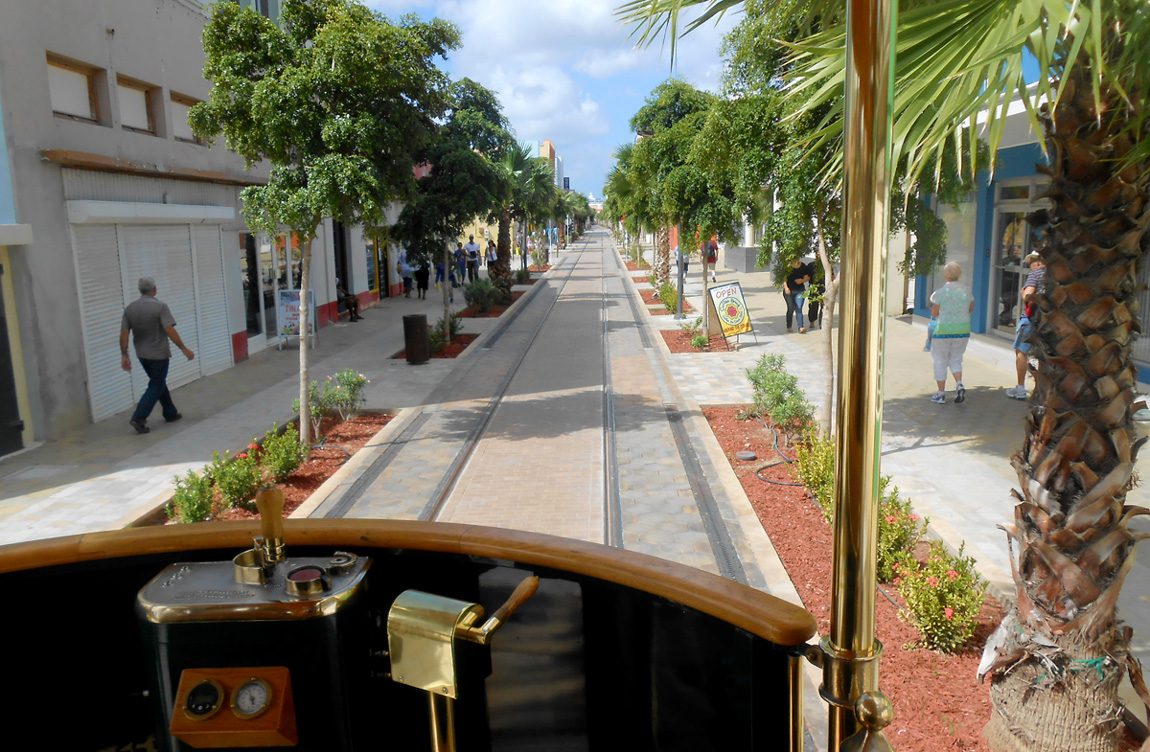
Here is how I actually use it: I ride the full loop once just to get the lay of the land and let the conductor point out landmarks, then I hop off where something caught my eye — usually near Plaza Daniel Leo or the Fort. The trams generally run from around 10 a.m. to 5 p.m., Monday through Saturday, every 15 to 30 minutes depending on the season and the cruise schedule. They do not run on Sundays, so don’t build a Sunday plan around them. It is a small thing, but gliding silently down a car-free colonial street with the sea breeze coming through is one of those quietly perfect travel moments.
Walk the colorful Dutch colonial architecture
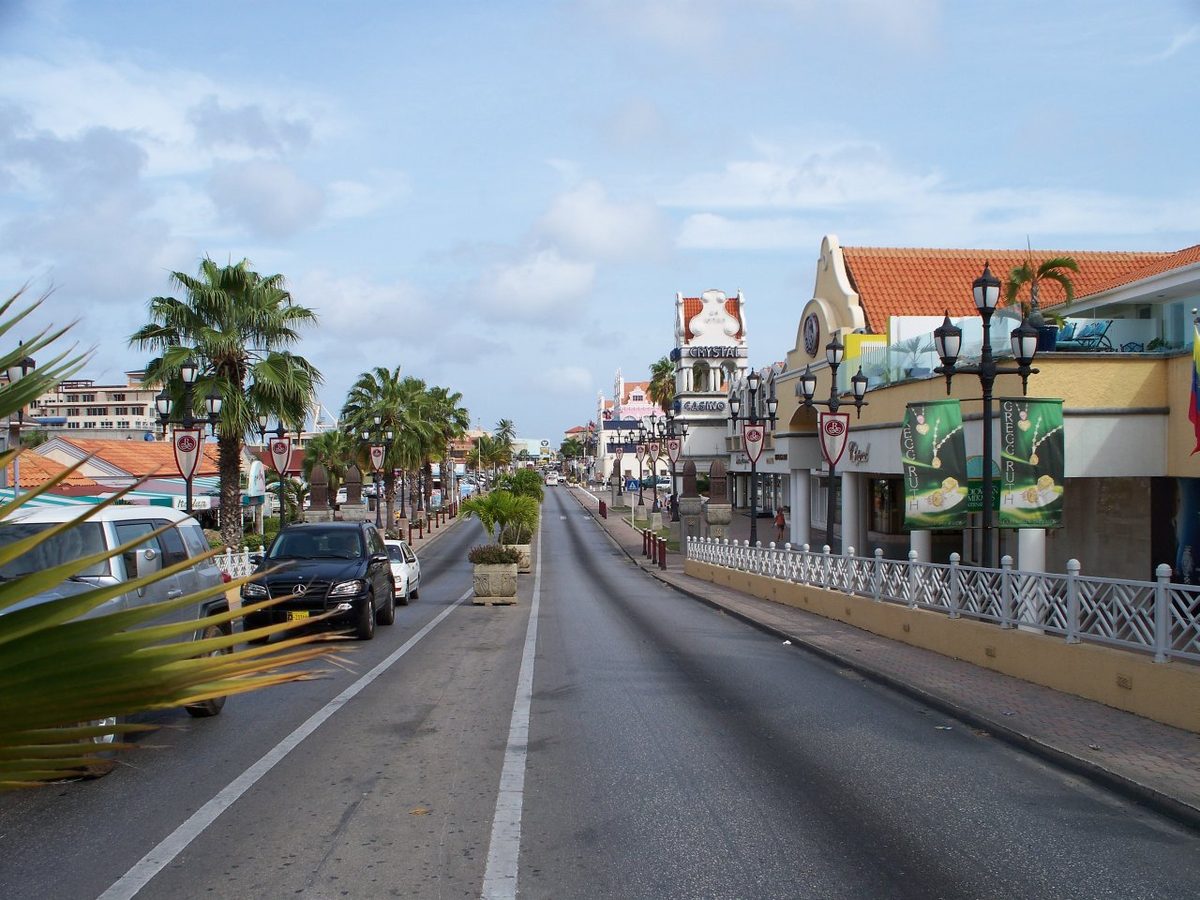
This is the Oranjestad that ends up on everyone’s camera roll. Aruba was a Dutch colony, and the capital wears it proudly: rows of low buildings painted in mango, teal, coral, and lime, trimmed with white gingerbread fretwork and topped with those distinctive curved Dutch gables. It is the Netherlands by way of the Caribbean, and it photographs like a dream in late-afternoon light.
Plaza Daniel Leo and Main Street
The prettiest concentration is around Plaza Daniel Leo, the little square on Main Street (Caya G.F. Betico Croes) where the most photogenic restored facades line up shoulder to shoulder. Stand on the corner, look up at the ornate rooflines, and you will see why people fall for this town. The whole street is a pedestrian mall now, so you can wander down the middle without dodging traffic. I like doing it slowly, ducking into courtyards and side alleys where the tour groups don’t bother to go.
The eight blue horses (and a name change)
Scattered around downtown you will spot eight bright-blue horse sculptures. They are part of the 2015 “Paardenbaai” public-art project, and they are a wink at history: before 1824, this place was known as Playa Caballos — “Horses’ Beach” — supposedly because horses were once unloaded here. When the Dutch renamed it, they chose Oranjestad, “Orange City,” after the royal House of Orange. Finding all eight blue horses is a fun, free scavenger hunt if you are exploring Aruba with kids.
The green Stadhuis and the harborfront
Don’t miss the mint-green Stadhuis (City Hall), where couples from all over the world come to get legally married — it is one of the most charming civic buildings I have seen anywhere. From there it is a short walk to the harbor, where private yachts and the marina give you that postcard view back toward the colorful skyline.
Step into Aruba’s history: forts and museums
For a town this breezy, Oranjestad takes its history seriously, and the museums here are better than first-timers expect. Two of them sit within a couple of blocks of each other, and one is completely free.
Fort Zoutman & the Willem III Tower
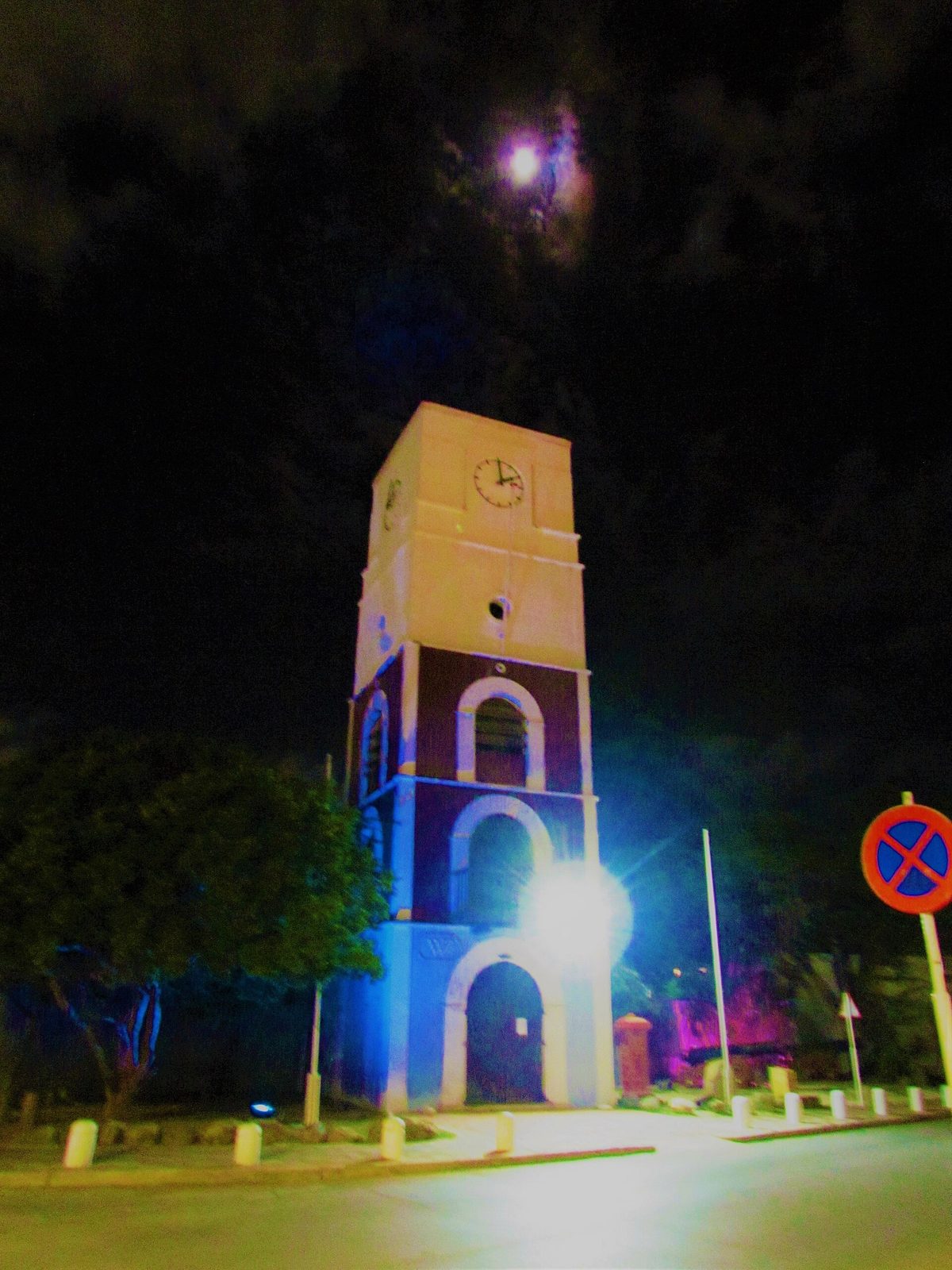
This is the headline. Fort Zoutman is the oldest building on Aruba, built by the Dutch in 1798 to guard the harbor against pirates and privateers. The taller Willem III Tower next to it went up in 1868 and pulled double duty as a public clock tower and the island’s first lighthouse — back when that little flame was how ships found their way into Paardenbaai at night. Squeezed between the fort and the tower is the Historical Museum of Aruba, a compact collection that walks you through the island’s story from the Dutch period onward.
Honestly, the museum is small — give it 30 to 45 minutes — but standing inside walls that have watched over this harbor for more than two centuries is the point. Admission is modest (think a few dollars), and the courtyard alone is worth a look.
If your trip lands you here on a Tuesday evening, do not miss the Bon Bini Festival. “Bon bini” means “welcome” in Papiamento, and every Tuesday from around 6:30 p.m. the fort’s courtyard fills with folkloric dancers in traditional costume, live music, local food and drink, and craft stalls. It is touristy in the best way — warm, unpretentious, and genuinely fun. For a small entrance fee it is the most authentic slice of Aruban culture you will find downtown after dark.
The National Archaeological Museum of Aruba (NAMA)
This one surprised me, and it is my pick for the single best indoor thing to do in Oranjestad — partly because it is excellent and partly because it is free. The National Archaeological Museum sits on Schelpstraat, inside the beautifully restored Ecury family home, and it tells the story of the island’s earliest inhabitants across more than 3,500 years — the Caquetio people, their pottery and burial customs, tools, and daily life long before any European showed up.
The displays are modern and well laid out, the air conditioning is a blessing on a hot afternoon, and you can easily spend 45 minutes to an hour here. It is open weekdays (roughly 9 a.m. to 5 p.m., closed weekends, so plan accordingly), and the fact that something this good costs nothing still feels like a small miracle. If you want one museum that explains where Aruba came from, this is it.
Cas di Cultura and a few cultural extras
Just outside the immediate core is Cas di Cultura, Aruba’s national theatre, which hosts local and visiting performers throughout the year — worth a glance at the schedule if you like live arts. History buffs will also notice monuments around the Parliament building honoring figures like Betico Croes, the father of Aruba’s autonomy, and WWII resistance hero Boy Ecury. None of these take long, but they add texture to a downtown wander.
Shopping in downtown Aruba: from duty-free to handmade
Oranjestad is the island’s shopping capital, and it covers the whole spectrum — designer watches at one end, hand-poured Aruban soap at the other. I am not a big shopper, but I always make time for two stops here.
The malls and Main Street
The Renaissance Mall is the upscale, air-conditioned option, with luxury names like jewelers and watch boutiques, while the colorful Royal Plaza Mall on the waterfront mixes souvenir shops with jewelers under its wedding-cake architecture. Along Main Street you will find perfume, electronics, liquor, and Dutch cheese. Aruba is a duty-free-friendly destination, so genuine deals exist on jewelry, watches, and liquor — but compare prices to home first, because not everything is a bargain. For what your day actually costs once shopping, dining, and taxis add up, see our Aruba vacation cost guide.
Cosecha: buy something actually made in Aruba
If you buy one souvenir in Oranjestad, make it from Cosecha. It is a government-supported non-profit craft center housed in a gorgeous, roughly century-old yellow mansion, and everything on the shelves is genuinely Aruban-made — ceramics, woven goods, art, jewelry, soaps — each piece carrying a seal that certifies it as local craftsmanship. The quality is a world away from the mass-produced trinkets in the cruise stalls, and you are putting money straight into a local artisan’s hands. It is my favorite shop on the island, full stop.
The flea market and waterfront stalls
Across from the cruise terminal and along the marina, a covered flea market of around 40 stalls sells the cheerful stuff — shell jewelry, woodwork, sarongs, hot sauce, and, yes, Cuban cigars. Haggling is expected and good-natured. It is the right place for inexpensive, fun keepsakes when you don’t need museum-grade craft.
Renaissance Marketplace & the waterfront
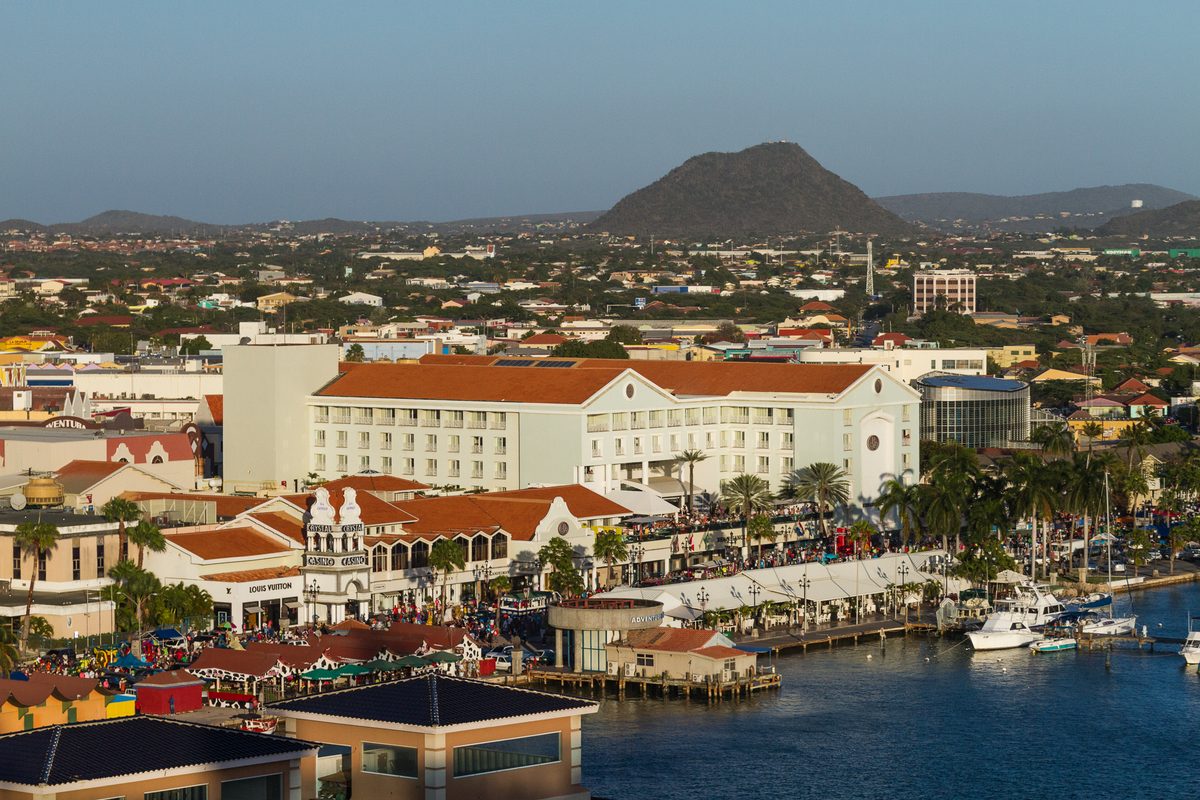
When the museums close and the heat eases, the Renaissance Marketplace is where downtown comes alive. This open-air, canal-side complex wraps around the marina with restaurants, cafes, bars, a casino, and a stage that hosts live music many evenings — I have happily killed a couple of hours here over drinks while a Latin band played and the yachts bobbed under the lights. It is the easy answer to “what do we do in Oranjestad in the evening.”
From here you are steps from Wilhelmina Park, a small, leafy harbor-front green space with tropical plantings and a statue of Queen Wilhelmina of the Netherlands gazing out to sea. It is not a destination in itself, but it is a pleasant five-minute pause and a nice photo with the water behind you.
The cruise port
For the hundreds of thousands who arrive by ship, the cruise port drops you right into all of this. Four berths line the waterfront, and from any of them it is a five- to ten-minute walk to Lloyd G. Smith Boulevard, the malls, and the trolley stop. There is a terminal with shops, a tourist-info desk, and taxis waiting. Honestly, no cruise port in the Caribbean makes an independent walking day this effortless — you can step off the gangway and be sipping a coffee on Main Street within fifteen minutes, no tour required.
Surfside Beach & the Linear Park
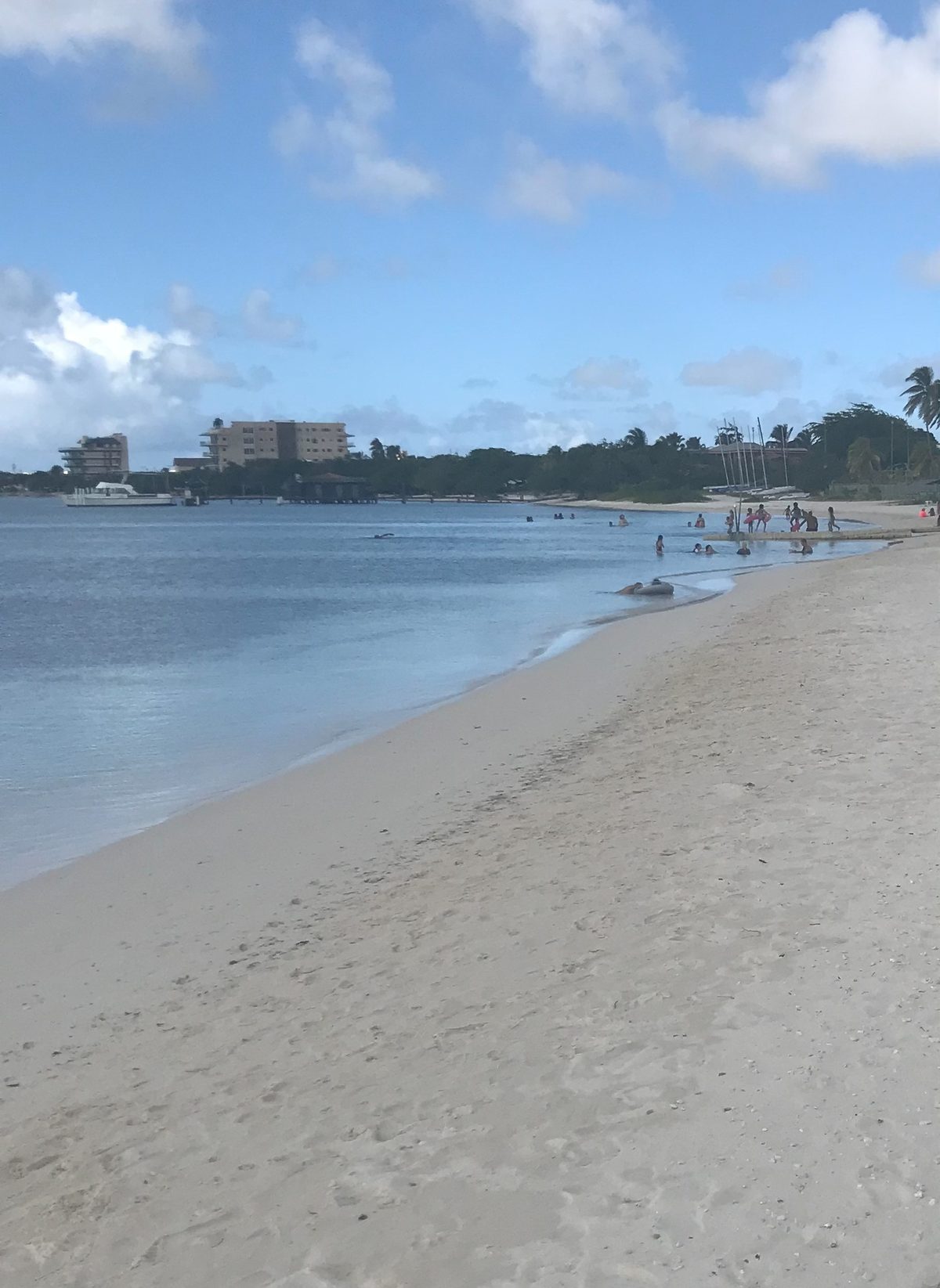
People forget Oranjestad has its own beach, and a good one for a quick dip. Surfside Beach is the closest sand to downtown — roughly a 15-minute walk south along Lloyd G. Smith Boulevard, or a few minutes by taxi. It is a calm, shallow, family-friendly stretch with a playground, beach bars, and easy water for stand-up paddleboarding or kayaking. It is not Eagle Beach (few places are), but for a cruise day or an hour between sights, it does the job nicely. If beaches are your priority, our full Aruba beaches guide covers the famous wide-sand options up the coast.
Connecting it all is the Linear Park, a roughly four-mile red-brick promenade that runs along the coast from the airport, past Surfside, all the way to the cruise terminal. It is shaded in stretches, dotted with benches and exercise stations, and it is the prettiest way to walk between downtown and the beach with the sea on one side. Joggers love it at sunrise; I love it at sunset. It is also a relaxed option for anyone exploring Aruba water sports on a budget, since paddle rentals cluster near Surfside.
Where to eat and drink downtown
Downtown Oranjestad punches above its weight for food, mixing local Aruban cooking with Argentine steakhouses, fresh seafood, and international options. A few pointers from many lunches and dinners here:
- For local flavor: look for keshi yena (a stuffed-cheese casserole), fresh catch of the day, and pastechi (fried savory pastries) from a hole-in-the-wall counter — cheap, fast, and delicious.
- For a waterfront dinner: the Renaissance Marketplace and the marina restaurants give you sea breeze, people-watching, and a drinks list. Reserve on a busy cruise night.
- For coffee and a break: the cafes tucked into Main Street courtyards are my reset button mid-shopping.
I have kept names general on purpose — downtown’s lineup shifts, and you should check current reviews — but our Aruba restaurants guide goes deep on specific spots and price ranges islandwide.
Oranjestad after dark
Downtown is not the island’s main party zone — that energy lives up in Palm Beach — but Oranjestad holds its own in the evening. The Renaissance Marketplace has live bands and lively bars, and there are a couple of waterfront casinos (the Renaissance’s Crystal and Seaport casinos among them) if you fancy a flutter. It is a more relaxed, local-leaning night than the high-rise strip. For the full picture, including the bigger clubs and casino scene, see our Aruba nightlife guide.
How to spend a half day or a full day in Oranjestad
Here is exactly how I plan it, depending on how much time you have. Both routes are walkable and lean on the free trolley to save your feet.
The perfect half day (about 3–4 hours)
- Start at the cruise port / waterfront and walk to the nearest trolley stop. Ride the full loop once to orient yourself (20–30 min).
- Hop off near Plaza Daniel Leo and walk Main Street, photographing the colorful colonial facades and hunting a few blue horses (45 min).
- Tour the National Archaeological Museum — free, air-conditioned, genuinely interesting (45 min).
- Walk to Fort Zoutman for the fort, tower, and a quick museum look (30 min).
- Finish at the Renaissance Marketplace for a drink or lunch on the water, with a swing past Cosecha for a real souvenir (45–60 min).
A full day (add the beach)
Do the half-day route in the cooler morning, break for a long lunch, then walk the Linear Park down to Surfside Beach for an afternoon swim and paddle. Circle back for sunset and an evening at the Marketplace or a casino. That is a complete, satisfying Oranjestad day without ever needing a car.
If downtown is just one piece of a longer trip, slot it into a wider plan with our Aruba itinerary guide — a half day in the capital pairs perfectly with beach days and a drive through Arikok.
Practical tips for visiting Oranjestad
- Is it safe? Yes — Aruba is consistently rated among the safest Caribbean destinations, and downtown is comfortable to walk by day and evening. Use normal city sense: watch your bag in crowds and don’t leave valuables on the beach.
- Is it walkable? Very. It is flat and compact; the trolley covers the rest. Comfortable shoes beat fashion here.
- When to go: Mid-morning to mid-afternoon for the liveliest streets; weekdays for the museums (several close Sunday). For the island’s best months overall, see the best time to visit Aruba.
- Sun & heat: The Aruban sun is fierce. Bring water, sunscreen, sunglasses, and a hat — shade is limited on Main Street at midday.
- Money: US dollars are accepted everywhere; you rarely need florins. Cards are widely taken, but carry small bills for the flea market and trolley tips.
- Stay nearby? A few hotels sit right downtown if you want to wake up in the middle of it — see where to stay in Aruba. And before you go, skim our general Aruba travel tips.
Who will love Oranjestad (and who can skip it)
Cruise passengers: This is your easiest, cheapest, most rewarding day — step off, walk in, and you have history, shopping, and a beach within reach. History and culture lovers: the two museums and the fort make it a must. Couples on an Aruba honeymoon will enjoy a romantic waterfront dinner and the colonial streets at golden hour. Families get the free trolley, blue-horse hunt, and Surfside playground. If you came to Aruba purely to lie on Eagle Beach and never move, you can skip downtown — but you would be missing the island’s soul.
Frequently asked questions about Oranjestad
What is Oranjestad known for?
Oranjestad is Aruba’s capital and largest city, known for its candy-colored Dutch colonial architecture, palm-lined Main Street, duty-free shopping, and the free downtown streetcar. It is also home to the island’s oldest building, Fort Zoutman (1798), two well-regarded museums, the lively Renaissance Marketplace, and the main cruise port — all packed into a flat, walkable few blocks.
Is Oranjestad worth visiting?
Absolutely. Even if you came to Aruba for the beaches, half a day in Oranjestad gives you the island’s history, culture, and best people-watching. The free trolley, free Archaeological Museum, colorful streets, and waterfront dining make it one of the most rewarding — and affordable — ways to spend a morning, especially on a cruise day.
How long do you need in Oranjestad?
A half day, about three to four hours, is enough to ride the trolley, walk Main Street, see Fort Zoutman and the Archaeological Museum, and grab lunch on the waterfront. Add a full day if you also want to walk the Linear Park to Surfside Beach for a swim, shop in earnest, or stay for evening music and a casino.
Is the Oranjestad streetcar really free?
Yes — the downtown trolley is completely free, with no ticket or reservation needed. It runs roughly 10 a.m. to 5 p.m., Monday through Saturday (not Sundays), looping between the cruise terminal and Main Street with about six stops. Tipping the conductor a dollar is appreciated but optional. It is one of the best free things to do downtown.
Is Oranjestad walkable and safe?
Very much so. Downtown is flat, compact, and pedestrian-friendly, with Main Street closed to traffic, and Aruba ranks among the safest Caribbean destinations. Walking by day or in the early evening is comfortable. As anywhere, mind your belongings in crowds and avoid leaving valuables unattended at the beach.
What are the best things to do near the cruise port?
Everything is within a five- to ten-minute walk of the cruise port: hop the free trolley, browse the Renaissance Mall and flea market, tour Fort Zoutman and the Archaeological Museum, buy local crafts at Cosecha, and eat at the Renaissance Marketplace. For sand, Surfside Beach is about a 15-minute walk south along the waterfront.
Final thoughts
Oranjestad rewards the traveler who slows down. Give it a morning on foot — the trolley, a couple of museums, those impossibly colorful streets, a long lunch by the water — and Aruba’s capital stops being a place you pass through and becomes one of the highlights of the trip. It is walkable, it is friendly, much of it is free, and it tells you the story of the island in a way no beach ever could. Lace up comfortable shoes, ride the streetcar, and let downtown surprise you. Then head back out to explore the rest of the amazing things to do in Aruba.
About the author: This guide was written by the ArubaTourism.org editorial team — travelers who have spent countless mornings walking Oranjestad’s Main Street, riding the streetcar, and eating their way around the Renaissance Marketplace. We publish independent, first-hand Aruba travel guides and update them as the island changes. Last updated June 2026. Hours and prices change, so please confirm current details with each venue before you visit.
Sources: Aruba Tourism Authority (aruba.com), the National Archaeological Museum Aruba, and VisitAruba.com for historical dates, opening hours, and venue details, cross-checked with our own visits.
Photo credits
- Colorful Dutch colonial buildings along Main Street in downtown Oranjestad, Aruba — Photo: Set1536 / CC BY-SA 3.0 via Wikimedia Commons. Source
- The free downtown streetcar trolley running down Main Street in Oranjestad, Aruba — Photo: Roger from Sarasota, Florida, U.S.A. / CC BY-SA 2.0 via Wikimedia Commons. Source
- Fort Zoutman and the Willem III Tower, the oldest building in Oranjestad, Aruba — Photo: Isbelia90 / CC BY-SA 4.0 via Wikimedia Commons. Source
- The Renaissance Marketplace, marina and waterfront in downtown Oranjestad, Aruba — Photo: Chris Favero / CC BY-SA 2.0 via Wikimedia Commons. Source
- Surfside Beach, the closest beach to downtown Oranjestad, Aruba — Photo: Caribiana / CC BY-SA 4.0 via Wikimedia Commons. Source