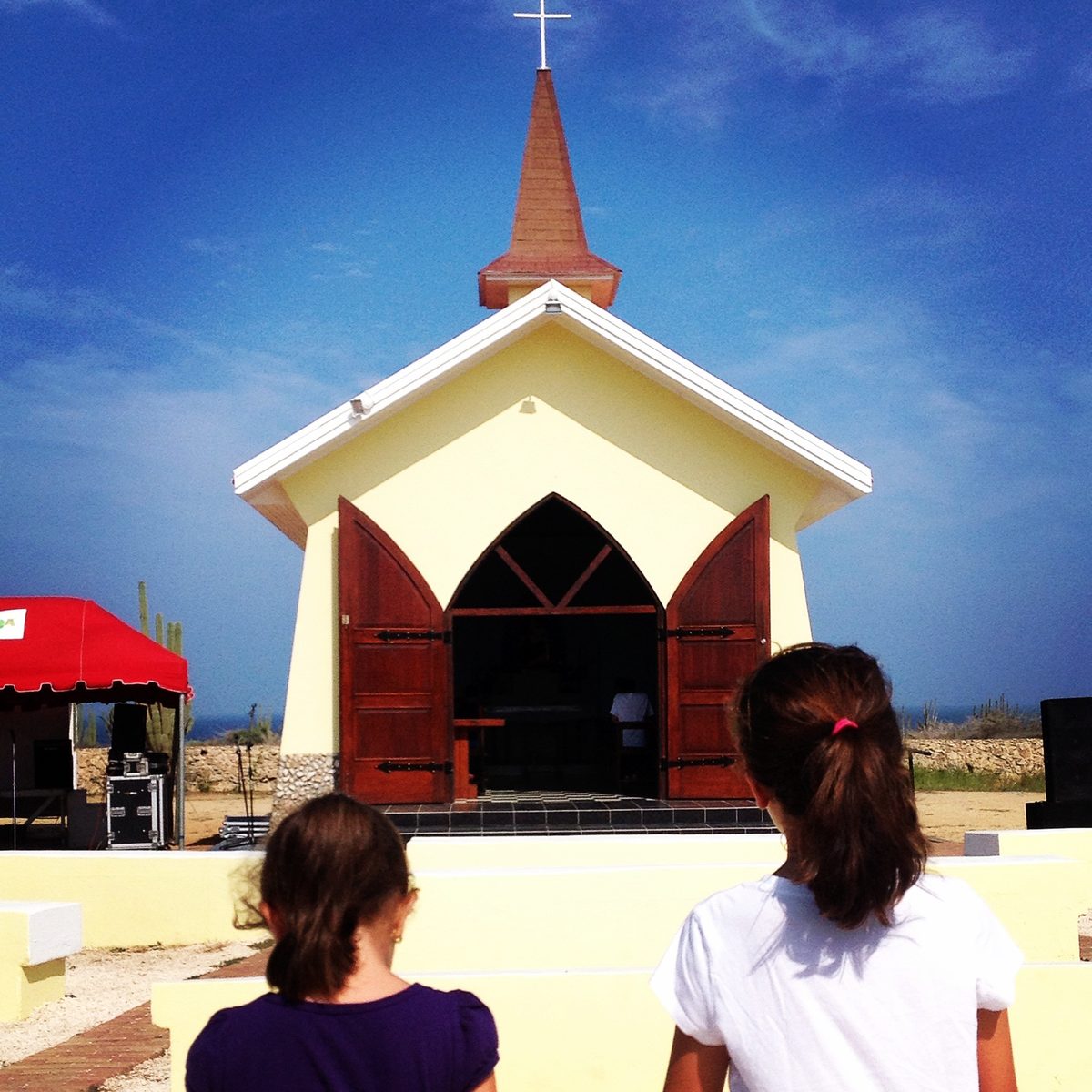
On a windswept hill above Aruba’s rugged north coast stands a tiny mustard-yellow church that punches far above its size. Alto Vista Chapel marks the spot where the island’s first Catholic church was raised in 1750, and the peaceful, cross-lined road that winds out to it is as much a part of the experience as the chapel itself. It is free, it is quietly moving, and the whole visit takes maybe twenty minutes — yet it rewards anyone who slows down for it. Here is the full story behind the chapel, how to visit it respectfully, and what to see nearby.
Alto Vista Chapel is the bright-yellow Catholic chapel on a hill above Aruba’s rugged north coast, near Noord. It is Aruba’s first church — first built in 1750 and rebuilt in 1952 — and is known as the “Pilgrims Church.” Entry is free, it is open to all faiths, and the winding road in is lined with white crosses. Plan on 30 to 45 minutes.
This guide is for travelers who want more than a drive-by photo. Whether you are renting a car for a north-coast loop, taking a tour, or visiting on a cruise day, I will walk you through the chapel’s remarkable history, what to actually look at when you get there, how to find it and park, how to be respectful at a working place of worship, the best time to go, and the nearby stops that turn Alto Vista into a half-day adventure. It is one of the most rewarding free things to do on the island, and one of my favorite stops in our roundup of things to do in Aruba.
Alto Vista Chapel at a glance
| Detail | What to know |
|---|---|
| What it is | Aruba’s first Catholic church (1750; current chapel 1952), known as the “Pilgrims Church” |
| Location | A hilltop above the north coast, northeast of Noord (about 12.576°N, 70.011°W) |
| Cost | Free — no ticket needed. A donation box inside is appreciated, not required |
| Hours | Roughly dawn to dusk (around 6:00am–6:00pm); the grounds are open-air. Hours vary, so check locally |
| How long to visit | 30 to 45 minutes for the chapel and peace labyrinth; longer if you walk the trails |
| Best time | Early morning or late afternoon — cooler, quieter, and the prettiest light |
| Mass | Weekly, usually Tuesday, led by a priest from Noord; a Good Friday pilgrimage walks here from Oranjestad |
| Getting there | About 10 to 15 minutes from Palm Beach by car or taxi; the last stretch is unpaved but fine for a normal rental |
| Good to know | It is a working chapel. Dress modestly, keep voices low, and do not use flash during services |
The history: Aruba’s first church and why it nearly vanished
For such a small building, Alto Vista carries an outsized story — and it is the reason I think the chapel is worth the dusty drive even if you are not religious at all. This is the spot where the Catholic faith first took root on the island, and the fact that anything stands here today is something close to a small miracle.
1750: Domingo Antonio Silvestre and the Caquetio
The original chapel went up in 1750, decades before Aruba had a resident priest of its own. It was the work of Domingo Antonio Silvestre, a missionary from Santa Ana de Coro in Venezuela, who funded the project largely out of his own pocket and built it with the labor of the Caquetio people, the island’s Indigenous inhabitants. The first structure was humble — stone walls and a straw roof — and it was dedicated to the Virgin Mary as the “Mother of the Rosary.”
It is worth pausing on this. The “high view” that gives Alto Vista its name (alto vista roughly means “high view” in Spanish) was the cradle of organized religion in Aruba. Silvestre and, later, his descendants taught the Rosary to the Caquetio, and priests sailed over from the Venezuelan mainland a few times a year to perform baptisms, weddings, and Mass. For nearly thirty years, this remote hilltop was the spiritual center of the whole island. I will also gently flag what the glossier accounts tend to skip: the early colonial era in the Caribbean was brutal for Indigenous peoples, and the relationship between the Spanish and the Caquetio was not the simple harmony the brochures imply. The history here is real and complicated, which to me makes the place more moving, not less.
The plague, abandonment, and a century of ruin
Then it all fell apart. A plague swept through the Alto Vista area. Many residents died; the survivors abandoned the settlement and moved to Noord, where Aruba’s second church was eventually built. The little chapel on the hill was deserted from around 1816 and slowly collapsed into a pile of stones. The original Spanish cross from its altar was carried off and passed from priest to priest; today it is kept at St. Ann’s Church in Noord and is considered one of the oldest pieces of European art in the Dutch Caribbean. For more than a century, Alto Vista was essentially a forgotten ruin in the cactus.
1952: a schoolteacher rebuilds a ruin
Here is the part that gets me every time. The chapel you visit today exists because of one determined Aruban schoolteacher, Francisca, who came across the scant remains of the old church while leading her students on a hike through the Alto Vista area. Moved by what she found, she petitioned the local Bishop for funds to rebuild. The first answer was no. So she fundraised among ordinary Arubans — reportedly gathering around 5,000 florins — commissioned a statue of the Virgin Mary from the Netherlands, and asked again. The second time, she got her way.
The present chapel was rebuilt in 1952, designed by the Dutch engineer J.A. Hille of the public works department, on the exact footprint and orientation of the 1750 original — a modest stone box roughly 50 feet long and 16 feet wide, with the façade facing east toward the morning sun. It was painted the cheerful bright yellow it still wears, and that color is now its signature. The Marian statue was later crowned with a gem-studded gold crown paid for by local donations. (It was once vandalized and has since been replaced.) When you stand inside, you are standing in a building that ordinary islanders willed back into existence out of sheer devotion. That context completely changes how the place feels.
Why it is called the “Pilgrims Church”
You will see Alto Vista described everywhere as the “Pilgrims Church,” or pilgrim church Aruba, and the name is not just marketing. This hill has been a destination for the faithful since the 1700s, and it still is.
The most striking tradition is the Good Friday pilgrimage, when local Catholics walk on foot all the way from Oranjestad out to Alto Vista — a long, hot, deeply meaningful trek across the island to mark the Passion. There is also an annual feast day in January (associated with Santa Filomena) that draws devotees up the hill, and regular weekly Mass, usually on Tuesdays, performed by a priest who comes over from Noord. Outside of those services, modern “pilgrims” of every stripe come for quiet meditation. The chapel makes a point of welcoming everyone — Catholic or not, religious or not. I have sat in those curved pews next to honeymooners, solo hikers, and a cruise couple who just wanted five minutes of cool shade and silence, and nobody looked out of place.
The winding road and the white crosses (the Stations of the Cross)
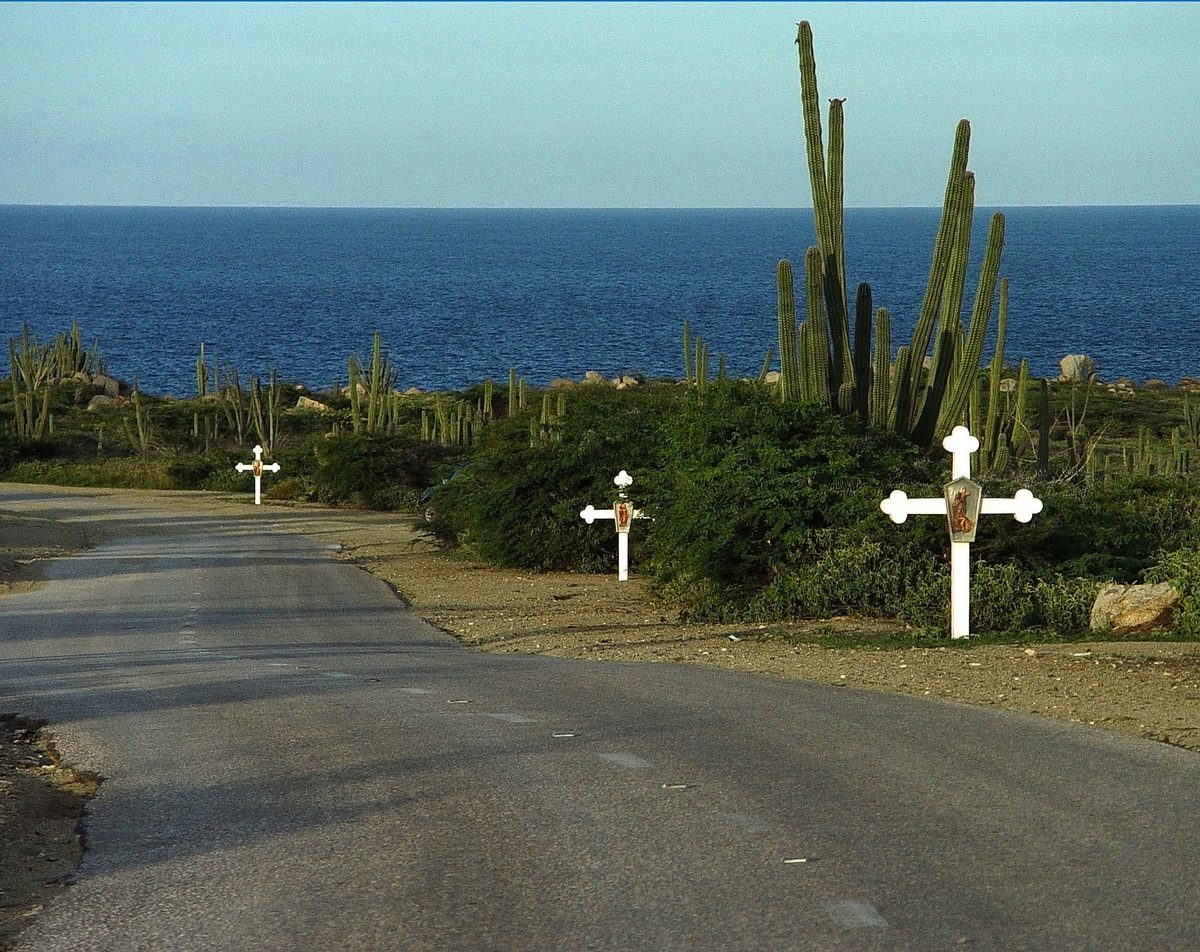
The approach is half the experience, and it is what most people photograph first. The final road up to the chapel is unpaved, dusty, and winding, and it is lined with a series of simple white crosses set against the scrubby, cactus-dotted landscape. These mark the Stations of the Cross — the fourteen moments of Christ’s Passion that pilgrims traditionally pray through in sequence — so the drive (or walk) in becomes its own small devotional journey, whether or not you intend it that way.
Visually, it is unforgettable: a thin ribbon of pale road, the white crosses marching up the hillside, the cobalt Caribbean glinting beyond, and that single yellow chapel waiting at the top. If you can, slow down and walk the last stretch on foot. The crosses mean a lot more at three miles an hour than at fifteen.
What to see when you get there
The chapel itself is tiny, so do not expect a grand cathedral. The reward here is in the details and the setting. Here is what I would not want you to miss.
The bright-yellow exterior
That sunny yellow paint is the chapel’s calling card, and it pops against the blue sky in a way that makes even a quick phone photo look great. Notice the simple wooden shutters, the modest cross above the door, and the way the building sits low and humble on its rise rather than dominating it. Stone pews are built into the ground outside, originally to seat the overflow of worshippers on busy feast days — a nice clue to how popular this remote spot once was.
The iconic white cross and the tokens
Standing tall near the entrance is a large white cross that has become a symbol of hope and faith for locals and visitors alike. Look closely around its base and on the surrounding ground and you will often see small tokens left behind — ribbons, pebbles, coins, handwritten notes — little physical prayers and wishes from the people who have come before you. It is genuinely touching. If you want to leave something, keep it small and respectful, and never disturb what others have placed.
Inside the chapel
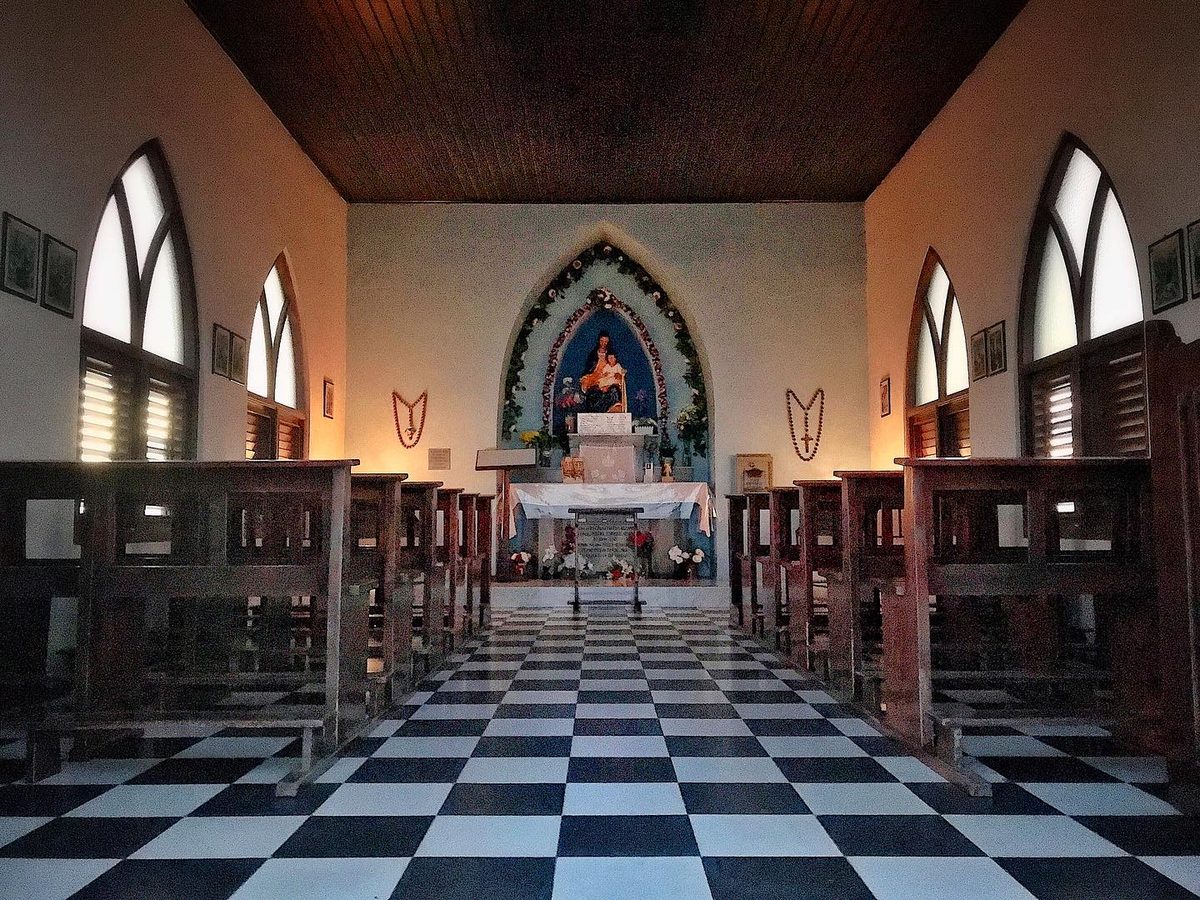
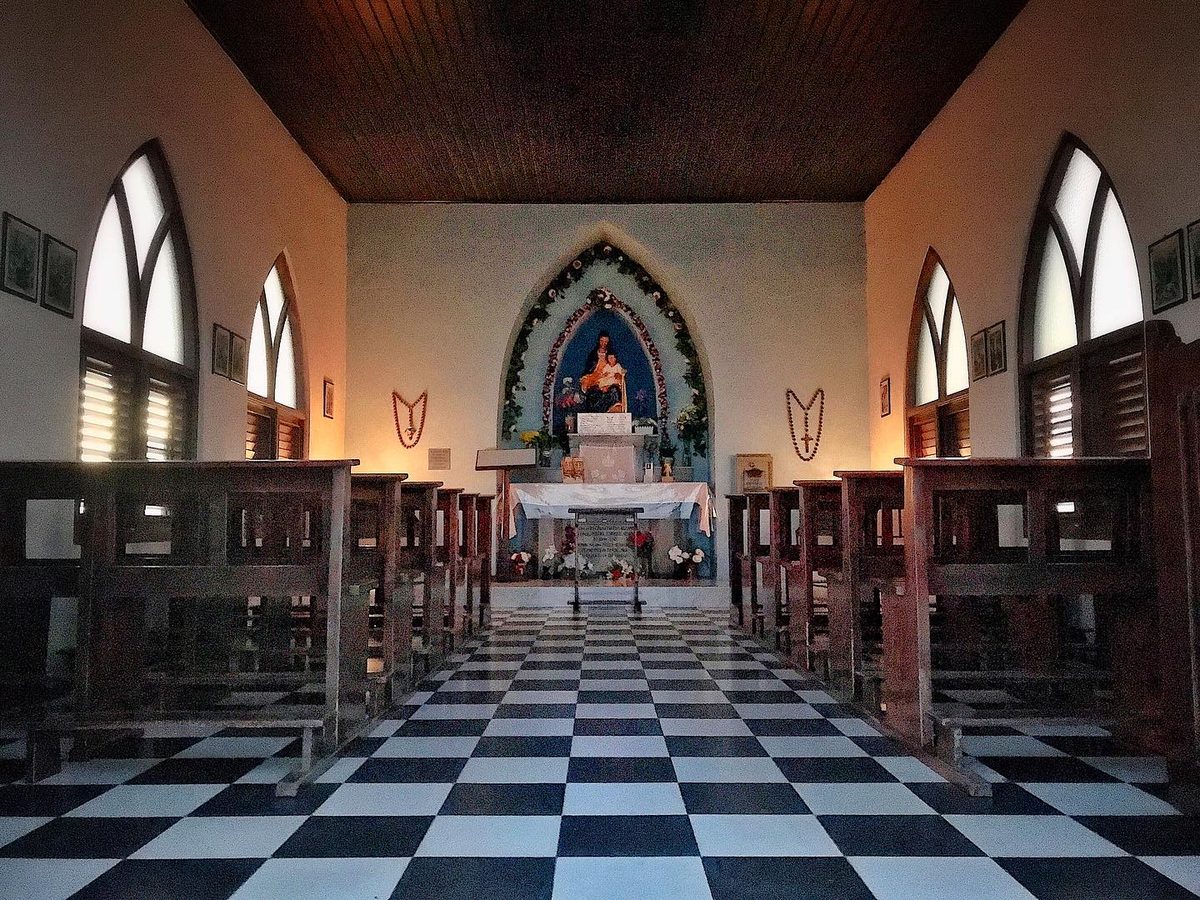
Step through the doorway and the temperature drops, the light softens, and the noise of the wind falls away. The interior is plain in the best sense: whitewashed walls, a simple altar, the crowned statue of the Virgin Mary, a handful of religious images, and those distinctive curved (semicircular) pews facing the front. There are no flashy stained-glass windows — just a quiet, serene room built for prayer. A donation box sits inside; if the chapel moves you, a small contribution helps with its upkeep. Take a moment here even if you are only mildly curious. The stillness is the whole point.
The founders’ graves and the old chapel outline
This is the detail almost everyone walks right past. Around the chapel, marked by stones, you can trace the footprint of the original 1750 building, and a few old graves remain nearby — including, by tradition, those of Domingo Antonio Silvestre, the founder, and an early caretaker of the church. Standing where the very first church in Aruba once stood, looking at the resting place of the man who built it, is a quietly powerful thing. The white crosses ringing the grounds also echo the Stations of the Cross from the road.
The view
Finally, just turn around. From the hilltop you get a sweeping, uninterrupted panorama of Aruba’s wild north coast: rugged limestone, surf pounding the rocks, cactus running to the horizon, and that big Caribbean sky. Honestly, even visitors with zero interest in the chapel’s spiritual side tell me the view alone justifies the trip. It is one of the best free vantage points on the island.
The Peace Labyrinth and peace garden
A short walk from the chapel is a feature a lot of visitors miss because they do not know to look for it: the Peace Labyrinth. It is not a maze you can get lost in — a labyrinth has a single winding path that leads to the center and back out again — and this one is modeled on the famous medieval Chartres labyrinth in France. The idea is simple and surprisingly effective: you walk the path slowly, let your mind settle, and use the journey to the center as a kind of moving meditation.
People sometimes compare the surrounding peace garden to a zen garden, and that is about right. Set against the open Aruban countryside, with the wind and the sea as your soundtrack, it is a lovely place to slow your heart rate for a few minutes — whether you treat it as prayer, mindfulness, or just a quiet stroll. I am not a religious person, and I still found walking the labyrinth weirdly grounding after a few days of beach bars and busy Palm Beach. Bring water; the path is exposed and there is almost no shade.
How to get to Alto Vista Chapel
Alto Vista sits northeast of Noord, up above the north coast, and it is genuinely easy to reach — the only mild adventure is the last unpaved stretch. Here are your options.
By rental car (my recommendation)
A car gives you the freedom to linger and to chain Alto Vista together with the other north-coast sights. From the Palm Beach and Noord high-rise hotel area it is only about a 10-minute drive; from Oranjestad, budget around 15 minutes; from the cruise terminal, roughly 20 minutes. Follow the signs toward Noord and Alto Vista. The final approach turns to packed dirt and can be dusty and bumpy, but it is perfectly drivable in a standard rental car — you do not need a Jeep or 4×4 just for the chapel. Drive slowly, both for your suspension and to take in those white crosses. For the bigger picture on renting and driving here, see our guide to getting around Aruba.
Parking
There is a free parking area right by the chapel, and it is usually easy to find a spot. Regular cars can park in front of or behind the chapel, and there are separate designated areas for tour buses and for the UTV and ATV tours that pass through. From the lot it is just a short, flat walk to the entrance. No meters, no attendants, no fees — one of the many reasons Alto Vista lands on our list of budget-friendly things to do in Aruba.
By taxi
If you are not driving, a taxi is straightforward. Aruba taxis use fixed government rates rather than meters, so agree on the fare before you set off, and consider asking the driver to wait or to come back for you at an agreed time — cabs do not just cruise past a remote chapel, so you do not want to be stranded on the hill. Tell the driver clearly you want “Alto Vista Chapel.”
By organized tour
Alto Vista is a standard stop on most north-coast and island sightseeing tours — Jeep safaris, UTV and ATV off-road tours, and the hop-on bus-style island circuits almost all swing by, usually pairing it with the California Lighthouse, the Bushiribana gold-mill ruins, and the Natural Bridge area. This is the easiest hands-off option on a cruise day. The trade-off is that you will only get a short window at the chapel, often with a crowd. If a calm, contemplative visit matters to you, a car or taxi early in the day beats a tour.
By public bus
It is possible but a bit of a project. Arubus public buses run between Oranjestad and the Noord area, but they do not go to the chapel itself. You would ride to the nearest stop in Noord and then walk roughly 10 to 15 minutes (or more) along the road to the chapel. In the midday heat, with little shade, I would not recommend the bus unless you are a confident walker traveling on a tight budget. Map it carefully and carry plenty of water.
Etiquette: it is a working chapel, not just a photo stop
This is the part I most want you to take to heart. Alto Vista looks like an attraction, but it is a living, consecrated place of worship where locals pray, hold Mass, and mark life’s biggest moments. A little respect goes a long way.
- Dress modestly. You will be coming from the beach, but throw on a cover-up. The general guidance is to keep shoulders and knees covered, especially if you plan to step inside. No bare chests, no dripping swimsuits.
- Keep your voice down. Someone may be praying. Treat the interior the way you would any church — quiet voices, phones on silent.
- Never interrupt a service. If Mass or the Good Friday pilgrimage is happening, do not wander in snapping photos. Hang back, observe respectfully from a distance, or come another time.
- Ask before photographing people, and skip the flash inside. More on photography below.
- Leave the tokens alone. Those ribbons and notes at the cross are other people’s prayers. Add to them gently if you like, but never take or rearrange them.
- Take your trash with you. There is little to no staff and limited bins. Leave the hilltop exactly as you found it.
The best time to visit Alto Vista Chapel
Timing makes a real difference at an exposed, shadeless hilltop site like this. My strong advice: go early in the morning or in the late afternoon. You will dodge the worst of the heat, you will likely beat the tour buses (which tend to roll through mid-morning to midday), and you will get the soft, golden light that makes both the yellow chapel and the coastline look their best. Sunrise visits, in particular, are magical and almost guaranteed to be crowd-free.
Avoid the harsh midday sun if you can — there is no shade to retreat to, and the photos wash out. As for the season, Aruba is reliably warm, dry, and sunny year-round, so any month works; the wind off the north coast actually makes Alto Vista feel pleasant even when the rest of the island is baking. If you want to time your whole trip around the nicest conditions and the calendar of local events, our guide to the best time to visit Aruba breaks it down month by month. One thing worth checking: weekly Mass is usually on Tuesdays, so if you specifically want a purely quiet, tourist-style visit, a non-service morning is your best bet.
Photography tips
Alto Vista is one of the most photogenic spots on the island, and a little planning pays off.
- Shoot in golden hour. Early morning or late afternoon light flatters the yellow walls and the rugged coast far more than flat midday glare.
- Use the white crosses as a leading line. Position yourself so the row of crosses on the winding road draws the eye up toward the chapel — it is the signature Alto Vista shot.
- Get the chapel against the sea. Walk around the back and sides to frame the yellow chapel with the blue Caribbean and cactus behind it.
- Be discreet and reverent inside. No flash (it is disruptive and harsh on the old interior), and absolutely no photos during a service. If people are praying, put the camera away.
- Mind the wind. It is breezy up here — secure hats, lens caps, and anything that can blow off the hill, and brace your phone for sharper shots.
Combine it with the north coast: a perfect half-day loop
Here is the single best piece of advice in this guide: do not drive all the way out to Alto Vista just for the chapel. You are already in the wild, beautiful, under-visited north of the island, so make a morning of it. The chapel pairs naturally with a cluster of rugged, mostly free sights, and together they make one of my favorite half-day self-drive loops in Aruba.
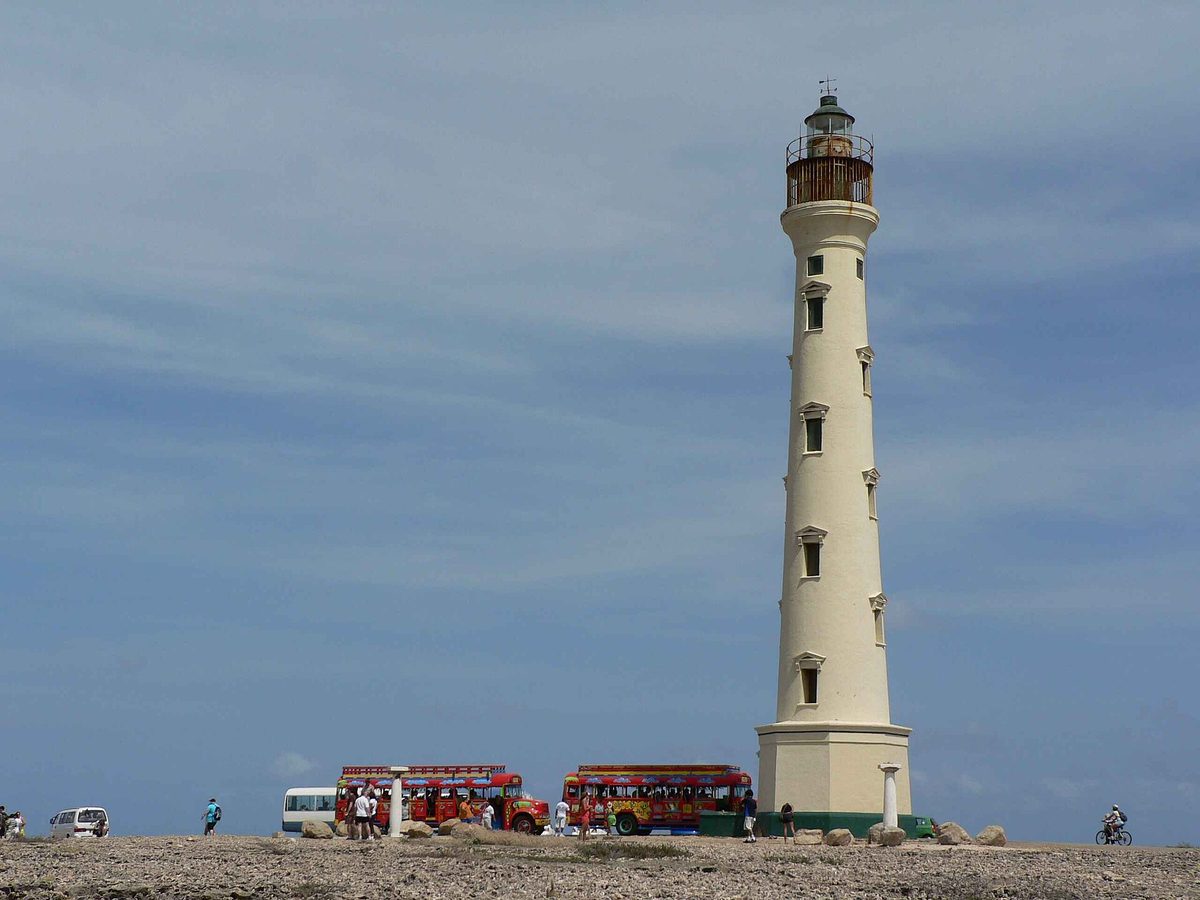
California Lighthouse
Just a few kilometers from Alto Vista, on the island’s northwestern tip, the California Lighthouse stands on a high, windswept bluff with what might be the best panoramic view on Aruba — you can see the curve of Palm Beach on one side and the untamed north coast on the other. It is a classic sunset spot and an easy, scenic add-on. Many people pair the lighthouse and the chapel in a single outing.
Bushiribana Gold Mill Ruins
Further along the rocky north shore are the Bushiribana ruins — the haunting stone remains of a 19th-century gold smelter, left over from Aruba’s brief but very real gold rush. The weathered walls perched right above the crashing surf are wonderfully atmospheric and extremely photogenic, and clambering around them (carefully) is free. It is a complete change of mood from the chapel: industrial history instead of spiritual history.
The Natural Bridge and Baby Natural Bridge
Close to Bushiribana you will find the Natural Bridge area, where the pounding sea has carved dramatic limestone arches into the coast. The largest original bridge famously collapsed years ago, but the nearby “Baby” Natural Bridge still stands, and the whole stretch of foaming, rock-strewn coastline is spectacular to watch. It is the natural turnaround point for a north-coast loop.
Arikok and the Natural Pool
If you have a proper 4×4 and a full morning, the rugged interior and coastline continue into Arikok National Park, home to caves, more cactus-studded trails, and the famous Conchi Natural Pool. This is more of a dedicated half- or full-day adventure than a quick add-on, but it is the natural next step for travelers who fall in love with Aruba’s wild side after a stop at Alto Vista.
A sensible order for a self-drive morning: leave Palm Beach early, hit Alto Vista first while it is cool and quiet, then loop out to California Lighthouse, Bushiribana, and the Natural Bridge, and be back for lunch or the beach by early afternoon. Want help slotting this into a longer trip? Our Aruba itinerary guide shows exactly where a north-coast morning fits, and after all that sun you will appreciate one of the island’s best beaches in the afternoon.
Who Alto Vista Chapel is for
History and culture lovers
If you are the kind of traveler who reads the plaques, this is essential. It is the literal birthplace of Catholicism in Aruba, with 270 years of story packed into one small yellow building. Pair it with the Bushiribana ruins for a north-coast history morning.
Couples
The quiet, the views, and the romance of that hilltop setting make Alto Vista a lovely, low-key stop for two — especially at sunrise or late afternoon. It slots neatly into a relaxed day for couples planning an Aruba honeymoon.
Families
It is short, free, and easy, which is exactly what you want with kids. The drive in past the white crosses, the bright chapel, and the big coastal view hold attention for the 20 to 30 minutes most families will want. Bring water and sun protection. For more along these lines, see our guide to Aruba with kids.
Cruise visitors
On a cruise day, Alto Vista is an easy, photogenic, low-cost taxi or tour stop close to the port, usually bundled with the lighthouse and Natural Bridge. Just leave yourself a comfortable buffer to get back to the ship.
A few practical reminders before you go
- Bring water, sunscreen, and a hat. The hilltop is fully exposed and there is essentially no shade.
- Wear comfortable, closed shoes. The ground is rough, rocky, and dusty — not the place for delicate sandals if you plan to walk the labyrinth or trails.
- Carry a little cash. Entry is free, but small bills are handy for the donation box.
- Have a plan to get back if you came by taxi — arrange a return pickup rather than hoping to flag one down.
- Top up the gas. The north is remote; do not head out on an empty tank.
For broader logistics — SIM cards, money, safety, and what to pack — our Aruba travel tips guide covers the essentials, and if you are still deciding on a base, see which area of Aruba to stay in (the Palm Beach and Noord area puts you closest to Alto Vista).
Frequently asked questions
Is Alto Vista Chapel worth visiting?
Yes — and even if you are not religious. It is Aruba’s oldest church with a genuinely remarkable history, the bright-yellow chapel and white-cross road are unmistakably photogenic, and the hilltop view over the wild north coast is one of the best free vantage points on the island. It is a short, easy, no-cost stop that adds real depth to a north-coast day.
How much does it cost to visit Alto Vista Chapel?
Nothing. Entry is completely free and no ticket is required. There is a donation box inside the chapel if you would like to contribute to its upkeep, but it is entirely optional. Parking nearby is free too, which makes Alto Vista one of the best-value attractions in Aruba.
What are Alto Vista Chapel’s opening hours?
The grounds are essentially open from around dawn until dusk — roughly 6:00am to 6:00pm, though you will see slightly different times quoted by different sources. Because it is a working chapel rather than a ticketed attraction, hours are informal, so it is wise to check locally and to avoid weekly Mass (usually Tuesday) if you want a quiet, tourist-style visit.
Why is it called the Pilgrims Church?
Because it has been a destination for the faithful since the 1700s and still is. Local Catholics make a Good Friday pilgrimage on foot from Oranjestad to the chapel, an annual January feast day draws devotees up the hill, and people of all backgrounds come year-round for quiet reflection. The name reflects that long tradition of journeying to this remote hilltop to pray.
How do you get to Alto Vista Chapel?
It sits northeast of Noord, above the north coast. By car it is about 10 minutes from Palm Beach, 15 from Oranjestad, and 20 from the cruise port; the final stretch is unpaved but fine for a normal rental. You can also take a taxi (agree the fare first and arrange a return) or join an island or north-coast tour that includes it.
Do you need a 4×4 to reach the chapel?
No. While the last part of the road is packed dirt and a little bumpy and dusty, a standard rental car handles it without trouble — just drive slowly. You only need a proper 4×4 if you plan to push on into the rougher coastline and Arikok National Park beyond the chapel.
How long should I spend at Alto Vista Chapel?
Plan on about 30 to 45 minutes to see the chapel inside and out, walk the peace labyrinth, take photos, and soak in the view. If you add a hike on the nearby trails or pair it with the lighthouse, ruins, and Natural Bridge, you can easily turn it into a half-day on the north coast.
Can non-Catholics or non-Christians visit?
Absolutely. The chapel explicitly welcomes visitors of all faiths and of none, whether you come for the history, the views, the meditation, or simple curiosity. The only expectation is respect: dress modestly, keep quiet inside, and do not disturb anyone who is praying or any service in progress.
What should I wear to Alto Vista Chapel?
Dress modestly out of respect — shoulders and knees covered is the standard guidance, so bring a cover-up over beachwear. Otherwise, dress for sun and rough ground: a hat, sunscreen, sunglasses, and comfortable closed shoes, plus plenty of water, since the exposed hilltop offers almost no shade.
Final thoughts
I still remember how quiet it got when I turned off that engine on the hill. Alto Vista is not a big, showy attraction, and that is exactly why I love it. In a country of glittering resorts and busy beaches, here is a tiny yellow chapel that has survived a plague, a hundred years of ruin, and the sheer determination of a schoolteacher who refused to let it disappear — standing alone above a wild coast, still welcoming pilgrims and curious travelers alike. Give it more than a drive-by. Walk the road past the white crosses, sit in the cool shade inside for a minute, trace the labyrinth, and turn around to take in that view. It is free, it is moving, and it is one of the most genuinely Aruban places you can visit. Then point the car toward the lighthouse and keep exploring — the north coast is just getting started.
Photo credits
All images via Wikimedia Commons, used under their respective Creative Commons licenses. Alto Vista Chapel exterior: Em erasmus (CC BY-SA 3.0) · Road to Alto Vista with white crosses: Serge Melki (CC BY 2.0) · Alto Vista Chapel interior: Dalopezschipper (CC BY-SA 4.0) · California Lighthouse: David Stanley (CC BY 2.0). Alto Vista Chapel interior by Dalopezschipper (CC BY-SA 4.0).