Here is the worry I hear from parents before almost every Aruba trip: the island is tiny, it is famous for beaches, and surely a 15-year-old will be bored stiff by day two. Put that fear down. After more trips doing Aruba with teenagers than I can count, often dragging moody, screen-glued kids along, I can tell you the opposite is true. The island is one of the easiest places in the Caribbean to keep older kids genuinely hooked, because what teens crave on vacation is precisely what this place sells: speed, water, a little independence, and a social scene where they actually want to be seen.
The trick is knowing where to point them. Planning a trip to Aruba with teenagers is less about ticking off a list of attractions and more about matching the right adrenaline, the right beach, and the right amount of freedom to the kid sitting in your back seat. Get that mix right and you will spend the week watching them surface from a snorkel, grinning, instead of begging for the resort Wi-Fi password.
This guide is built from real days on the ground: the activities my teens asked to repeat, the ones with age minimums that tripped us up, the food trucks they still talk about, and the spots that actually earned a place on their camera roll. It leans into the stuff designed for the 13-to-18 crowd, not the toddler-and-stroller version of the island. For the broader family picture, our complete guide to visiting Aruba with kids covers the younger end and the logistics that apply to everyone.
Is Aruba good for teenagers? Yes, and it is one of the best Caribbean islands for them. Teens get adrenaline water sports like jet skiing and parasailing, off-road UTV and Jeep safaris, world-class snorkeling over a real shipwreck, a buzzing Palm Beach social scene, and enough safety and English to give them real independence. Boredom is rarely the problem here.
At a glance: the best things to do in Aruba for teens
Before the deep dive, here is the cheat sheet I wish someone had handed me on my first trip. Prices are approximate and shift by season and operator, but they give you a realistic sense of what to budget. Age minimums matter more than you would think in Aruba, so I have flagged the ones that catch families out.
| Activity | Thrill level | Approx cost (per person) | Min age | Where |
|---|---|---|---|---|
| Jet ski rental | High | around $90 for 30 min | 16 to drive solo; younger rides along | Palm & Eagle Beach |
| Parasailing | High | around $70 | No firm min; under ~12 tandem with adult | Palm Beach |
| Flyboarding | Very high | around $120 for 30 min | 15 with parental consent | Palm Beach / Oranjestad |
| UTV / ATV safari | High | around $130 | Ride at any age; drive a UTV at 16+ with license | Arikok & north coast |
| Catamaran snorkel (Antilla wreck) | Medium | around $60 | All ages | Departs Palm Beach |
| Windsurf / kitesurf lesson | Medium-high | around $80 for 2 hr | ~10+ windsurf; ~12+ kitesurf | Fisherman’s Huts / Hadicurari |
| Go-kart racing | Medium | around $25 per race | Varies by kart; juniors welcome | Near Oranjestad |
| Flamingos at Renaissance Island | Low | day pass around $125 | All ages | Private island off Oranjestad |
Notice how much of that list is water and motion. That is the whole strategy for choosing things to do across Aruba when teens are involved: front-load the adrenaline, then let the beach and the food scene carry the slow hours.
Adrenaline and water sports: where teens come alive
If your teenager has a pulse, this is where the trip is won. Aruba’s west coast is essentially one long water-sports playground, and the constant trade winds that make the island so reliably sunny also make it a magnet for anything that moves on or above the water. Vendors set up right on the sand in front of the Palm Beach resorts, so you rarely have to plan more than a day ahead.
I always start a first-timer with a jet ski, because nothing else converts a skeptical teen faster. Rentals run around $90 for half an hour off Palm or Eagle Beach. Most operators let a 16-year-old drive solo with a parent’s sign-off, while younger teens ride double behind an adult. Set expectations before you hand over the throttle: there are no-wake zones near swimmers, and the rental staff will brief you. My rule is one supervised lap together, then I let them open it up in the clear water beyond the buoys.
Parasailing is the gateway thrill for kids who think they are too cool to be impressed. At around $70 for a flight off Palm Beach, you get hauled several hundred feet above the Caribbean behind a speedboat, the whole island laid out below you, and it is calmer than it looks. Two can usually go up together, which is perfect for siblings who will spend the rest of the day arguing about who was less scared.
For the genuine daredevils, flyboarding is the one that breaks the internet on their feed. Strapped to a board connected to a jet-ski’s water jet, you are launched a few feet (or, by the end of the session, several feet) out of the water like a clumsy dolphin. It runs about $120 for 30 minutes and usually carries a minimum age of 15 with a parent present. Expect a lot of faceplants in the first ten minutes and a lot of bragging for the rest of the week.
Calmer options still count. Banana boat and tubing rides are cheap, social, and ideal when you have a mixed group of ages or a teen who wants the splash without the height. Stand-up paddleboarding rents for very little on the calmer mornings and doubles as a sneaky core workout you can frame as fun. None of these need a booking; just walk the beach and pick a vendor with newer-looking gear and a clear safety briefing.
Windsurfing and kitesurfing at Fisherman’s Huts
Aruba is, quietly, one of the world’s great windsurfing and kitesurfing destinations, and the epicenter is Fisherman’s Huts (Hadicurari) just north of the Palm Beach high-rises. The water there is flat and shallow a long way out, the wind is steady and side-on, and a string of schools run lessons for first-timers. A two-hour beginner windsurf lesson is around $80, and most schools take kids from about age 10. Kitesurfing is more demanding and usually starts around age 12, with the first lesson spent flying the kite on the beach before you ever touch the board.
Even if your teen never tries it, Fisherman’s Huts is worth a stop just to watch the experts skim across the bay during the windy afternoons. It is one of the more genuinely cool free spectacles on the island. Our deep dive into water sports in Aruba breaks down every operator, season, and price point if you want to plan this part properly. The short version: if you have a teenager who likes a challenge, book the lesson early in the trip so they have time to get good and ask for a second session.
Snorkeling and diving the Antilla wreck
The single activity my teens rate highest, year after year, is snorkeling the Antilla shipwreck. It is a 400-foot German freighter scuttled in World War II, sitting in clear, shallow water off the northwest coast, and it is one of the largest wrecks in the Caribbean. Swimming over something that massive and eerie, with fish streaming in and out of the hull, lands very differently for a teenager than a postcard reef does. It feels like exploring, not sightseeing.
The easy way to do it is a catamaran snorkel cruise, around $60 a head, departing from Palm Beach. A typical trip hits the Antilla plus two reef stops like Boca Catalina and Malmok, where green sea turtles graze the seagrass and angelfish patrol the coral. The boats usually have a rope swing and a slide off the back, which means even the teen who claims to hate snorkeling spends the whole sail launching themselves into the water. Bring reef-safe sunscreen and tell them to keep the mask on past the first five minutes; the turtles are worth the patience.
If you have a teenager who wants to take it further, several dive shops run a Discover Scuba experience for ages 10 and up, and full PADI Junior Open Water certification from age 12. Aruba’s calm, warm water and good visibility make it a forgiving place to learn. For non-swimmers or kids who panic with a mask, SNUBA (a tethered hose system, no tank on your back) and even a glass-bottom kayak or the Atlantis submarine give you the underwater payoff without the full commitment. There is genuinely a version of this for every comfort level.
Land adventure: UTVs, Jeep safaris and Arikok National Park
When the novelty of the beach dips around day three, take the adventure inland. Aruba’s wild side, the desert-like interior and the rugged, wave-pounded north coast, is best seen behind the wheel of something with knobbly tires, and this is where teens who do not love the water find their thing.
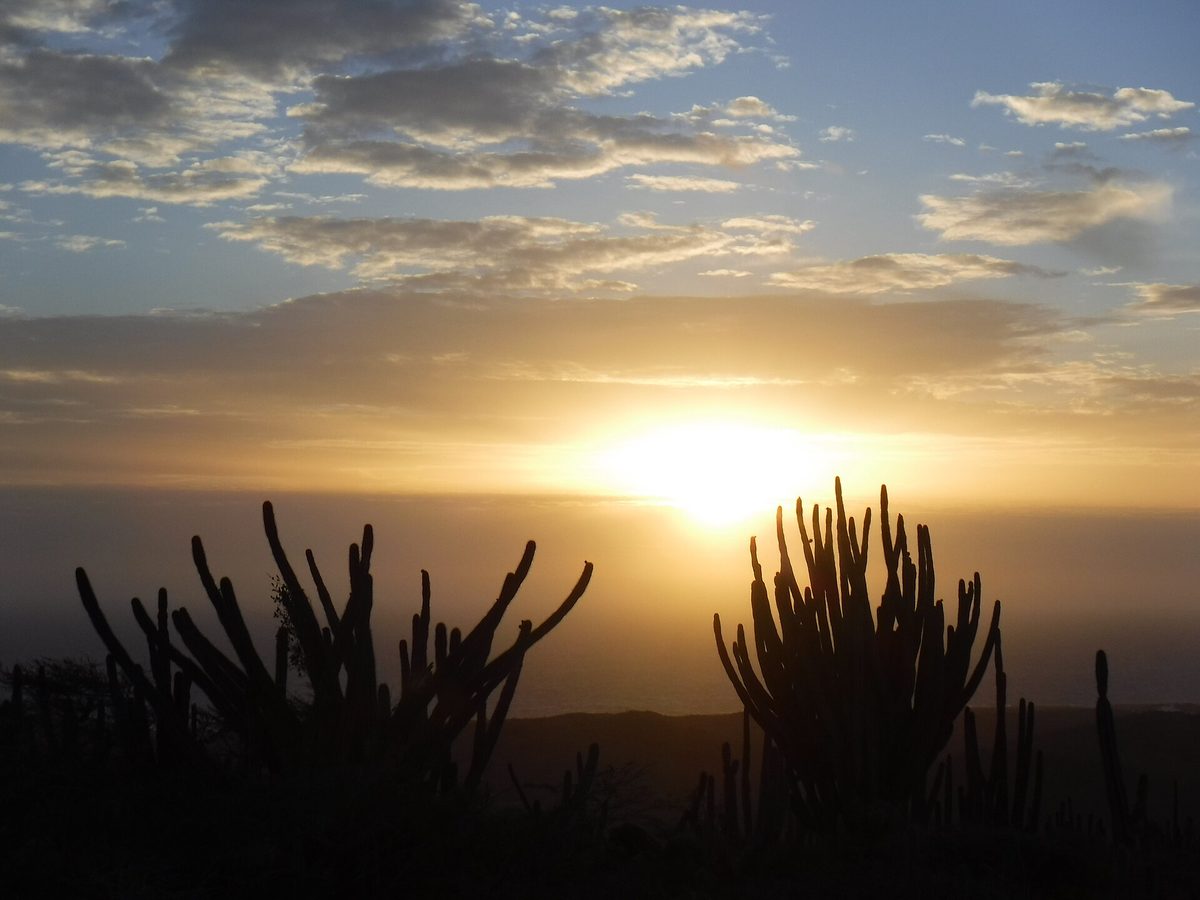
A UTV or ATV safari is the headline act. For around $130, you bounce across the cunucu (countryside) past tall cacti, the skeletal divi-divi trees, gold-mine ruins at Bushiribana, and out to the dramatic coastline. The important detail for families: in most cases a teen can ride from any age, but to drive a UTV themselves they generally need to be 16-plus with a valid driver’s license. Younger teens ride shotgun with a parent, which is honestly half the fun, because the dust and the bumps are the point. These tours are dusty, loud, and exactly the kind of thing a 14-year-old describes as “actually sick.”
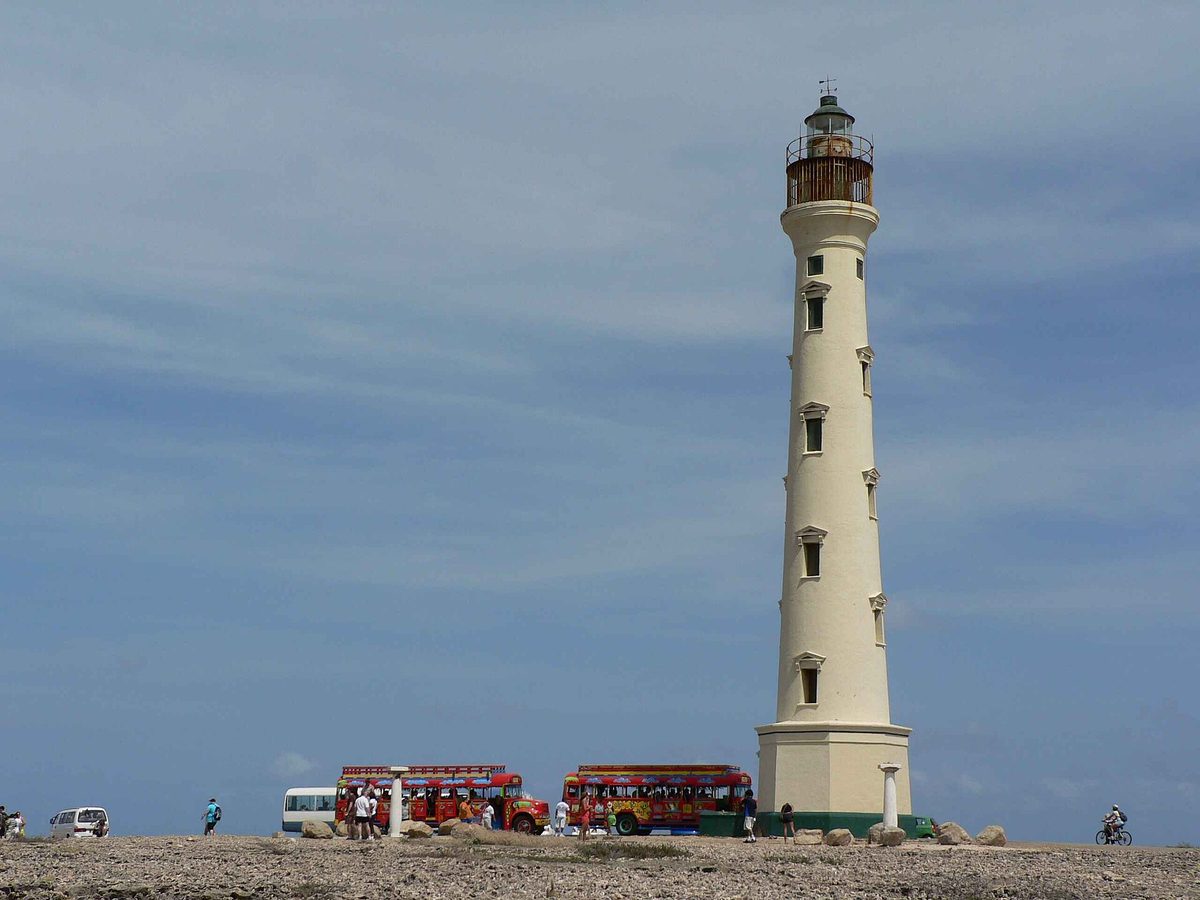
Prefer to let someone else drive? A guided Jeep or Land Rover safari covers the same wild north coast with stops at the California Lighthouse, the Alto Vista Chapel, the gold-mill ruins, and the remains of the Natural Bridge. It is a half-day, hands-off way to see the parts of the island you cannot reach in a normal rental car, and it pairs well with teens who would rather film the scenery than steer through it.
Arikok National Park and the Natural Pool
Arikok National Park covers nearly a fifth of the island and is the wild heart of any land adventure. Teens who like to climb and explore will gravitate to the caves: Quadirikiri Cave, where shafts of sunlight pour through holes in the roof, and Fontein Cave, with centuries-old rock drawings left by the island’s original Caquetio inhabitants. Yes, there are bats. The bats are, according to every teenager I have brought here, “the best part.”
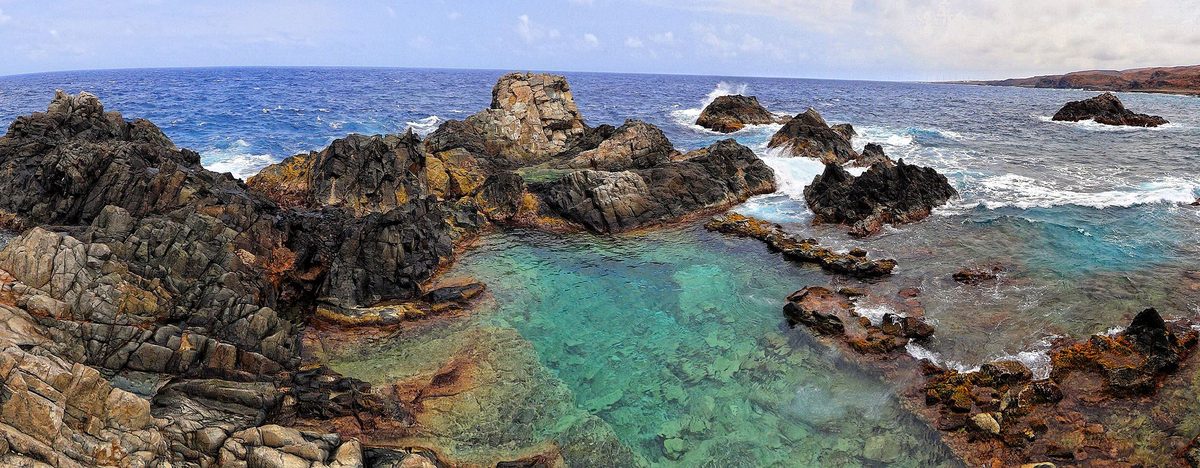
The crown jewel inside the park is the Natural Pool (Conchi), a circular pool of calm water ringed by volcanic rock and protected from the crashing surf. You cannot drive a regular car there; you need a 4×4, a UTV tour, or a horseback ride, and the final approach is genuinely rugged, so wear proper shoes with grip. Once you are in, you are swimming in a natural bowl with waves exploding on the rocks a few feet away. It is the single most photographed-against-the-odds spot teens bring home, and it earns it. Note that the park controls access and the Natural Pool can close in rough conditions, so check before you commit a whole day to it.
For climbers, the Ayo and Casibari Rock Formations are huge tumbled boulders you can scramble up for a view across the island, and they are free. My teens treat them like a natural jungle gym. If you want a fuller menu of guided trips, our roundup of Aruba excursions compares the UTV, Jeep, horseback, and combo tours so you can match the right one to your crew’s energy and budget.
Planning a day in Aruba with teenagers: the social scene and downtime
Adrenaline is only half the equation. The other half, the part that genuinely makes or breaks a trip to Aruba with teenagers, is downtime that does not feel like downtime. Teens need a scene: somewhere to wander, be semi-independent, and run into other people their age. Aruba delivers this better than almost any island its size.
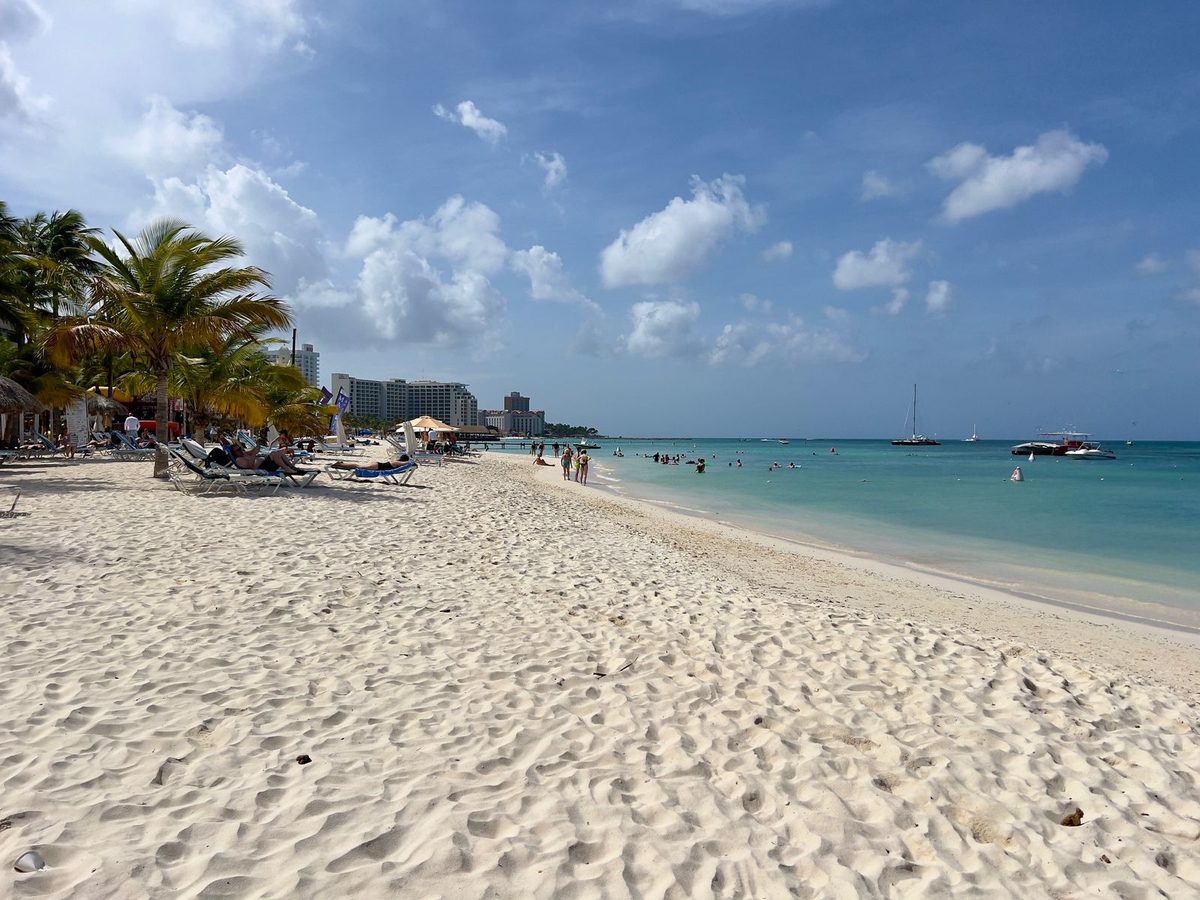
The center of gravity is the Palm Beach strip. By late afternoon the two-mile stretch of resorts, beach bars, and shopping turns into a slow, sociable parade. Most beach bars happily serve teens elaborate mocktails, so a 15-year-old can perch at a bar with a fancy virgin pina colada and feel thoroughly grown up. Paseo Herencia, the open-air shopping and entertainment center across from the high-rises, is the natural teen hub: frozen yogurt and gelato, casual restaurants, a dancing-fountain show in the evenings, and enough foot traffic that older teens can roam in a pack while you have a quiet dinner nearby.
For rainy spells or a change of pace, there is bowling and an arcade, go-kart racing at a track near Oranjestad (around $25 a race and fiercely competitive between siblings), and movies. A practical heads-up on casinos: several resorts have them, but the minimum gambling age in Aruba is 18, and some venues set it at 21, so teenagers can usually walk through the floor with you but cannot play. Treat the casino as a quick novelty walk-through, not an activity.
If your teens are old enough to want a taste of the island’s after-dark energy without actually drinking, the early-evening hours on Palm Beach, live music spilling out of the bars, food trucks firing up, are the sweet spot. Our guide to Aruba nightlife is mostly aimed at adults, but it is useful for understanding which areas stay family-friendly early and which turn into 18-plus zones later, so you can plan the handoff between “everyone’s out together” and “parents stay, teens head back to the room.”
Shopping and food teens actually want
Feeding teenagers on vacation is a sport, and Aruba makes it easy because the casual food scene is excellent and the portions are generous. The move I recommend to every family is the food trucks. Mama’s Food Truck in the Eagle Beach parking lot is a legend, piling plates with steak, shrimp, fish, fries, and sweet plantains for a fraction of resort prices. Trucks cluster around Palm Beach and Oranjestad in the evenings, and they are the kind of cheap, hands-on, choose-your-own dinner that teens love precisely because it does not feel like a sit-down meal with the family.
For a real meal, teens reliably go for the casual spots: Lola’s Taqueria for tacos near the Palm Beach resorts, Argentinian grills with huge portions, and the Dutch pancake houses where a savory or sweet pancake the size of a dinner plate disappears in minutes. If you have a teen who has discovered cafe culture and Instagram in the same year, Santos Coffee and Les Cappuchinas are exactly their speed: iced lattes, avocado toast, a boho garden setting, and backdrops engineered for photos. I have lost entire mornings to teenagers and their phones in both.
Oranjestad, the colorful capital, is worth half a day. The pastel Dutch colonial buildings make a good photo wander, the free streetcar loops the main drag, and the shopping runs from souvenir T-shirts to the Renaissance Mall’s brand-name stores. For a different kind of teen, the street-art murals of San Nicolas at the island’s south end are a genuine highlight: building-sized, vivid, and very shareable. Whether your teenager is into fashion, photography, or just air-conditioning and snacks, there is a version of a shopping afternoon that works.
Instagram-worthy spots that earn the photo
Let us be honest: for a lot of teens, “will it look good on my feed” is a real decision criterion, and Aruba has some genuinely spectacular backdrops. The most coveted is the flamingos at Renaissance Island. This private island off Oranjestad is home to a small flock of pink flamingos that wander right up to you on the beach. The catch: access is limited. You generally need to be a guest at the Renaissance Wind Creek resort, or snag a day pass (around $125, first-come and never guaranteed) from the resort’s front desk. If a flamingo selfie is genuinely on your teen’s bucket list, factor that into where you stay; our overview of where to stay in Aruba walks through the trade-offs.
The California Lighthouse at the island’s northern tip gives you sweeping coastline views and a classic golden-hour photo, and it is free to visit the grounds. The Natural Bridge area, even though the original arch collapsed in 2005, still has dramatic surf, smaller bridges, and that raw north-coast drama that photographs beautifully. The divi-divi trees bent permanently by the trade winds, and the iconic fofoti trees on Eagle Beach, are the shots that say “Aruba” at a glance. For more offbeat backdrops, our list of unique things to do in Aruba is full of the kind of spots that feel like a discovery rather than a tour-bus stop, which is exactly what photo-minded teens want.
Giving teens independence, safely
Here is the part that, for many parents, is the real reason Aruba works so well for this age group. The island is consistently ranked among the safest in the Caribbean, English is spoken everywhere, the US dollar is accepted alongside the local florin, and the main tourist zones are compact and walkable. That combination means you can give a teenager a meaningful taste of independence without lying awake about it.
What that looks like in practice: I let my older teens walk the Palm Beach strip on their own to grab food or browse Paseo Herencia, with a check-in time and a shared location on their phone. The resort beach is right there, lifeguards and crowds nearby, so a couple of teens can spend an afternoon swimming and people-watching while the adults nap. Sensible water rules still apply, currents on the north and east coasts are no joke, so I keep the solo swimming to the calm, protected west-coast beaches like Palm, Eagle, and Baby Beach.
A few ground rules I have learned the hard way: agree on a meeting point and time before you split up, make sure at least one teen in the group has a working phone and data, and brief them on the no-wake zones and flag systems if they are doing water sports without you. The goal is a kid who comes home feeling like they had their own vacation inside yours. That sense of earned freedom is, for a teenager, often the most memorable souvenir of all. For the wider safety and logistics picture, our Aruba travel tips cover everything from tipping to driving.
How many days do you need, and when to go
For a teen-focused trip, I would not go shorter than five nights, and seven is the sweet spot. That gives you two or three big-ticket adventures (a UTV safari, a catamaran snorkel, a windsurf lesson), a couple of pure beach-and-social days, and a buffer for the inevitable slow morning after a late night on the strip. Aruba sits outside the hurricane belt and is sunny and dry almost year-round, so there is no truly bad time to visit, but the calmer water of late spring is a touch friendlier for first-time snorkelers. Our breakdown of the best time to visit Aruba goes month by month, and if you are mapping out the days, the sample Aruba itineraries give you a ready-made structure you can tweak around your teens’ interests.
FAQ: Aruba with teenagers
What can teenagers do in Aruba?
Plenty. Teens can jet ski, parasail, flyboard, windsurf and kitesurf, snorkel the Antilla shipwreck, take a UTV or Jeep safari through Arikok National Park, swim in the Natural Pool, race go-karts, shop and eat around Palm Beach and Oranjestad, and chase photos at the flamingos, lighthouse, and murals. The hard part is fitting it all in, not finding things to do.
Is Aruba good for teenagers, or is it just a beach island?
It is genuinely good for teens. While the beaches are world-class, the island’s draw for this age group is the adrenaline: water sports off Palm Beach, off-road safaris, and excellent snorkeling. Add a safe, walkable, English-speaking environment that lets teens roam a bit on their own, and Aruba beats the “small boring island” stereotype easily.
What is the minimum age to drive a jet ski or UTV in Aruba?
It varies by operator, but as a rule teens generally need to be 16 with a valid driver’s license to drive a jet ski or UTV solo. Younger teens can almost always ride along with a parent or guide. Always confirm the specific minimum and any parental-consent paperwork with your chosen operator when you book.
Can teenagers go to the casinos in Aruba?
Not to gamble. The minimum gambling age in Aruba is 18, and some casinos set it at 21. Teenagers can usually walk through a casino floor with their parents to see it, but they cannot play the tables or machines. Plan casino time as a brief novelty rather than a teen activity.
How can teens see the flamingos in Aruba?
The famous pink flamingos live on Renaissance Island, a private island off Oranjestad. Access is limited to guests of the Renaissance Wind Creek resort or to day-pass holders, and passes (around $125) are first-come and not guaranteed. If a flamingo photo is a priority, the simplest route is to book a stay at that resort.
Is Aruba safe enough to let teenagers explore on their own?
Within reason, yes. Aruba is one of the safest Caribbean islands, the main tourist areas are compact and walkable, and English is widely spoken. Many parents let older teens roam the Palm Beach strip and beach with a check-in time and shared phone location. Keep solo swimming to the calm west-coast beaches and away from the rough north and east coasts.
By the ArubaTourism.org team — Last updated October 2026.
Keep planning your family trip
Ready to build the rest of the trip around your teens? Start with our full Aruba with kids guide, then sort the budget with our Aruba vacation cost breakdown, narrow the beaches in our guide to Aruba’s beaches, line up dinners from our Aruba restaurants roundup, and check the flights-and-car logistics in getting to and around Aruba.
Photo credits:
- California Lighthouse, Aruba — Photo: David Stanley from Nanaimo, Canada / CC BY 2.0 via Wikimedia Commons.
- Palm Beach, Aruba — Photo: Kwihi / CC BY 4.0 via Wikimedia Commons.
- Aruba desert landscape near the national park — Photo: Ginelly.Q / CC0 via Wikimedia Commons.
- Aruba Natural Pool — Photo: Bjorn Christian Torrissen / CC BY-SA 3.0 via Wikimedia Commons.