Here is the thing nobody tells you about Aruba’s California Lighthouse: the lighthouse itself is the least interesting part. What you are really driving to the island’s wild northwestern tip for is the view — a 360-degree sweep of dunes, rocky coast, and impossibly blue water, at its best when the sun goes down. This guide covers everything worth knowing before you go: the shipwreck story behind the name, how to get there, when to visit, what is nearby, and why it has earned a spot on almost every Aruba itinerary.
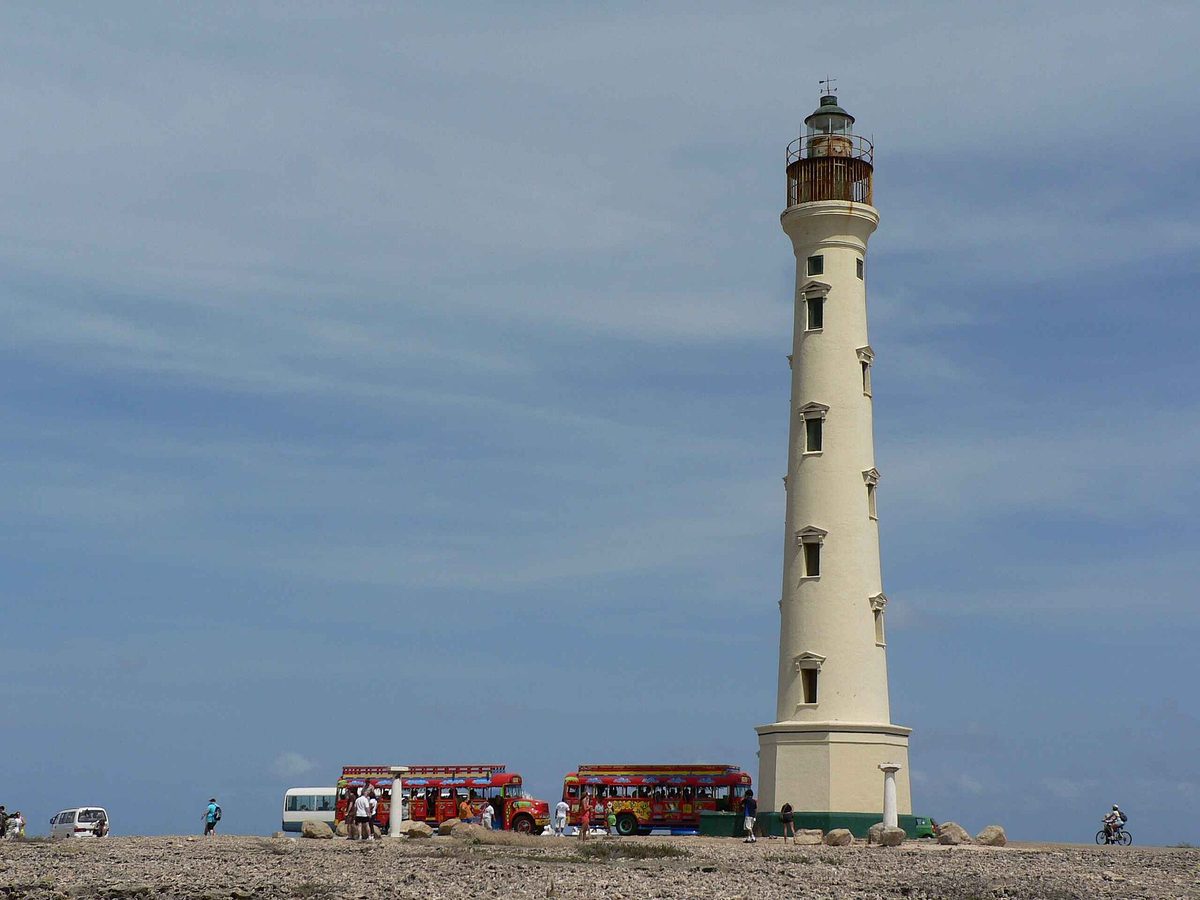
The California Lighthouse Aruba is the white stone tower on the island’s far northwestern point, named after the steamship S.S. California that wrecked nearby in 1891. Built between roughly 1914 and 1916, it stands about 98 feet (30 m) tall on the windswept Hudishibana plateau. It’s free to visit the grounds, around $5 to climb, open daily, and the views — especially at sunset — are the best on the island.
This guide is for anyone trying to figure out whether the lighthouse is worth the trip (it is), how to get there, when to go, what it costs, and how to fold it into a bigger half-day around Aruba’s north tip. I’ll give you the real history, the practical logistics, honest photography advice, and the nearby stops — Arashi Beach, Malmok, the Alto Vista chapel loop — that turn a 20-minute photo stop into one of the best mornings or evenings of your trip. For the wider picture, this is one of the standout entries in our guide to things to do in Aruba.
California Lighthouse Aruba at a glance
| Detail | What to know |
|---|---|
| Location | Hudishibana, northwestern tip of Aruba, in Noord — past Arashi Beach and Malmok |
| What it is | Historic stone lighthouse (c. 1914–1916), the tallest structure on the island |
| Height | About 98 ft (30 m); roughly 120 spiral steps to the top |
| Grounds | Free to walk around, open 24/7 — the plateau is public land |
| To climb inside | Around $5 per person; typically open daily ~9:00 am to 7:00 pm (check the Facebook page) |
| Best time to visit | Sunset, hands down. Early morning is the quiet, cool alternative |
| How long to spend | 20–30 minutes for photos; 1.5–2 hours if you climb, eat, or linger for sunset |
| Getting there | ~20 min drive from Oranjestad, ~11 min from Palm Beach; rental car or taxi is easiest |
| On site | Faro Blanco (Italian restaurant), Yum Yum food truck, parking, big open views |
The story behind the name: a shipwreck, not a state
Here’s the question everyone asks, and the answer surprises most people: the lighthouse has nothing to do with the U.S. state of California. It’s named after a ship. The S.S. California was a wooden British steamship of the West India and Pacific Steamship Company, and on the night of September 23, 1891 — more than two decades before the lighthouse existed — it ran aground and sank just off this stretch of coast while sailing from Liverpool toward the Americas.
There’s a wonderful bit of local folklore attached to it. The ship was carrying merchandise — clothing, provisions, furniture — and a lot of it washed ashore. Locals, being practical people, collected the goods to sell at market. Two police officers were sent over from Curaçao to stop them, and as they tramped around the district of Noord asking where “California” was, the locals reportedly found it hilarious: the officers didn’t realize “California” was the name of a ship, not a place. The name stuck to the whole area, and later to the lighthouse built nearby. Arubans of a certain generation still talk about the “drowned goods” that clothed schoolchildren for years afterward.
One important footnote, because the internet gets this wrong constantly: the S.S. California is not the S.S. Californian, the infamous ship that failed to come to the Titanic’s aid in 1912. Different ship, different ocean, and our California sank 21 years before the Titanic ever set sail. The wreck still lies scattered off the northeast coast at a maximum depth of around 46 feet (14 m), in an area known for strong currents, and it’s a recognized dive site — though it has largely disintegrated into fragments over the past 130-odd years.
A French-designed tower built by donkey
The history of the lighthouse itself is just as good. Back in 1913, Aruba was part of the colony of Curaçao and dependencies, so the request to build a lighthouse out here had to be routed through Curaçao. The design was approved that same year, drawn up by a French architect named Leon Jean Marie Bourgeois. If you look closely at the clean, tapered, slightly Art-Nouveau lines of the tower, you can see the influence of two French icons of the era — the Eiffel Tower and the Cordouan lighthouse, France’s oldest. It sits on an octagonal stone base with a double gallery and a lantern room up top.
Construction ran from about 1914 to 1916, and getting it built out here was no small feat. In 1915 there were no roads to Hudishibana at all — just a single donkey-and-horse path. To haul the stone, lime, cement, tools, and the imported French light all the way from the harbor in Oranjestad to the westernmost point of the island, the builders rented donkeys from a local family, the Figaroas, who lived in Noord. World War I made it even harder: the actual lamp, manufactured by Barbier, Bénard et Turenne in France, was difficult to ship across a wartime Atlantic.
The light first shone in 1918. With no electricity on the island, it burned a kerosene-like fuel the locals called farol, and the rotation was driven by a weighted pendulum — a 79-foot drop that had to be reset every twelve hours. The light ran from six in the evening to six in the morning, cycling thousands of times a night on a single gallon of fuel. It was upgraded to acetylene gas in 1965 and finally electrified in 1970, when it was also automated. The very first keeper was a young man named Jacob Jacobs, who had learned the trade on tiny Klein Curaçao; the last keeper, Federico Fingal, watched over it until 1962. Locals will tell you the isolated keeper’s house was rumored to be haunted — that old service house is now part of the restaurant attached to the tower.
In May 2016 the lighthouse was restored to mark the 100th anniversary of its completion, and that’s when the interior was reopened so visitors could climb to the top. Today it’s a protected cultural-heritage monument, cared for by the Monuments Fund Aruba (Stichting Monumentenfonds Aruba). For an island people sometimes assume is all beach bars and casinos, the California Lighthouse is a genuine, century-old piece of maritime history — and it’s earned its place as one of Aruba’s defining landmarks.
What you’ll actually see up there
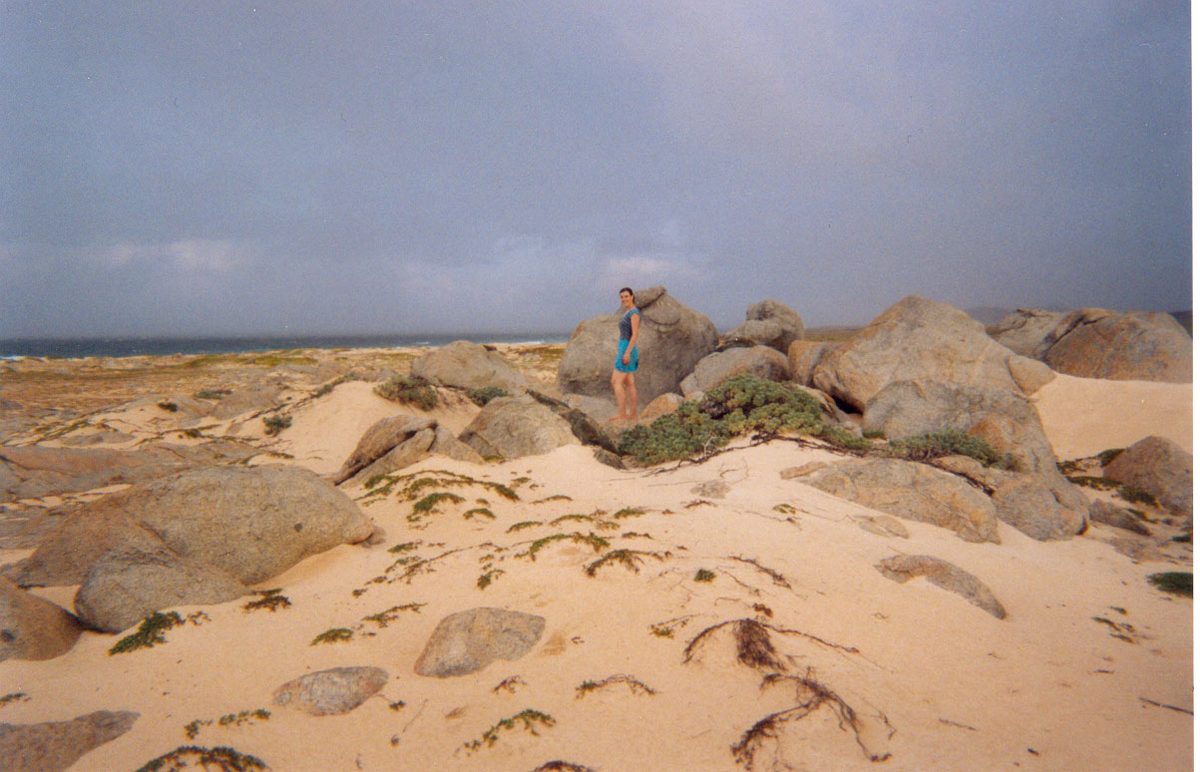
The reason this spot works isn’t really the tower — it’s the position. The lighthouse sits on a bare limestone shelf at the island’s highest seaside point on this end, and because Aruba narrows to almost nothing up here, you can see both coastlines from a single vantage. To the south and east, the calm Caribbean side: the high-rise hotels of Palm Beach, the gentler water, the long sweep toward Oranjestad. To the north and west, the wild side: churning surf, jagged ironshore, and that strange moonscape of pale rock and scrub that makes you forget you’re on a tropical island at all.
The 360-degree panorama
If you climb the tower (more on that below), the reward is a genuine 360-degree view. On a clear day you can pick out the Hooiberg — Aruba’s little haystack-shaped mountain — sitting inland, the resort strip glinting to the south, and nothing but open sea to the horizon in the other direction. Even from the ground, walking a loop around the base gives you most of it. Bring sunglasses; the glare off the white rock and the water is intense, and the wind up here is no joke — it’s one of the breeziest spots on a famously breezy island.
The dunes and the moonscape
Right around the lighthouse are the Sasariwichi dunes — drifts of pale, fine sand piled against dark boulders, with hardy sea grape and divi-divi scrub clinging on. It genuinely does look lunar, which is exactly why so many island Jeep and UTV tours make this their turnaround point. Wear real shoes if you plan to wander off the paved area; the ironshore is sharp and unforgiving, and flip-flops will betray you. It’s a beautiful, slightly otherworldly place to poke around for fifteen minutes while someone in your group is up the tower.
How to get to the California Lighthouse
The lighthouse is at the literal end of the road on Aruba’s northwest tip, in the Noord district, past Malmok and Arashi Beach. The good news: it’s easy to reach and hard to get lost — you basically follow the coast northwest until the pavement runs out at the tower. From downtown Oranjestad it’s about a 20-minute drive; from the Palm Beach high-rise hotels, more like 11 minutes. Here’s how each option really works.
By rental car (my recommendation)
A car is by far the best way to do the lighthouse, mostly because it unlocks everything else nearby and lets you stay for sunset on your own schedule. From Palm Beach or Oranjestad, head northwest on L.G. Smith Boulevard and just keep following the coast; once you pass Arashi the signs to “California Lighthouse” take over for the final stretch. The last bit of road is paved now but can feel a little rugged and potholed — go slow, especially after dark. If you’re weighing whether to rent, our broader rundown of getting to and around Aruba walks through the trade-offs, and a half-day with the lighthouse, Arashi, and Alto Vista is the kind of itinerary a car was made for.
By taxi
Taxis are everywhere in the resort areas and will happily run you out here. Aruba’s taxis use fixed government rates rather than meters, so agree on the fare before you get in — and remember it can get pricey if you’re coming all the way from the south of the island. The smart move is to ask the driver to wait (you’ll pay for the time, but you’re not stranded at the end of a road with no traffic) or to arrange a pickup time. For sunset, build in a buffer; this is not a place where empty taxis cruise by.
By bus
You can do it on the cheap with Arubus. Take the L10 line toward Arashi and ride it to the final stop next to Arashi Beach. From there, though, you’re on foot for the last stretch — it’s roughly a 1.5 km (just under a mile) walk uphill to the lighthouse, exposed and often windy, with no shade. It’s doable for active travelers in the morning; I would not want to do it at midday or be caught walking it back in the dark after sunset. Check return times before you commit.
By organized tour
Almost every island sightseeing tour — Jeep safaris, UTV/ATV adventures, the open-air “kukoo kunuku” party buses, even Segway tours — stops at the California Lighthouse, because it’s the natural northern anchor of any loop. If you’re not renting a car, joining a half-day island tour is a painless way to tick it off alongside other north-side sights. It’s also a good fit if climbing logistics or driving on unfamiliar roads aren’t your thing.
Parking
There’s a free, informal parking area on the rock right by the tower and the restaurant — no machines, no fees, just pull in and find a spot. It rarely fills completely, but it does get busiest in the 60–90 minutes before sunset, when everyone has the same idea. If it’s packed, you’ll find more room down by Arashi Beach and can walk up. Don’t leave valuables visible in the car; it’s a remote spot.
The best time to visit: sunset is the move
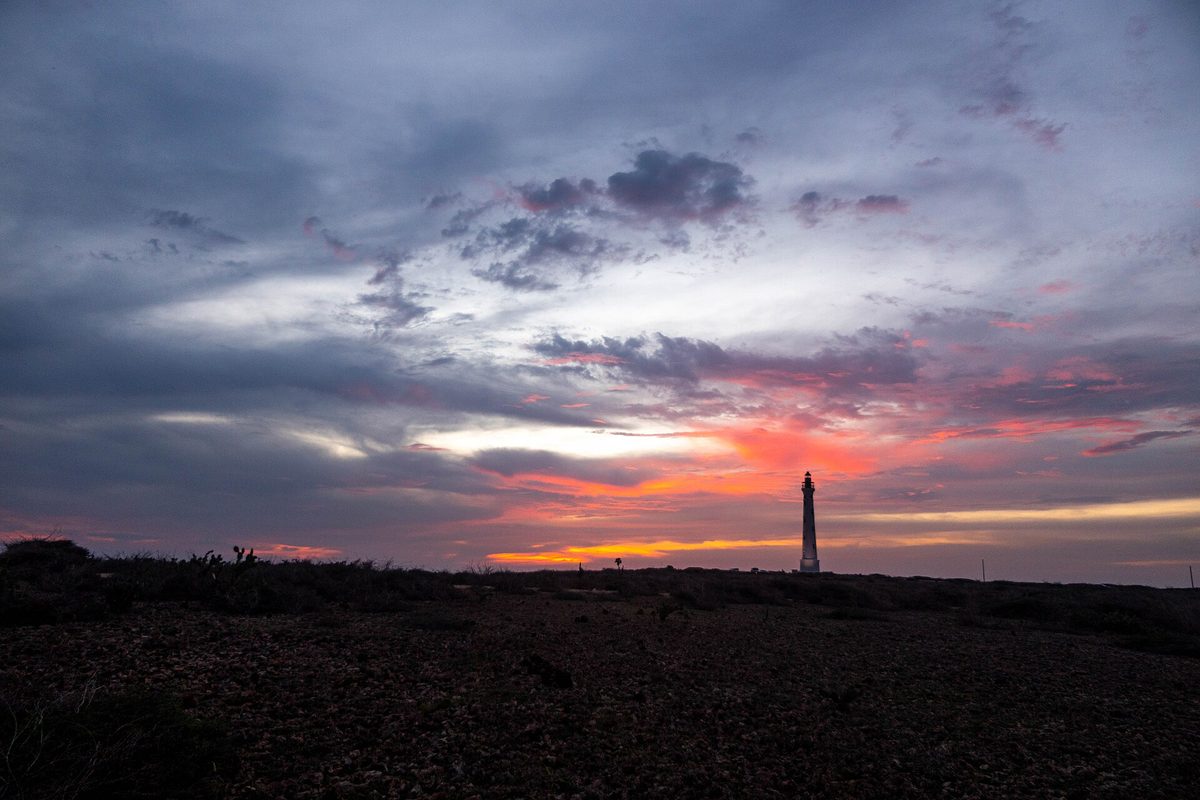
I’ll be blunt: if you only go once, go for sunset. The California Lighthouse faces the open western horizon, sits high above the surrounding land, and has almost nothing to block the view — which makes it the single best sunset spot on Aruba. As the sun drops, the whole sky behind the tower goes orange and pink, the white stone catches the last light, and on a clear evening you might even catch the famous “green flash” the instant the sun disappears into the Caribbean. It’s genuinely special, and it’s free.
A few timing notes from doing this a lot. Aruba sits close to the equator, so sunset lands somewhere around 6:30–7:00 pm most of the year and doesn’t swing wildly by season. Aim to arrive 45–60 minutes early: you’ll get parking, you can climb the tower or grab a drink first, and you’ll be set up when the colors peak. The crowd thins fast once the sun is down, but stick around a few extra minutes — the “afterglow” right after sunset is often the prettiest part, and so is the moment the lighthouse beam clicks on.
That said, sunrise and early morning have their own appeal. From roughly opening time until mid-morning the site is quiet, the light is soft and good for photos of the tower itself, and it’s noticeably cooler before the day heats up. If you’re an early riser, or you want the place more or less to yourself, morning is a lovely and underrated alternative. For how the seasons affect crowds, heat, and daylight, our guide to the best time to visit Aruba is worth a look before you plan.
Can you climb the California Lighthouse?
Yes — and this is the part a lot of older guidebooks get wrong, because for decades you couldn’t. After the 2016 restoration, the interior was reopened, and today you can climb the spiral staircase to the top for a small fee. Expect to pay around $5 per person; there are usually no reservations needed for the basic climb — you just show up, pay at the entrance, and head up. Hours are typically about 9:00 am to 7:00 pm daily, but they shift with private events and season, so it’s worth checking the lighthouse’s Facebook page for the current day’s hours before you make a special trip.
What the climb is actually like
Be honest with yourself about two things: heights and tight spaces. The staircase is a narrow metal spiral — roughly 120 steps — and it winds up inside a slim stone tube with not much room to pass. If you’re claustrophobic, it can feel close; if you have a real fear of heights, the open gallery at the top (around 98 feet up, with the wind ripping past) is a lot. For most people it’s a totally manageable few-minute climb with a huge payoff. It’s not stroller- or wheelchair-accessible, and it’s not ideal for travelers with serious mobility limits, but kids who like a challenge usually love it. Take your time, hold the rail, and let people coming down pass on the wider landings.
If you’d rather not climb
Here’s the thing worth repeating: you do not have to climb to enjoy this place. The grounds are free and open, and honestly most of the magic — the 360 outlook, the sunset, the moonscape, the photos — is available from the base. Plenty of people I’ve brought out here never go up the tower at all and leave thrilled. So if the staircase isn’t for you, skip it guilt-free and just walk the plateau.
Faro Blanco: dinner with a lighthouse view
Tucked right against the base of the tower — in what was once the keeper’s service house — is Faro Blanco (you’ll also see it written as El Faro Blanco or “La Trattoria el Faro Blanco”), an Italian restaurant with one of the most romantic settings on the island. The food is classic trattoria — pasta, seafood, Italian mains — but the real draw is the location: terraced seating on the hillside looking out over the coast, with the white lighthouse rising behind you and the sunset doing its thing in front. It is, unsurprisingly, a popular spot for couples and special occasions.
If you want a sunset table, reserve ahead — this is one of the most sought-after dinner views in Aruba and it books up, especially in high season. Prices sit at the higher end, which fits the setting and the view you’re paying for. There’s also usually a little Yum Yum food truck parked outside the lighthouse for a cheap cold drink, a coconut, or a popsicle if you’re not after a full sit-down meal. For more options across the island, see our guide to Aruba restaurants, and because this is such a classic romantic outing, it also features in our Aruba honeymoon planning.
Photography tips for the California Lighthouse
This is one of the most photogenic spots on Aruba, and a little planning makes a big difference. A few things I’ve learned shooting it over the years:
- Shoot the “golden hour,” then stay for “blue hour.” The 30 minutes before sunset gives you warm light on the tower; the 20 minutes after gives you that deep blue sky with the lighthouse beam on — often the more dramatic shot.
- Use the dunes and boulders as foreground. A bare tower against the sky is fine, but framing it with the pale sand, a divi-divi branch, or the dark ironshore rock gives the photo depth and a real sense of place.
- Get low for the classic silhouette. Crouch so the lighthouse breaks the horizon against the colored sky — that’s the postcard shot, and it hides the parking area and crowds.
- Mind the wind. It’s gusty up here. Brace your phone or camera, weight a tripod down, and protect your lens from blowing sand near the dunes.
- Climb for the aerial-style view. From the top gallery you can shoot straight down both coastlines — a perspective you can’t get from the ground.
- Go wide, then go tight. Capture the whole sweep, then zoom in on the lantern room and the weathered stonework for variety.
Combine it with these north-tip stops
The smartest way to “do” the California Lighthouse is to treat it as the anchor of a half-day on Aruba’s north and west tip, because some of the island’s best beaches and quirkiest sights are within a few minutes’ drive. Here’s how I’d string them together.
Arashi Beach
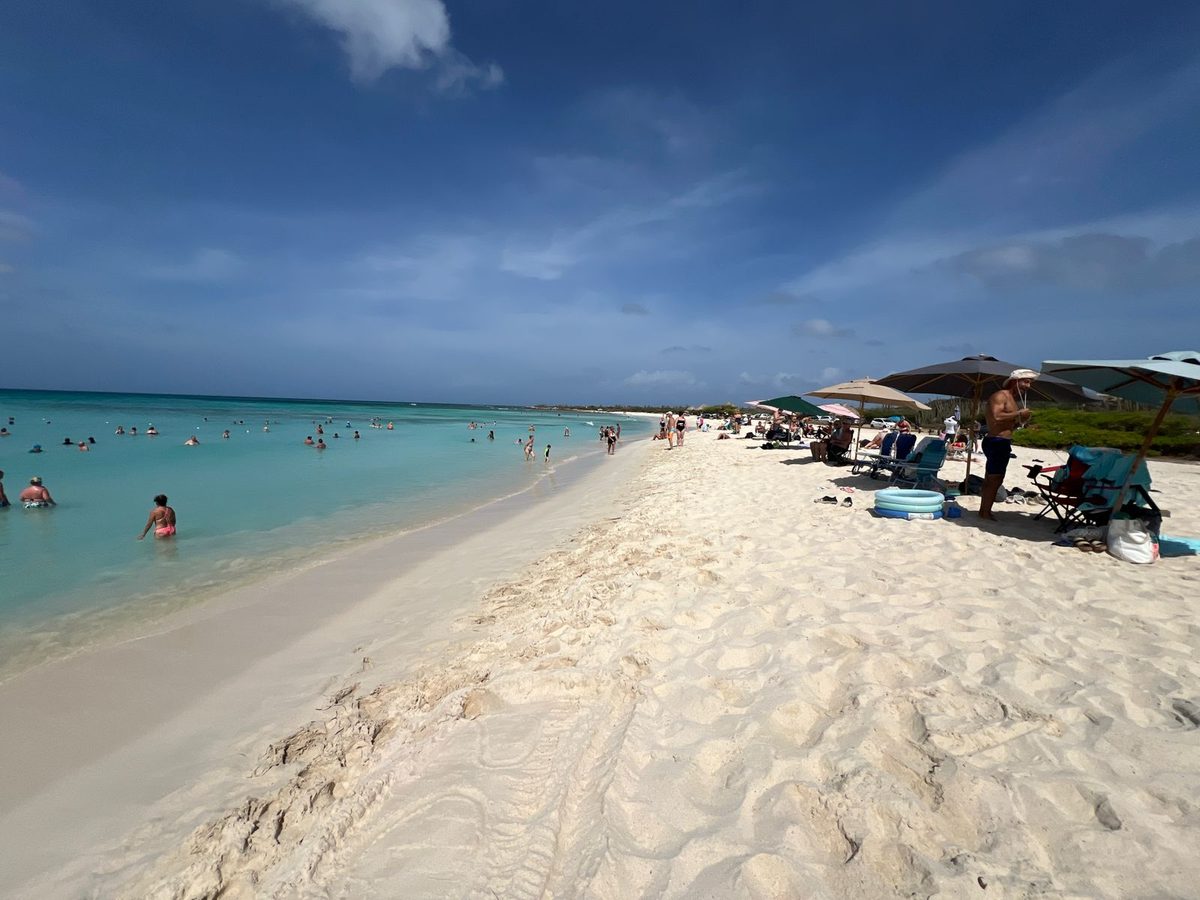
Arashi is the closest beach to the lighthouse — just a few minutes back down the road — and it’s the obvious pairing. It’s a calm, white-sand cove with clear, shallow water, a small beach shack for snacks and drinks, and decent snorkeling around the rocks at either end. It’s noticeably more laid-back than the busy resort beaches; locals come here on weekends. I love doing Arashi in the late afternoon for a swim, then driving five minutes up to the lighthouse for sunset. For the full lineup of sand, see our complete guide to Aruba’s beaches.
Malmok Beach and the snorkeling
Just south of Arashi, Malmok is less a sunbathing beach (it’s rocky, with little sand) and more a snorkeling and swimming spot, with some of the clearest water on the island. It’s also the jumping-off area for boats heading to the Antilla shipwreck, one of the Caribbean’s largest wreck dives. If snorkeling or diving is your thing, this whole northwest stretch is gold — our guide to Aruba water sports covers the wrecks, reefs, and where to rent gear.
Boca Catalina
Between Malmok and Arashi, tiny Boca Catalina is a sheltered little bay that’s a favorite for snorkeling — calm, clear, and full of fish, with easy entry. It’s small and can get busy, but it’s a lovely quick stop and another good swim before or after the lighthouse.
The Alto Vista Chapel loop
A little inland and to the east, the Alto Vista Chapel is a bright-yellow pilgrimage chapel set on a hill amid cactus and rolling scrub — peaceful, photogenic, and steeped in history as the site of Aruba’s first Catholic church. Many visitors connect it with the lighthouse on a north-side loop, sometimes continuing on the rough roads toward the ruins of the Bushiribana gold mill and the Natural Bridge area on the wild north coast. If you’re up for some unpaved adventure, this side of the island rewards it.
Make a half-day of it: a sample plan
If I were handing a friend a simple plan, it would look like this: start mid-to-late afternoon with a swim and snorkel at Arashi or Boca Catalina, dry off and drive five minutes to the California Lighthouse about an hour before sunset, walk the grounds and climb the tower while the light is good, then either grab a sunset table at Faro Blanco or simply post up on the rocks with a cold drink from the food truck and watch the sky go orange. Add the Alto Vista Chapel on the way out if you have a car and want one more stop. That’s a near-perfect Aruba afternoon, and it slots neatly into any Aruba itinerary.
Is the California Lighthouse worth visiting?
Yes — with one honest caveat. The lighthouse is not a “destination” you spend hours at on its own; the tower is small, the climb is brief, and if you drove all the way out at high noon just to look at it for ten minutes, you might feel slightly underwhelmed. But that’s the wrong way to use it. Go for the setting — the 360 views, the moonscape, and above all the sunset — and pair it with the nearby beaches, and it becomes one of the most memorable, most photographed, and most genuinely Aruban things you’ll do. It’s free to enjoy the grounds, cheap to climb, and unforgettable at the right hour. I send everyone here.
By type of traveler
Couples
This is prime romance territory: sunset at the lighthouse followed by dinner at Faro Blanco is one of the most romantic evenings on the island. Reserve a sunset table well ahead.
Families with kids
Kids who like a challenge love climbing the tower, and the open space at the base lets them run off energy. Combine with the calm, shallow water at Arashi for an easy half-day. Just mind the narrow staircase with very young children, and keep an eye on the sharp rocks. See our guide to Aruba with kids for more family-friendly pairings.
Budget travelers
It’s one of the best free attractions on the island — the grounds and the sunset cost nothing, and the climb is only about $5. Skip the pricey dinner, grab a drink from the food truck, and you’ve got a top-tier evening for almost nothing. More money-saving angles are in our Aruba vacation cost guide.
Adventure seekers
The north tip is the launch pad for Jeep and UTV tours, the rough road out to the Natural Bridge, and the Antilla wreck dive off Malmok. Use the lighthouse as your scenic turnaround on a wilder day exploring the island’s untamed coast.
Practical tips before you go
- Wear real shoes if you’ll explore the dunes or ironshore — flip-flops don’t cut it on the sharp rock.
- Bring water, sunglasses, and sunscreen. There’s almost no shade, and the glare and wind are strong.
- Time it for sunset (or early morning) and check the climb hours on the lighthouse’s Facebook page first.
- Reserve Faro Blanco ahead if you want a sunset table.
- Don’t leave valuables in the car — it’s a remote lot.
- Drive carefully on the final stretch, especially after dark; the road is paved but rough in spots. Our Aruba travel tips cover driving, safety, and etiquette.
Frequently asked questions
Why is it called the California Lighthouse?
It’s named after the S.S. California, a British steamship that sank just off this coast on September 23, 1891 — years before the lighthouse was built. The wreck (and a bit of local folklore involving confused police officers) gave the whole area its name. It has nothing to do with the U.S. state, and it is not the S.S. Californian of Titanic infamy — that’s a different ship entirely.
Can you go inside and climb the California Lighthouse?
Yes. Since the 2016 restoration you can climb the spiral staircase — roughly 120 steps — to the gallery near the top for panoramic views. It typically costs around $5, with no reservation needed. The staircase is narrow and the top is about 98 feet up, so it’s not ideal for anyone with serious claustrophobia or a strong fear of heights.
How much does it cost to visit?
Walking the grounds and watching the sunset is completely free. Climbing the tower is around $5 per person. Dinner at Faro Blanco is a separate, higher-end expense, and the little food truck outside sells cheap drinks and snacks.
What are the California Lighthouse opening hours?
The outdoor grounds are open and free 24/7. To climb inside, the lighthouse is generally open daily from about 9:00 am to 7:00 pm, though hours change for private events and by season. Check the official California Lighthouse Facebook page for the current day’s hours before making a special trip.
What is the best time to visit the California Lighthouse?
Sunset, without question — it’s the best sunset spot on Aruba, with open western views and a chance at the green flash. Arrive 45–60 minutes early for parking and the climb. Early morning is the quiet, cooler alternative if you’d rather avoid crowds.
How do you get to the California Lighthouse?
It’s on Aruba’s northwestern tip in Noord, past Arashi Beach — about a 20-minute drive from Oranjestad or 11 minutes from Palm Beach. A rental car or taxi is easiest; the L10 Arubus runs to Arashi Beach (then it’s about a 1.5 km walk), and most island tours stop here too.
How tall is the California Lighthouse and how old is it?
It stands about 98 feet (30 meters) tall — the tallest structure on Aruba — and was built around 1914–1916, with its light first shining in 1918. It was designed by French architect Leon Jean Marie Bourgeois and restored in 2016 for its 100th anniversary.
Is the California Lighthouse worth it?
Absolutely, if you go for the setting rather than the building alone. The 360-degree views, the moonscape dunes, and especially the sunset make it one of Aruba’s signature experiences — and pairing it with Arashi Beach or dinner at Faro Blanco turns a quick photo stop into a highlight of the trip.
Final thoughts
That rough road I almost turned around on? I’m glad I didn’t, and I’ve talked a lot of friends out of doing the same. The California Lighthouse rewards you for going a little farther than the resort strip — for trading the umbrella-lined sand for a windy plateau where you can see the whole island at once and watch the sun fall into the sea behind a century-old French tower. Time it for golden hour, bring good shoes and a camera, fold in a swim at Arashi and maybe a plate of pasta at Faro Blanco, and you’ll understand why this lonely white lighthouse keeps ending up on everyone’s “best of Aruba” list. It’s earned it.
For more landmarks, beaches, and natural wonders to build your trip around, head back to our hub on things to do in Aruba, or read up on the island’s wild interior in our guide to Arikok National Park and where to base yourself in where to stay in Aruba.
Sources
Historical details (construction dates, the S.S. California wreck, the lighthouse’s design and keepers) draw on the Monuments Fund Aruba (Stichting Monumentenfonds Aruba), the public record compiled on Wikipedia’s California Lighthouse entry, and the Aruba Tourism Authority’s official site, aruba.com. Visitor information (hours, the ~$5 climb fee) reflects publicly posted details at the time of writing; because hours change with private events and season, always confirm current times on the lighthouse’s official Facebook page before you go.
Photo credits
All images via Wikimedia Commons, used under their respective licenses.
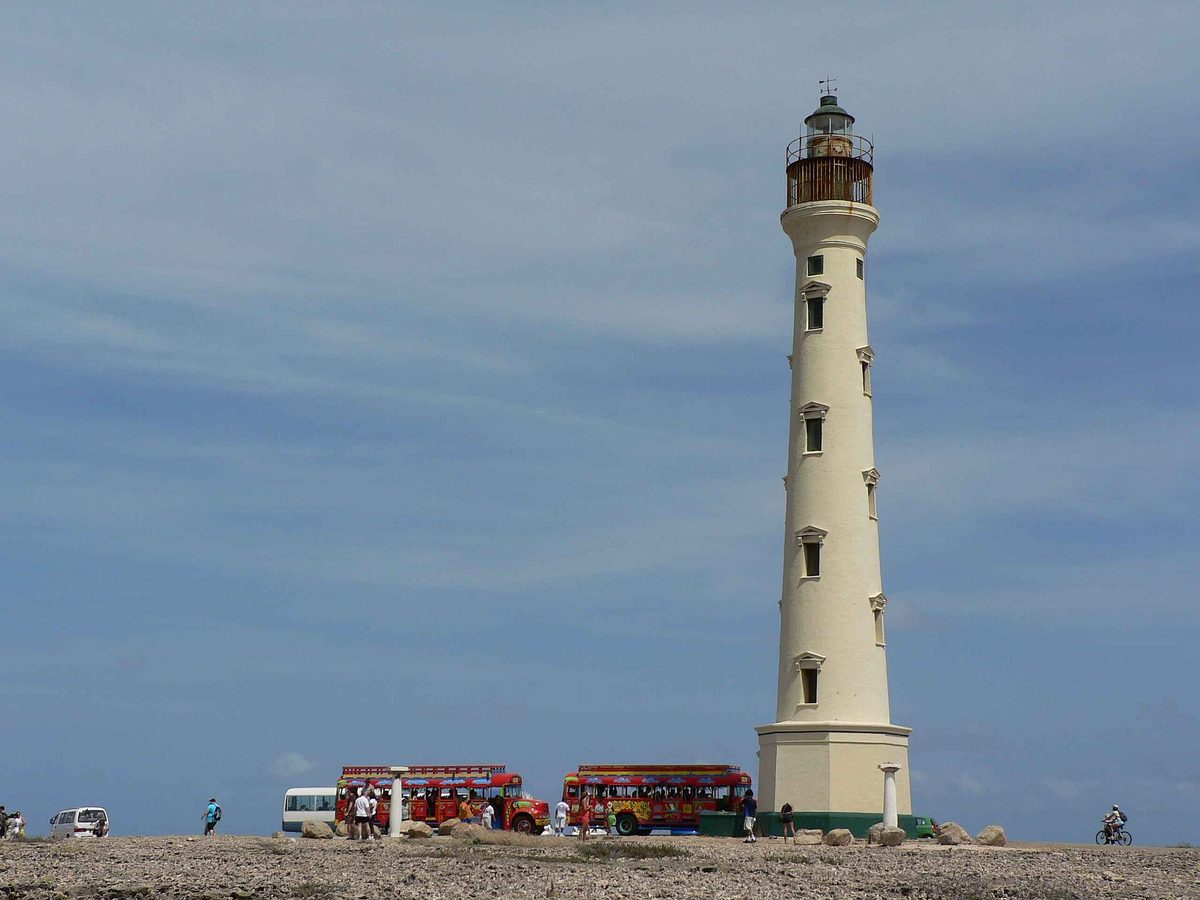
California Lighthouse on its Hudishibana plateau — David Stanley (CC BY 2.0).
Sunset behind the lighthouse — Noshha.photography (CC BY-SA 4.0).
Arashi Beach — Kwihi (CC BY 4.0).
Sand dunes near the lighthouse — David et Magalie (CC BY 2.0). Tour buses at the lighthouse by David Stanley (CC BY 2.0).