What do you actually want from five days on Aruba: more beach, more adventure, or a balance of both? Be honest with yourself before you book a single tour, because it changes everything. If you crave nothing but a lounger and a rum punch, you can absolutely do that here. But the people who come home raving are usually the ones who plan a proper 5 day Aruba itinerary built around balance: two or three slow beach mornings, one big adventure day in the desert interior, a sunset cruise, and just enough Oranjestad to feel like you saw the island and not only your resort pool. That is the trip I am going to map out for you, hour by hour.
Five days is genuinely the sweet spot. It is long enough to recover from the flight, settle into island time, do the one or two experiences worth booking ahead, and still leave a day where you do absolutely nothing. After helping plan dozens of these trips, I have one strong opinion: do not over-schedule. Aruba rewards the people who slow down.
The short answer: what a perfect 5-day Aruba itinerary looks like
A great 5-day Aruba itinerary blends three or four relaxed beach mornings on Eagle and Palm Beach with one full adventure day in Arikok National Park, a sunset catamaran cruise, a half-day in Oranjestad, and an easy departure. It suits couples, first-timers, and families who want sun plus a little exploring, without rushing or renting a car every single day.
Your 5 days in Aruba at a glance
Here is the whole plan on one screen. Each day is built around a relaxed morning, a flexible afternoon, and a memorable evening, so you are never sprinting from thing to thing. Times are deliberately loose; this is a vacation, not a bus tour.
| Day | Morning | Afternoon | Evening |
|---|---|---|---|
| Day 1 — Arrive & settle | Land, taxi to hotel, grab lunch | Eagle Beach toes-in-sand, easy swim | Sunset + casual dinner at Palm Beach |
| Day 2 — Palm Beach & water | Snorkel at Boca Catalina / Catalina Bay | Palm Beach loungers, De Palm Pier | Sunset catamaran cruise (book ahead) |
| Day 3 — Adventure day | Arikok National Park + Natural Pool (4×4) | Baby Beach swim & San Nicolas murals | Quiet dinner, early night |
| Day 4 — Oranjestad & culture | Oranjestad stroll, free streetcar, shopping | California Lighthouse + Arashi Beach | Pelican Pier or Zeerovers seafood |
| Day 5 — Slow goodbye | Last beach walk, swim, breakfast | Pack, late checkout, airport | Fly home |
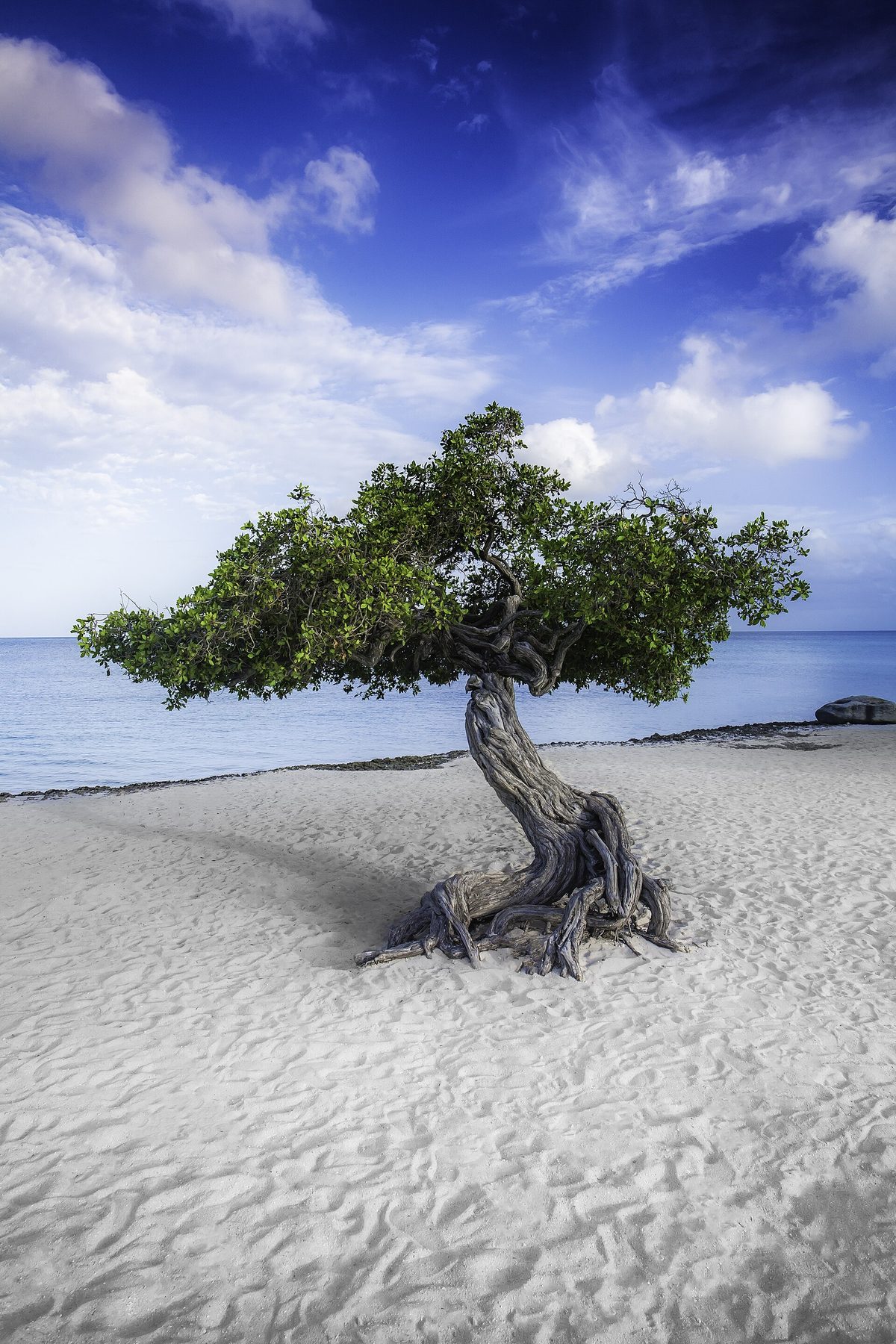
Before we dive into the day-by-day, a quick orientation. Aruba is small — roughly 20 miles long — and almost everything you will want sits on the calm, leeward western and southern coasts. The hotel zone splits into two strips: Eagle Beach (low-rise, wider, quieter) and Palm Beach (high-rise resorts, restaurants, watersports, the buzz). The capital, Oranjestad, is a 10–15 minute drive south. The wild interior and the rugged windward coast — Arikok National Park, the Natural Pool, Baby Beach — are out east, 35–60 minutes away depending where you start. Keep that mental map and the plan below makes sense. For the bigger picture, our complete Aruba itinerary planning guide compares trips from one day to two weeks.
Day 1: Arrive, exhale, and find your feet on Eagle Beach
Most flights from the US East Coast land early-to-mid afternoon (it is about 4.5 hours from New York, 3 from Miami), so Day 1 is intentionally light. Do not try to cram a tour into it. You will be tired, possibly sunburned-eager, and the best first impression of Aruba is simply standing on a beach at sunset.
Afternoon: hotel check-in and a gentle beach
Clear immigration — it can be slow, so be patient — grab your bags, and take a taxi to your hotel. Airport taxis are fixed-rate: expect around $25–$35 to the Eagle Beach / Palm Beach resorts (it is a flat island tariff, not metered, and there is a small surcharge after midnight and on Sundays). Once you have dropped bags, walk straight to the sand. If you are at Eagle Beach, find the famous fofoti trees (the wind-bent trees everyone photographs — often mislabeled “divi-divi”). Float, do not snorkel; you are acclimating.
Where to eat tonight: keep it easy and close. The West Deck near Surfside Beach does island-Caribbean small plates with your feet near the water (mains around $18–$30). Or grab a casual bite at one of the Palm Beach strip spots. Have one drink, watch the sun drop — sunset is around 6:45–7:00 pm most of the year — and get an early night.
Swap this if… you land late: skip the beach, do a poolside dinner at your resort, and roll Day 1’s beach time into Day 2’s morning. Do not feel you have “lost” a day; you gained sleep.
Day 2: Palm Beach, snorkeling, and a sunset catamaran
Today is your classic Aruba beach-and-water day, and it ends with the single experience I would book before you even pack: a sunset sail. This is the day to lean into why people fly here.
Morning: snorkel at Boca Catalina
Head to Boca Catalina, a small protected cove on the northwest coast near Malmok. The water is clear and calm, and you will often see sergeant majors, parrotfish, and sometimes green sea turtles right off the rocks. It is free, but there is almost no shade and limited parking, so go by around 9 am. Bring your own mask or rent one ($10–$15/day from a dive shop). If you would rather have it organized, plenty of Aruba water sports operators run morning snorkel trips to Catalina and the Antilla shipwreck for roughly $45–$70 per person.
Afternoon: Palm Beach loungers and a piña colada
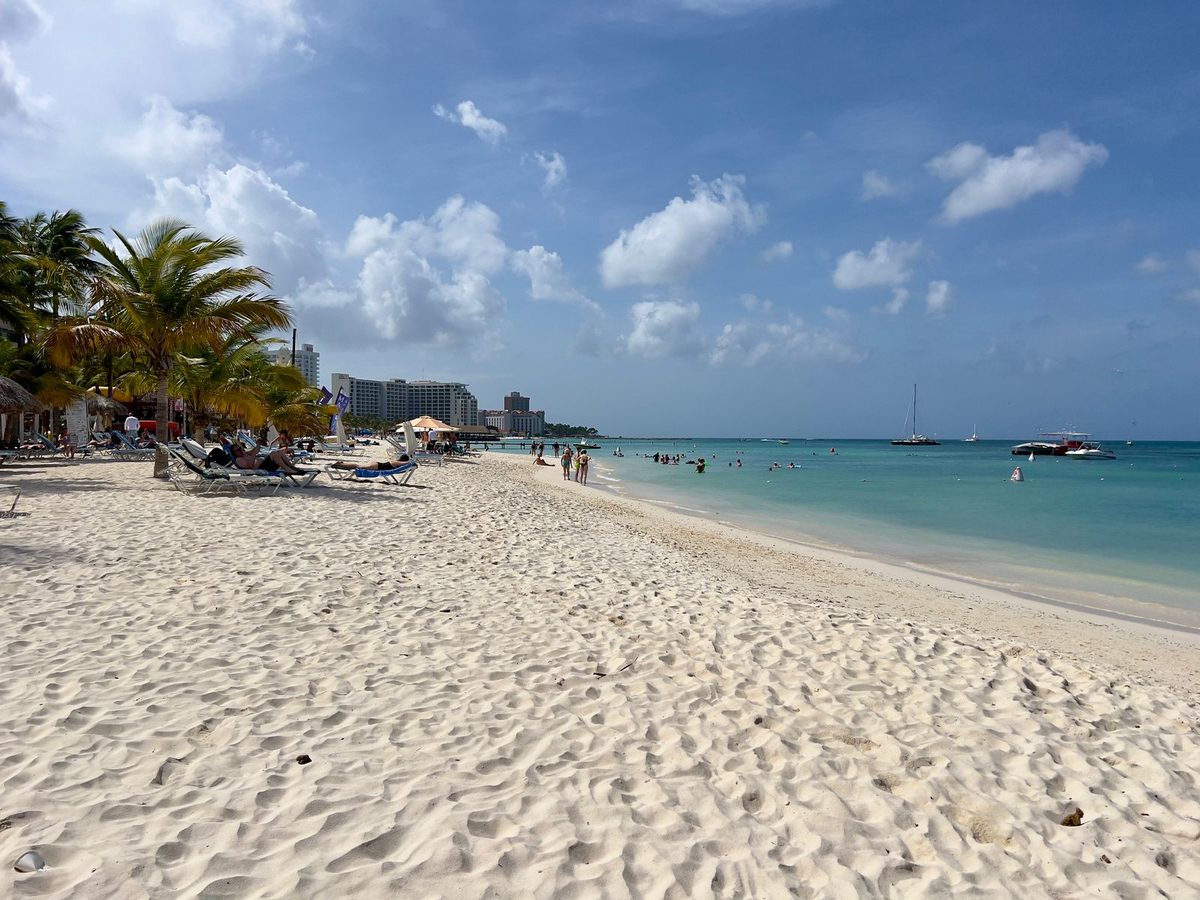
Migrate to Palm Beach for the full resort-beach experience: palapas, beach bars, jet-skis buzzing offshore, and people-watching. If you are not staying on Palm Beach, you can still use the public beach (all Aruba beaches are public) — just buy a drink at a beach bar to use a lounger, or rent a palapa set. Bugaloe on De Palm Pier is the easy choice for a long lunch over the water; expect around $14–$22 for mains and live music many afternoons.
Evening: sunset catamaran cruise
This is the splurge that everyone is glad they made. A two-hour sunset sail with open bar and snacks runs around $59–$95 per person (operators like Red Sail, Octopus, Jolly Pirates, and Pelican). You glide along the calm west coast, the high-rises glow gold, and the bar is open. Book at least two or three days ahead in high season — the good sunset slots sell out. Dinner afterward can be late and casual; you will be happy and a little sun-kissed.
Swap this if… you have kids who melt down at night: do a daytime snorkel sail (often the same operators, 9 am–1 pm, with a swim stop at the Antilla wreck) and keep the evening mellow at the resort.
Day 3: The big adventure day — Arikok, the Natural Pool, and Baby Beach
If your 5 day Aruba itinerary has one “wow” day, it is this one. The eastern interior is a different planet from the resort strip: cactus, divi-divi trees bent flat by the trade winds, gold-mine ruins, sea caves, and a natural rock pool where waves crash over the rim. Just know up front: you need a 4×4 to reach the Natural Pool (Conchi/Cura di Tortuga). A regular rental car cannot do it.
How to do it: tour vs self-drive
You have two good options. Book a guided 4×4, ATV, or UTV tour (roughly $85–$130 per person for a half-day with the Natural Pool, often including park entry, lunch, and snorkel gear) — easiest, no stress, someone else drives the brutal trail. Or rent your own Jeep Wrangler for the day (around $110–$160/day) and self-drive, which gives you total freedom but real responsibility on rough terrain. Arikok entry is around $11–$22 per adult depending on the current tariff (kids under 18 free); the park is open daily roughly 8 am–4 pm, and the San Fuego/Santa Cruz entrance opens earlier than the Vader Piet side. Buy tickets in advance online when you can.
Inside Arikok National Park
Inside the park, hit the highlights: the Natural Pool for a swim in the “natural jacuzzi,” Conchi and the dramatic windward cliffs, the Quadirikiri and Fontein caves (Fontein has Arawak rock drawings and resident bats), and Boca Prins with its surprising sand dunes. It is hot, dry, and shadeless — bring more water than you think you need, reef-safe sunscreen, real shoes, and a hat. Our full Arikok National Park guide breaks down every trail, cave, and entrance gate in detail.
Afternoon: Baby Beach and San Nicolas
From the park, work your way down to the island’s southern tip and Baby Beach — a shallow, calm, kid-perfect lagoon that is ideal after a dusty morning. There is a snack bar and palapas. On the way back, swing through San Nicolas, Aruba’s “Sunrise City,” now covered in huge, colorful street-art murals from the annual art festival. It is the most underrated 30 minutes on the island. Grab a cold drink at Charlie’s Bar, a wonderfully cluttered institution open since 1941.
Where to eat: if timing lines up, detour to Zeerovers in Savaneta — a no-frills, dock-side fish shack where you order fresh catch by the pound, fried, with funchi and plantain. It is a local legend and stays cheap (a big plate for around $15–$20).
Swap this if… rough 4×4 trails are not your thing: skip the Natural Pool and do a relaxed island sightseeing tour that hits the California Lighthouse, the Alto Vista Chapel, the Casibari rock formations, and the Natural Bridge ruins — all reachable by paved road in a normal car.
Day 4: Oranjestad, the north tip, and a seafood sunset
After yesterday’s dust and adrenaline, Day 4 dials it back into culture, color, and easy sightseeing. This is your “see the rest of the island” day, and none of it requires a 4×4.
Morning: Oranjestad and the free streetcar
Spend the morning in Oranjestad, the pastel Dutch-Caribbean capital. Ride the free open-air streetcar down Caya Betico Croes, browse the boutiques and the Renaissance Mall, and snap the candy-colored colonial buildings. If you like a little history, the small Fort Zoutman / Historical Museum and the Archaeological Museum (free) are both quick and worthwhile. Shopping is duty-free-ish and the cruise-port area can get busy mid-morning, so go early. For more ideas, see our roundup of things to do in Aruba beyond the beach.
Afternoon: California Lighthouse and Arashi Beach
Drive (or taxi) up to the island’s breezy northwest tip for the California Lighthouse, with big ocean views and a couple of restaurants nearby for lunch (Faro Blanco has the postcard view). Just below, Arashi Beach is a quieter, snorkel-friendly stretch that locals love and a perfect spot to ride out the afternoon. If you would rather not drive, this whole north loop is a standard stop on most island tours.
Evening: a proper seafood dinner
Tonight, eat well. Pelican Nest and Pinchos Grill & Bar (built on a pier over the water in the marina) are both lovely for a sunset seafood dinner with your feet near the waves; mains land around $28–$45. If you would rather stay casual and local, circle back to the Zeerovers/Charlie’s energy. However you do it, toast the trip — you have earned it. Hungry for more options? Our Aruba restaurants guide covers everything from food trucks to fine dining.
Swap this if… you want nightlife instead: Palm Beach lights up after dark with bars, the casinos, and the occasional bonfire party. See our Aruba nightlife guide for where the night actually happens.

Day 5: One last slow morning, then home
Resist the urge to schedule anything ambitious on your last day. Departure flights to the US tend to leave in the afternoon or early evening, and Aruba uses US pre-clearance, meaning you clear US Customs and Immigration in Aruba before you fly — so you land back home as a domestic arrival, but you also need to be at the airport early. Plan to be there about 3 hours before your flight; the pre-clearance lines can be long.
So: sleep in, have a long breakfast, take one final swim and a slow walk on Eagle Beach to bank the memory. Ask your hotel about a late checkout (many will hold your bags even if they cannot extend the room). Then taxi back to the airport with time to spare. Grab a last Balashi beer airside and toast One Happy Island.
Swap this if… you have a red-eye-style late flight: add a final easy activity — an aloe factory tour, the Butterfly Farm near Palm Beach, or one more beach — but keep it within 15 minutes of your hotel so you are never rushing for the airport.
Where to stay for this itinerary
For a balanced 5-day trip, base yourself on the Eagle Beach or Palm Beach strip. The two are only a few minutes apart but feel different, and which you pick shapes the vibe of your whole week.
- Palm Beach (high-rise zone): the big resorts (Marriott, Ritz-Carlton, Hilton, Hyatt, the Riu and Barceló all-inclusives), the most restaurants and bars within walking distance, casinos, and watersports right off the sand. Best if you want energy, convenience, and nightlife on your doorstep.
- Eagle Beach (low-rise zone): wider, quieter, often-rated-best-in-the-world beach; boutique and mid-rise properties (Bucuti & Tara, Amsterdam Manor, MVC Eagle Beach). Best for couples and anyone who wants calm.
- Oranjestad / Manchebo area: good value, closer to town, a short hop to either beach.
If you want everything bundled, an all-inclusive can be great value for five days of meals and drinks — compare options in our guide to Aruba all-inclusive resorts. Still weighing neighborhoods and property types? Our where to stay in Aruba guide goes deeper on every area.
Getting around: rental car vs taxi vs Arubus
You do not need a car for all five days, and renting one for the whole trip is often wasted money since you will spend three days near your hotel. Here is how I would mix it:
- Rental car (economy ~$45–$65/day): worth it for one or two days if you want to self-drive Oranjestad, the north tip, and the paved sightseeing loop. Roads on the west side are easy; just avoid the unpaved interior in a 2WD.
- 4×4 Jeep (~$110–$160/day): only if you are self-driving the Natural Pool on Day 3. Otherwise, let a tour handle that.
- Taxis: fixed island rates (no meters). Airport to the resorts runs about $25–$35; short hops within the hotel zone are roughly $10–$15. Convenient but adds up fast for a family.
- Arubus (public bus): the budget hero. The Line 10 runs between Oranjestad and the hotel strips frequently. One-way is around $2.60, a round-trip about $5, and an all-day pass roughly $10 (pay in cash, exact-ish). Buses run about every 15 minutes during the day. Great for the Oranjestad day.
My honest recommendation for most couples: taxi from the airport, walk and Arubus near your hotel, take one organized tour for the Natural Pool day, and rent a car for just the one Oranjestad/north-tip day. You will spend less and stress less. For the full breakdown, see getting to and around Aruba.
Best time to go (and how it changes this plan)
Aruba is a year-round, outside-the-hurricane-belt destination — it rarely gets storms and stays warm (mid-80s °F) all year. That is a big part of the appeal. A few timing notes that affect a 5-day trip:
- High season (mid-December–mid-April): driest, busiest, priciest. Book tours and sunset cruises well ahead. The trade winds are strongest, which keeps it comfortable but can affect snorkeling on exposed coasts.
- Shoulder (May–June, November): my favorite — great weather, thinner crowds, better rates. (June, when you may be reading this, is lovely and quieter.)
- Low season (September–November): Aruba’s slightly wetter months, but rain usually comes in short bursts. Best value, and the sea is often calmest.
Whatever month you choose, the day-by-day structure above holds; you are mostly adjusting how far ahead you book. For the full month-by-month rundown, see the best time to visit Aruba.

A sample 5-day Aruba budget
What does five days actually cost? Aruba is not a cheap-flights-and-hostels island; it skews mid-to-upscale. But you have real control over the total. Here is a realistic per-person estimate for a couple sharing a room (excluding international airfare), at two comfort levels. Treat every figure as “around” — prices drift with season and exchange rates. For the whole-trip version of this math, flights included, see what an Aruba vacation actually costs.
| Category (per person, 5 days) | Mid-range | Comfortable |
|---|---|---|
| Hotel (share of double room) | ~$650 | ~$1,300 |
| Food & drink | ~$350 | ~$600 |
| Sunset cruise | ~$80 | ~$95 |
| Natural Pool tour (or Jeep day) | ~$110 | ~$130 |
| Snorkel gear / minor activities | ~$40 | ~$70 |
| Car for 1 day + fuel | ~$35 | ~$60 |
| Taxis / Arubus | ~$45 | ~$70 |
| Approx. total (excl. flights) | ~$1,310 | ~$2,355 |
Ways to trim it: choose an all-inclusive to cap food and drink, ride the Arubus instead of taxis, skip the Jeep rental in favor of a shared tour, and travel in shoulder season. Ways it balloons: peak-season high-rise rooms, fine-dining every night, and private tours. For a complete breakdown including flights and hidden fees, see our Aruba vacation cost guide.
Day trips and adventure add-ons (if you want more)
The core plan leaves room to swap in something special. A few add-ons worth considering for a 5-day window:
- UTV / ATV self-drive safari: a louder, dustier alternative to the Jeep tour, hitting the Natural Pool, caves, and north coast (~$99–$145 pp). A blast if you like to drive.
- Horseback riding on the beach or through Arikok: sunset rides are popular and photogenic (~$85–$120 pp).
- Scuba diving the Antilla wreck: one of the Caribbean’s best shallow wrecks; a two-tank dive runs around $90–$120 for certified divers, or do a “discover scuba” intro.
- De Palm Island: an all-in-one snorkel-and-waterpark day island, handy for families (day passes roughly $100–$130 pp).
- Stand-up paddleboarding or kitesurfing at Fishermen’s Huts / Hadicurari, where the wind is reliable.
For more ways to fill flexible hours, browse the best things to do in Aruba and our list of free things to do if you are watching the budget.
What to skip on a 5-day trip
Five days is generous but not infinite. A few honest “do not bother” calls so you spend your time well:
- Renting a car for all five days. You will park it for three of them. Rent for one.
- Trying to “see everything.” Aruba is small, but the interior is slow going. Pick the Natural Pool or a full island loop on your adventure day, not both.
- Two separate boat trips. A sunset sail and a snorkel sail overlap a lot. One is plenty for five days unless you adore being on the water.
- A packed last day. Pre-clearance eats your departure morning. Keep Day 5 lazy.
- Over-booking dinners. Some of the best meals (Zeerovers, the food trucks at the Paseo Herencia area, a casual beach bar) are spontaneous. Leave a couple of nights open.
Traveling with little ones or planning a romantic five days? We have dedicated guides for Aruba with kids and the Aruba honeymoon that tweak this plan for your crew. And first-timers should skim our Aruba travel tips before they fly.

5 day Aruba itinerary FAQs
Is 5 days enough in Aruba?
Yes — five days is widely considered the sweet spot for Aruba. It is long enough to enjoy several beach days, do one big adventure (the Natural Pool and Arikok), take a sunset cruise, and see Oranjestad, while still leaving downtime to relax. Because the island is small, you can cover the highlights without ever feeling rushed.
How much does 5 days in Aruba cost?
For a couple sharing a room, budget roughly $1,300–$2,400 per person for five days excluding international flights, depending on whether you stay mid-range or upscale. That covers your hotel, food and drink, a sunset cruise, a Natural Pool tour, and local transport. All-inclusive resorts and shoulder-season travel can lower the total noticeably.
Do I need a rental car for a 5-day Aruba itinerary?
Not for the whole trip. Most travelers do best taking a taxi from the airport, walking or riding the Arubus near the resorts, booking one guided tour for the Natural Pool, and renting a car for just one day to explore Oranjestad and the north tip. A 4×4 Jeep is only necessary if you self-drive to the Natural Pool.
What is the best 5-day Aruba itinerary for first-timers?
The plan above is built for first-timers: arrive and settle on Day 1, beach and a sunset sail on Day 2, the Arikok and Natural Pool adventure on Day 3, Oranjestad and the north tip on Day 4, and a slow departure on Day 5. It balances the famous beaches with the wild interior so you leave feeling you truly saw Aruba.
When is the best time to visit Aruba for 5 days?
Aruba is great year-round because it sits outside the hurricane belt and stays warm and dry. High season (December–April) has the best weather but the biggest crowds and prices. The May–June and November shoulder months offer near-identical weather with fewer people and better rates, making them ideal for a relaxed five-day trip.
Can you see the Natural Pool without a tour?
Only with your own 4×4. The trail to the Natural Pool (Conchi) inside Arikok National Park is rough and impassable for regular cars, so you either rent a Jeep Wrangler and self-drive or join a guided 4×4, ATV, or UTV tour. For most visitors, a tour at around $85–$130 per person is the easier, safer choice.
What should I not miss on a 5-day Aruba trip?
Do not miss Eagle Beach at sunset, a sunset catamaran cruise, the Natural Pool and Arikok National Park, the colorful San Nicolas murals, and a casual local seafood meal at a spot like Zeerovers. Together these capture Aruba’s two sides — the polished resort coast and the wild, windswept interior — in a single trip.
By the ArubaTourism.org team — Last updated June 2026. Ready to start planning? Begin with our master Aruba itinerary guide, then explore Aruba’s best beaches and the rest of ArubaTourism.org.
Photo credits
Images in this guide are sourced from Wikimedia Commons / Openverse under their respective licenses. See the image captions and the credits below.
- Eagle Beach (fofoti tree) — Photo: Jason Boldero (CC BY 2.0) via Wikimedia Commons.
- Palm Beach — Photo: Kwihi (CC BY 4.0) via Wikimedia Commons.
- Natural Pool, Arikok — Photo: Bjørn Christian Tørrissen (CC BY-SA 3.0) via Wikimedia Commons.
- Oranjestad — Photo: Choinowski (CC BY-SA 4.0) via Wikimedia Commons.
- California Lighthouse — Photo: David Stanley (CC BY 2.0) via Wikimedia Commons.