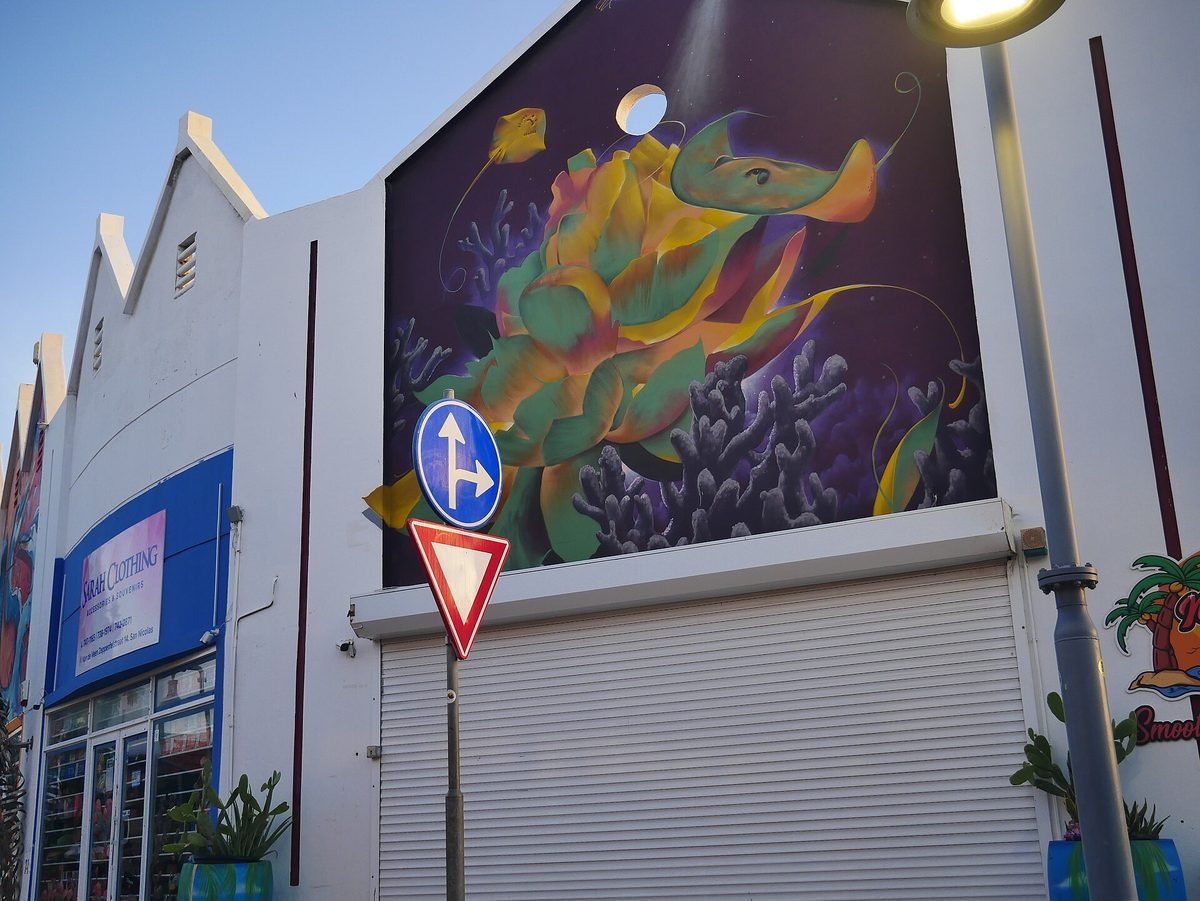
Drive southeast out of Oranjestad, across the bridge and past the salt flats, and you reach a completely different Aruba. San Nicolas — the island’s “second city” and former oil-refinery town — has reinvented itself as Aruba’s capital of street art and Carnival, its walls splashed with five-storey murals and its bars steeped in history. Most resort guests never make it down here, which is precisely why you should. This guide covers the best things to do in San Nicolas, Aruba’s most colorful and underrated corner: the murals, historic Charlie’s Bar, Baby Beach nearby, and how to catch Carnival.
San Nicolas, Aruba is the island’s second city and its arts-and-Carnival capital, nicknamed “Sunrise City” because the sun comes up on its eastern shore. About 30 minutes from the resorts, it’s known for 50-plus street-art murals from the Aruba Art Fair, Charlie’s Bar (open since 1941), Carnival, and nearby Baby Beach and Rodgers Beach.
This is the guide I wish I’d had on that first visit. I’ll walk you through the murals (and a self-guided route to see the best of them), the refinery history that explains why the town looks and feels the way it does, where to eat, the festivals worth timing a trip around, and how to get down here without overthinking it. I’ve written it for the curious traveler who wants one real day away from the beach chairs — cruise passengers, culture-seekers, families, and anyone who suspects the most interesting part of Aruba isn’t in the hotel zone. (Spoiler: it isn’t.)
San Nicolas at a glance
If you only skim one thing, make it this. Here’s how the main reasons to come down compare, and who each one is really for.
| What | Why go | Best for | Rough cost / time |
|---|---|---|---|
| Street-art murals | 50+ large-scale works on Main Street and side streets; the island’s signature cultural sight | Everyone; photographers, families, art lovers | Free to walk; 1.5–2 hrs |
| Charlie’s Bar | Aruba’s most famous bar, open since 1941, ceilings buried in memorabilia | History buffs, lunch, a cold drink | Mains ~$15–30 |
| Museum of Industry | The refinery, gold and aloe story inside the old Water Tower | History lovers, rainy hours | ~$10; ~1 hr |
| Community Museum / Nicolaas Store | Local history and art in a restored landmark store building | Culture-seekers | Low / donation; ~45 min |
| Baby Beach | Shallow, calm lagoon at the island’s tip | Families, swimmers, snorkelers | Free; half a day |
| Rodgers Beach | Quieter local beach next door | Couples, anyone avoiding crowds | Free |
| Carnival / Carubbian Festival | Where Aruba’s Carnival was born; seasonal street party energy | Festival travelers (seasonal) | Free–low |
My honest take: give San Nicolas a full day, not a rushed hour. The classic mistake is treating it as a 30-minute photo stop on the way to Baby Beach. Do the murals in the morning when the light is soft and the heat is bearable, eat lunch in town, and let the afternoon drift toward the coast.
Why is San Nicolas called “Sunrise City”?
The nickname is geographic, not poetic license. Aruba is a long, narrow island that runs roughly northwest to southeast, and San Nicolas sits at the far southeastern end. The sun comes up over its side of the island and sets over the hotel strip up north, so locals have long called it Sunrise City — the place to be for first light.
You’ll hear other names too. Older Arubans say Sint Nicolaas (the Dutch spelling), or just “SN.” And anything on this side of the big bridge from Oranjestad gets lumped under pariba di brug in Papiamento — “east of the bridge” — which loosely covers San Nicolas, Savaneta, and Pos Chiquito. None of this matters for navigation; your map app knows it as San Nicolas. But knowing the names helps you read the town the way the people who live here do.
What surprised me most is how different it feels from Palm Beach. There are no high-rise resorts, no timeshare touts, no swim-up bars. It’s a working town that happens to be covered in world-class art — lived-in, a little weathered, genuinely Aruban. If you’ve started to feel that the hotel zone could be Anywhere, Caribbean, this is the antidote.
San Nicolas Aruba street art: the murals that put the town on the map
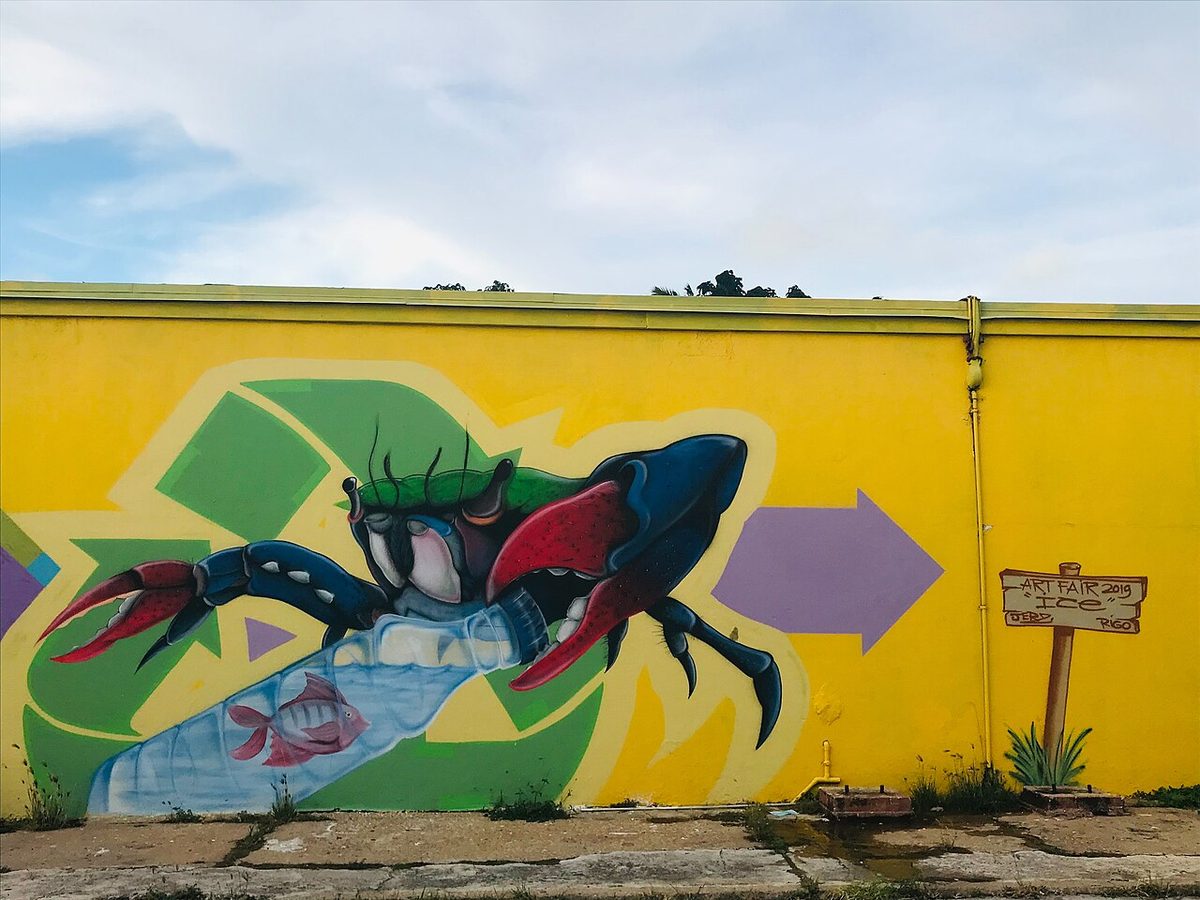
Let’s start with the reason most people make the trip. The San Nicolas street art is not a few scattered tags — it’s a curated, evolving collection of more than fifty large-scale murals, many of them museum-quality, spread across the buildings of downtown. Forbes has called San Nicolas the street-art capital of the Caribbean, and standing in the middle of Main Street with a giant photorealistic portrait on every side, I didn’t think that was hyperbole.
How a refinery town became an art town
The murals exist because of one stubborn local. Around 2015, a San Nicolas native named Tito Bolivar came home from a trip to Bogotá fired up by the street-art scene he’d seen there, and decided his fading hometown needed the same jolt. With his mother and co-organizer, Diana Croes, he launched the first Aruba Art Fair in 2016. The idea was simple and brilliant: invite serious muralists from around the world, give them walls, and let the work stay long after the festival packed up. Nine-plus editions later, those commissioned murals have turned a post-industrial main street into a permanent gallery.
That’s why the quality is so high. These aren’t amateur weekend pieces — they’re by artists with international reputations, painting their best work because the town gave them free rein.
Murals worth hunting for
A few I keep coming back to, so you know what you’re looking at:
- The blue iguana by WD (Wild Drawing), the Bali-born, Athens-based artist — a hyper-detailed tribute to Aruba’s endemic iguana, painted in part to highlight its conservation. It’s often the first one that stops people in their tracks.
- Portraits by ChemiS (Dmitrij Proškin), the Czech photorealist, including local faces and his “Playing at Rodger’s Beach” piece, where children build a sand refinery and the painted lamppost lines up exactly with a real one behind it. Look for it — it’s a clever bit of trompe l’oeil.
- Sarah-Quita Offringa by Portuguese muralist MrDheo — a portrait of Aruba’s own multiple-time world windsurfing champion. A nice reminder that the art celebrates local heroes, not just abstract beauty.
- Work by Rasheed Lowe (Mr Lowe), a homegrown talent born in Aruba in 2004 who was painting alongside international stars while still a teenager. His portraits of Black icons — Ali, Malcolm X, Mandela — are some of the most powerful walls in town.
- Odeith’s octopus, a 3D anamorphic piece on a corner that reads as a tribute to Tito himself — all those arms standing in for all those ideas.
- The Carnival Nymph mosaic by Chilean artist Isidora Paz López, and the seashell “angel wings” by Aruban mosaic artist Omaira Silva, just across from the ARTISA Gallery — the most-photographed wings in Aruba, and you’ll see why when someone stands in front of them.
One tip that genuinely surprised me: download the free Artivive app before you go. Several of the murals are augmented-reality enabled, and when you point your phone at them, the faces move. It feels like a gimmick until the first one comes alive, and then you’re walking around town pointing your phone at everything.
A self-guided mural walking route
You don’t need a tour to enjoy the murals, though I’ll make the case for one below. Here’s the loop I’d hand a friend who wanted to do it on foot in about 90 minutes:
- Start at the ARTISA Gallery on Bernard van de Veen Zeppenfeldstraat (B. v.d. Veen Zeppenfeldstraat) — it’s the unofficial heart of the art scene and a good orientation point. Park nearby; downtown is small and free street parking is easy outside Carnival.
- Look directly across the street for Omaira Silva’s seashell angel wings — get your wing photo out of the way early before the light gets harsh.
- Walk the length of Main Street (Bernardstraat / B. v.d. Veen Zeppenfeldstraat) slowly, then weave one block off it in each direction. The big pieces are on the main drag, but some of the best surprises are on the side streets and back walls.
- Don’t skip the alleys and the backs of buildings. Murals like the children-and-refinery piece reward a little wandering. If a wall looks blank, walk around it.
- Finish at a café or Charlie’s Bar for a cold drink. By the time you’ve done the loop you’ll have earned it.
Wear real shoes, bring water and sun protection, and start by 9 or 9:30am. Midday in San Nicolas is hot and shadeless, and the morning light makes the colors pop for photos. The whole downtown is walkable — you won’t need the car again until you head to the beach.
Galleries and a guided option
If you want context — who painted what, and why — book a mural tour. The well-known ones start around 9:30am at the ARTISA Gallery, run about two hours, and cost from roughly US$15 per person. Honestly, the stories are what made the murals stick for me; a good guide turns a wall of paint into a story about an artist who got detained for a portrait, or a teenager from town who’s now internationally collected. Worth the price of a couple of beers.
Beyond ARTISA, look for Space21 and other small studios and galleries that have opened as the scene matured. They’re the best place to actually buy work from local artists and to see what the next generation is making indoors.
The refinery years: San Nicolas history and reinvention
To understand why San Nicolas needed reinventing, you have to know what it used to be. For most of the 20th century this was a company town built on oil. Starting in the 1920s, crude was shipped from Lake Maracaibo in Venezuela to the Lago refinery at the island’s southeastern tip, and San Nicolas boomed. At its peak the refinery employed well over 10,000 people, drawing workers from across the Caribbean, the United States, and beyond — which is exactly why San Nicolas is the most multicultural corner of an already diverse island. The mix of English, Papiamento, and Caribbean influences you hear and taste here is a direct legacy of those refinery decades.
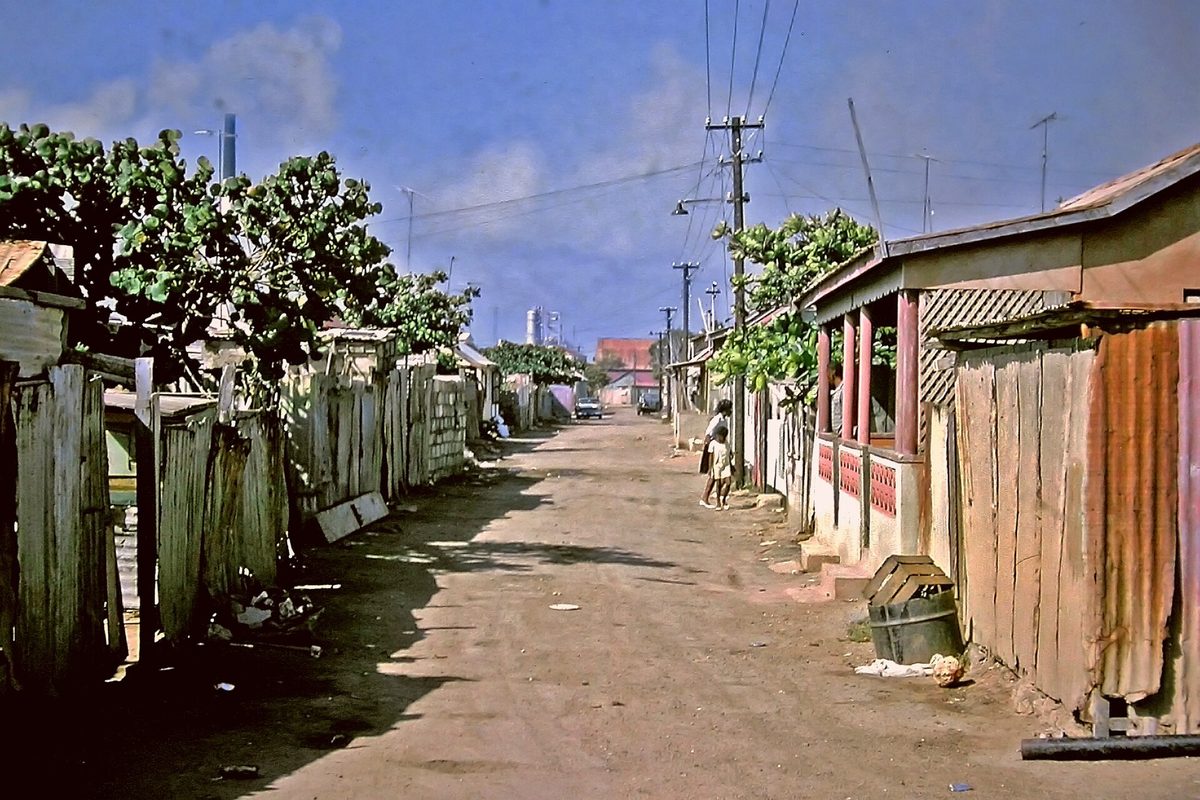
Then the oil era ended. The refinery wound down and the main operation closed in the mid-1980s, and the town that had been built around a single employer slid into a long, quiet decline. Storefronts emptied. The energy moved north to the tourist beaches. For roughly thirty years, San Nicolas was a place most visitors only passed through — if they came at all.
That’s the backdrop that makes the art so moving. The murals didn’t just decorate a pretty town; they were a deliberate act of revival in a place that needed one. When you stand in front of ChemiS’s children building a refinery out of sand, you’re looking at a piece that’s literally about this history, painted on a wall that history nearly hollowed out. The reinvention from refinery town to Sunrise City is the whole story, and you can read it on the buildings.
Museum of Industry
For the long version, spend an hour at the Museum of Industry, housed in the landmark Water Tower in downtown San Nicolas (it opened in 2016). It walks you through Aruba’s economic life chapter by chapter — the 19th-century gold rush, aloe cultivation, phosphate, and of course the oil years — with artifacts and photos that make the refinery era tangible. Admission runs around US$10. If the murals are the emotional version of the story, this is the factual one, and the two complement each other nicely. It’s also blessedly air-conditioned when the midday sun gets to be too much.
Community Museum and the Nicolaas Store
A short walk away, the Community Museum occupies the beautifully restored Nicolaas Store, one of the old commercial buildings that anchored Main Street in the boom years. Inside you’ll find a smaller, more intimate collection — local history, fossils, and rotating contemporary art that reflects how Arubans see their own past and present. The building itself is part of the appeal; it’s a lovely example of the town’s old architecture, saved and put back to use. The same Nicolaas Store building has also housed a café, so you can pair culture with a cold drink in one stop.
Charlie’s Bar: a San Nicolas institution since 1941
You cannot write honestly about San Nicolas and leave out Charlie’s Bar. It opened on September 18, 1941, founded by Charlie and Marie Brouns as a watering hole for the merchant marines and refinery workers who poured into town in the oil years. More than eighty years later it’s still here, still family-run, and still the most famous bar on the island.
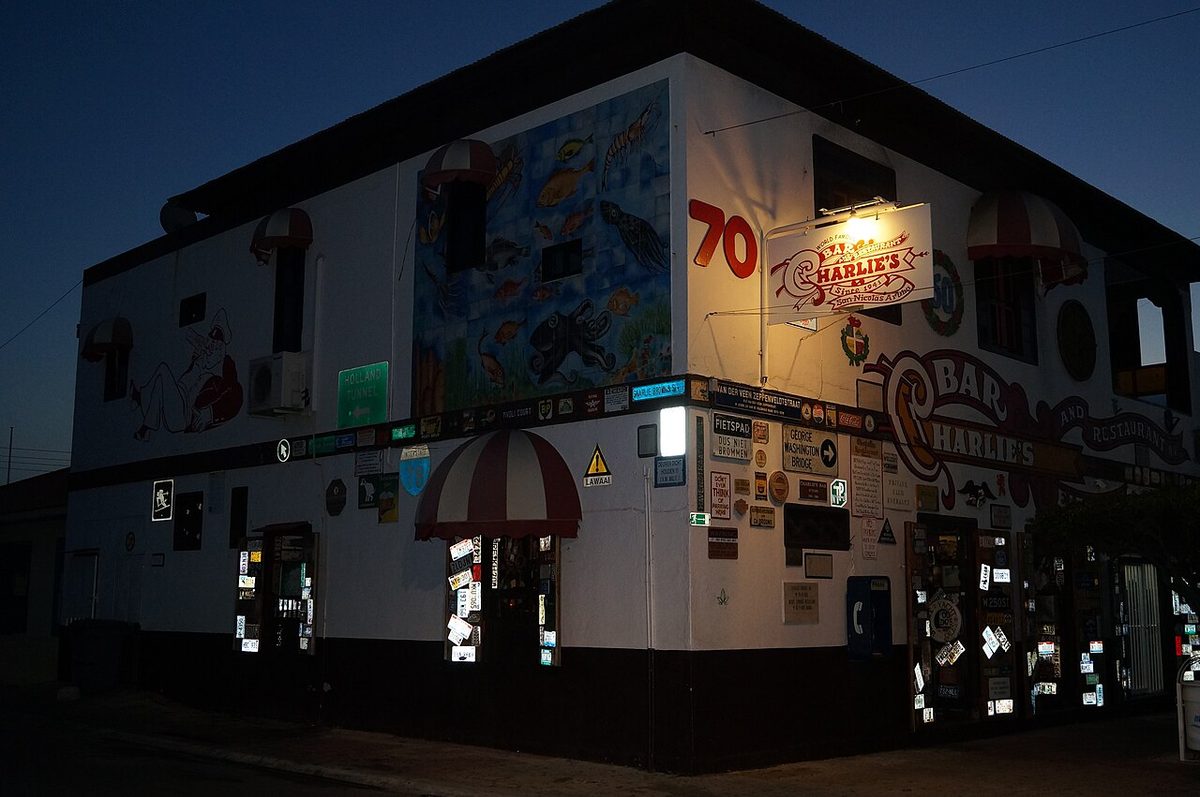
Walking in is the experience. Every inch of the ceiling and walls is buried under decades of accumulated stuff — license plates, dollar bills, dive finds, hard hats, trinkets left by generations of sailors and tourists, all furred with the patina of time. The story goes that scuba divers started the tradition by hanging their underwater discoveries here. It should feel like a tourist trap and somehow doesn’t; it feels like a museum that serves cold Balashi and plates of fish.
Come for lunch and a drink, soak in the room, and let the bartender point out the oddest objects overhead. Mains land in the rough range of US$15–30. Is it the best food on the island? No. Is it one of the most atmospheric rooms in the Caribbean, and the single most San Nicolas thing you can do? Absolutely. Go.
Where to eat in San Nicolas
The food down here is one of the underrated reasons to come. Because of the refinery diaspora, San Nicolas does Caribbean home cooking better than the resort strip, and at local prices. A few I’d steer you to:
- Charlie’s Bar — covered above; go for the room and a leisurely lunch as much as the menu.
- O’Niel Caribbean Kitchen — the local favorite for proper Caribbean plates, with patio seating. The kind of place island friends actually recommend to each other.
- Kamini’s Kitchen — started as a food truck and grew into a beloved sit-down spot; cozy, generous, and great value for Caribbean and Indian-influenced dishes.
- Kulture Café — bright, fresh, healthier fare in the Nicolaas Store building, right by the Community Museum. Good for a lighter lunch or a smoothie mid-mural-walk.
- Zeerovers — technically up the coast in Savaneta rather than San Nicolas proper, but if you’re already pariba it’s worth the short detour: fresh-caught fish and shrimp sold by weight, fried on the spot, eaten at picnic tables over the water. Come early or expect a line; it’s no secret.
If you’re building a day around food, my move is a light snack mid-morning, the murals, then a proper sit-down lunch in town before the beach. For the full island picture, our guide to the best restaurants in Aruba puts these San Nicolas spots in context with the rest of the island.
Carnival and the Carubbian Festival
San Nicolas isn’t only the art capital — it’s the cradle of Aruban Carnival. The island’s organized Carnival traces its roots to the mid-1950s, when clubs and neighborhoods down here began staging the first public celebrations, and San Nicolas has stayed central to the festivities ever since. If you visit during Carnival season — which builds through January and February and climaxes the weekend before Lent — you’ll find some of the biggest, most heartfelt parades on the island happening on these very streets.
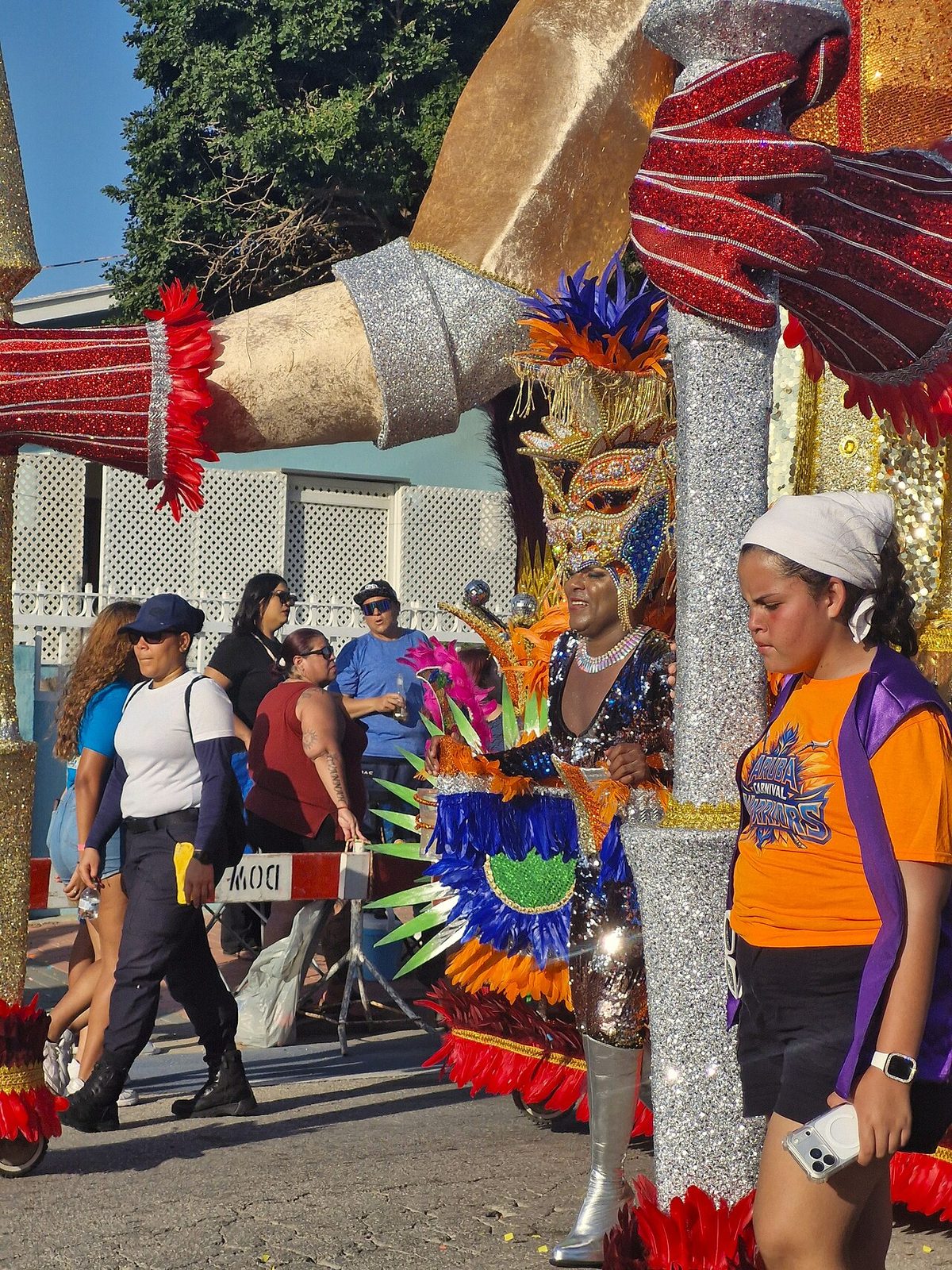
Two San Nicolas events anchor the season. The Grand Carnival Parade in San Nicolas is, for many locals, the emotional peak — a sprawling, all-day river of feathers, sequins, steel drums, and road-march music that often draws even bigger crowds than the capital’s parade. There’s also a torch-lit “lighting parade” that closes things out. If you can build your trip around it, do; it’s a completely different side of Aruba from the beach holiday.
Outside Carnival, the town has historically hosted the Carubbian Festival, a Thursday-evening street party on Main Street with local food stalls, live music, stilt walkers, and a taste of Carnival energy year-round. Its run has been on and off in recent years, so check whether it’s currently operating before you plan an evening around it — but when it’s on, it’s one of the most fun, low-key cultural nights on the island. For help picking your dates, see our guide to the best time to visit Aruba, which covers Carnival season and the weather month by month.
Beaches near San Nicolas
Here’s the bonus that makes San Nicolas an easy full-day trip: some of Aruba’s best calm-water beaches are minutes from downtown, out at the island’s very tip past Seroe Colorado. After a morning of murals, the coast is the perfect afternoon.
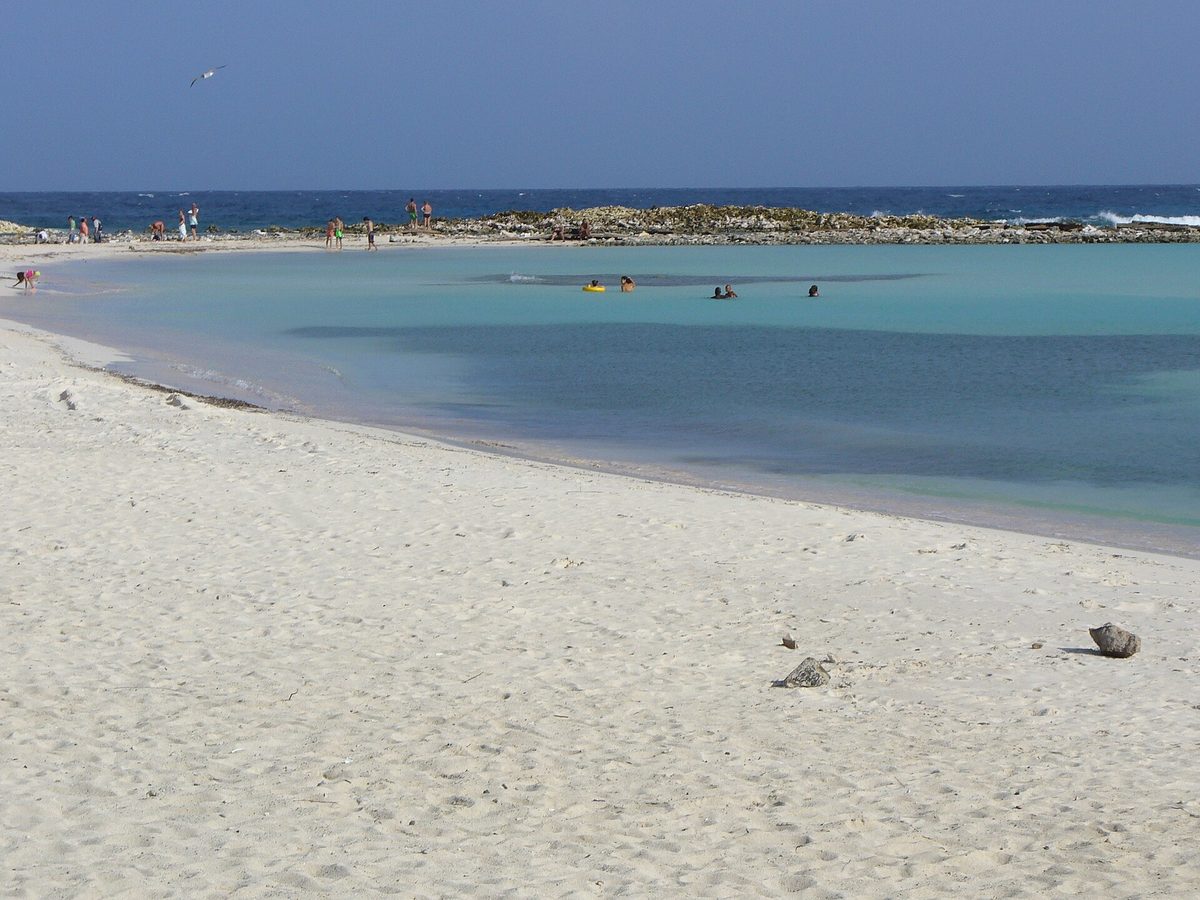
Baby Beach
Baby Beach is the headliner — a shallow, almost lagoon-like crescent of pale sand and warm, clear water protected by a reef. The shallows stay knee-deep a long way out, which is exactly why it’s a favorite for families with small kids and for anyone who just wants to float with a drink. There’s snorkeling along the rocks at the edges (mind the channel and stronger water there), some shade, and a beach bar and snack spots nearby. It’s the most popular beach pariba di brug for good reason. For families, our guide to Aruba with kids has more on Baby Beach and other gentle spots.
Rodgers Beach
Right next door, Rodgers Beach is the quieter local pick — a pretty curve of sand with calm water, usually noticeably less crowded than Baby Beach, especially midweek. There’s a refinery view at one end that some people find atmospheric and others find odd; I think it suits the area’s character. Bring your own cooler, set up early, and you’ve got a mellow afternoon. If you’re trying to choose between the island’s many shorelines, our complete Aruba beaches guide compares them all.
Boca Grandi, the Red Anchor, and a safety note
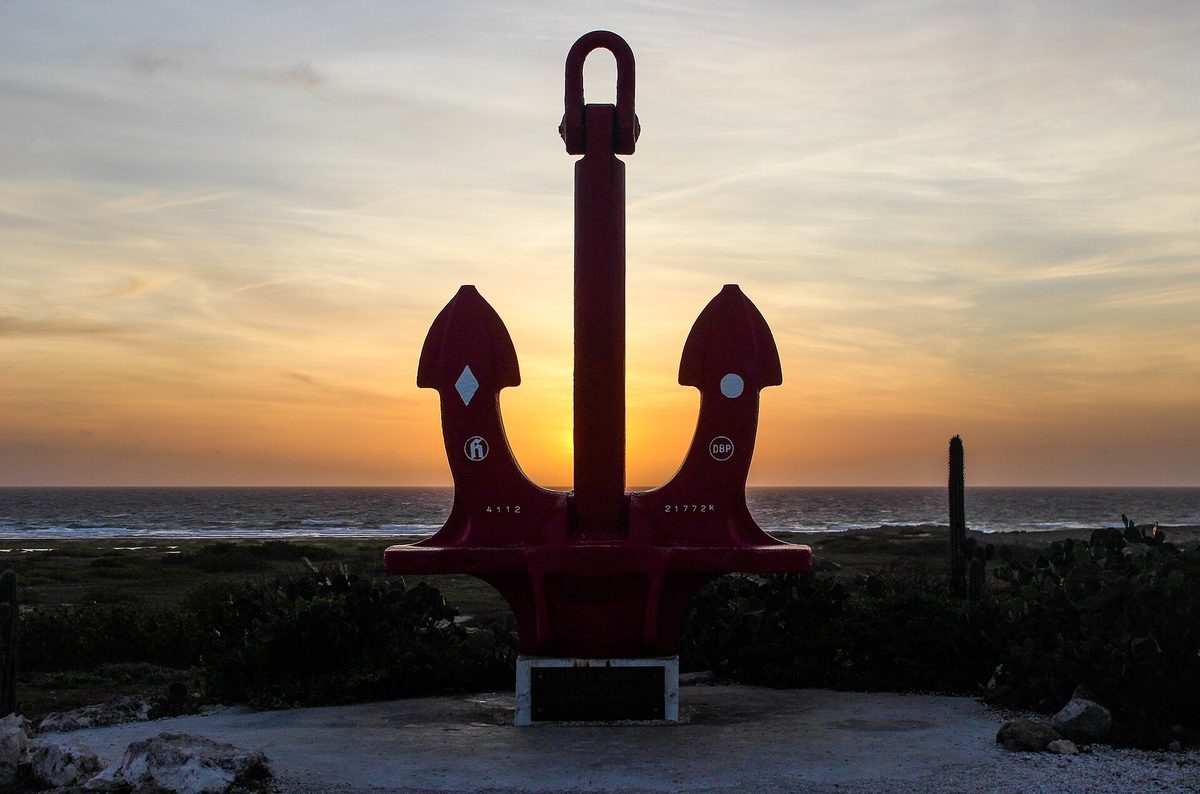
Two more worth knowing. The Big Red Anchor, on the road out toward Seroe Colorado, is a roadside monument honoring lost seamen (“To all seamen”) and a classic photo stop — it’s lit at night too. And Boca Grandi is a stunning windswept bay that’s a world-class kitesurfing spot thanks to its steady wind and waves.
Important: do not swim at Boca Grandi. The currents and shore break are genuinely dangerous, and it’s a place to watch the kites and feel the wind, not to get in the water. Keep it for photos and let the kitesurfers have the sea. If you’re into wind sports yourself, our Aruba water sports guide covers where to kite, windsurf, and snorkel safely.
One more local quirk: out in the rural stretches around San Nicolas and Seroe Colorado you’ll often meet Aruba’s wild donkeys ambling across the road. Slow down, enjoy them, and don’t feed them — they’re a charming hazard.
How to get to San Nicolas
Getting here is easy and cheap, which is part of why I push people to make the trip. San Nicolas sits about 19–20 km southeast of Oranjestad, and the drive takes roughly 30 minutes from the cruise port or capital, a little more from the Palm Beach resorts.
- By bus: The public Arubus runs the main route between Oranjestad and San Nicolas roughly every 30 minutes throughout the day. A single fare is around AWG 4.50 (about US$2.60); round trips and day passes are available at the main bus station. It’s the budget option and genuinely simple — the San Nicolas terminal is right in town.
- By rental car: My preferred way. You get the freedom to combine the murals, Charlie’s, the beaches, the Red Anchor, and a Zeerovers detour at your own pace. Roads to San Nicolas are good and well signed, and downtown parking is free and easy outside Carnival.
- By taxi or tour: Taxis work but add up over a full day; fixed island rates apply, so agree the fare first. Several operators also run mural-tour shuttles that bundle the ride with a guided walk, sometimes adding Baby Beach — a tidy option if you don’t want to drive.
For the full breakdown of buses, car rental, and taxi rates, see our guide to getting to and around Aruba.
Planning your visit: who it’s for and how to fit it in
So should San Nicolas be on your itinerary? Here’s my candid read by traveler type:
- Cruise passengers: Yes, if you have a full port day and want something beyond duty-free shopping. Bus or taxi down, do the murals and Charlie’s, and you’ll have a far better story than the people who never left the pier. Just watch your all-aboard time.
- Culture and art lovers: This is the single most interesting place on the island for you. Build a half- or full day around the murals and museums.
- Families: The combo of a short, colorful mural walk plus a swim at calm Baby Beach is a genuinely great kid day.
- Couples: A laid-back day of art, a long lunch, and quiet Rodgers Beach — lovely, and a nice break from resort sameness.
- Honestly, skip it if you have only a few hours on the island, hate heat, and just want a beach chair — you’ll be happier closer to your hotel. San Nicolas rewards the curious, not the rushed.
If you’re mapping out your week, our Aruba itinerary guide shows where a San Nicolas day fits best, and the broader things to do in Aruba guide is the hub for everything else on the island. For the practical stuff — money, tipping, getting a SIM — our Aruba travel tips are worth a skim before you go, and if you’re weighing where to base yourself, see our Aruba neighborhood breakdown.
Frequently asked questions
Is San Nicolas, Aruba worth visiting?
Yes — if you want one day of real Aruban culture away from the resorts, it’s the best trip on the island. The 50-plus street-art murals, Charlie’s Bar, the industry museums, and calm beaches like Baby Beach make for a full, varied day. Skip it only if you have just a few hours and want nothing but a beach chair.
How do I get to San Nicolas from the Aruba resorts?
It’s about a 30-minute trip southeast of Oranjestad. The public Arubus runs roughly every 30 minutes for around US$2.60 each way; a rental car gives you the most freedom to combine murals, beaches, and lunch; and taxis or tour shuttles are easy if you’d rather not drive. Roads are good and well signed.
What is San Nicolas, Aruba known for?
San Nicolas is known as Aruba’s arts-and-Carnival capital, or “Sunrise City.” Its fame rests on the open-air gallery of Aruba Art Fair murals, its history as the island’s oil-refinery town, the legendary Charlie’s Bar (since 1941), the birthplace of Aruban Carnival, and nearby Baby Beach and Rodgers Beach.
How many murals are in San Nicolas?
There are more than fifty large-scale murals across downtown San Nicolas, with new ones added at most editions of the Aruba Art Fair (held around September). Because street art weathers and walls change, the exact count shifts over time, but you can comfortably spend 1.5–2 hours walking the best of them.
When is the Aruba Art Fair?
The Aruba Art Fair is typically held in September, when artists paint new murals over a few days. You don’t need to visit during the fair to enjoy the art, though — the murals are permanent and viewable year-round, so any day works for a self-guided or guided walk.
Can you swim at the beaches near San Nicolas?
Yes at Baby Beach and Rodgers Beach, which are calm and family-friendly. No at Boca Grandi — its currents and shore break are dangerous, so it’s strictly a kitesurfing and photo spot. Always check local conditions, and take care around the rocky channel edges when snorkeling at Baby Beach.
Final thoughts
San Nicolas is the part of Aruba I send people to when they tell me the resort strip started to feel interchangeable. It’s a town that was knocked down by the end of an industry and chose, stubbornly and beautifully, to paint its way back — and you can feel that everywhere, from the murals to Charlie’s ceiling to the Carnival music in February. Give it a full day, eat the local food, watch the kites at Boca Grandi, catch a Sunrise City sunrise if you can. It’s the most human corner of the One Happy Island, and the one I’d least want you to miss.
Photo credits
All images via Wikimedia Commons, used under their respective licenses:
- Sea-life mural, San Nicolas — Ginelly.Q (CC0)
- Art Fair crab mural — Caribiana (CC BY-SA 4.0)
- Historic San Nicolas street — Arthur Meiners (CC BY-SA 4.0)
- Charlie’s Bar — Elizabeth Hopmans (CC BY-SA 3.0)
- Grand Carnival Parade, San Nicolas — Ginelly.Q (CC BY-SA 4.0)
- Baby Beach — Dje9537459 (public domain)
- The Big Red Anchor — JohnathanBaena (CC BY-SA 3.0)