Here is the thing nobody selling you a honeymoon package wants to admit: Aruba is not a closed door if your wallet is thin. Yes, the brochures are all infinity pools and $600 swim-up suites, and the Palm Beach high-rise strip will happily relieve you of a small fortune. But the beach those resorts sit on? Free. The Caribbean’s bluest water? Free. That sunset worth a $14 rooftop cocktail? Also free from the sand, if your drink came from a supermarket cooler.
So let’s bust the myth right now. Doing Aruba on a budget is not about suffering through a worse version of the island. It’s about spending where it counts and skipping the markup everywhere else. Locals live here on local prices; the trick is to shop, eat, and move around the way they do. I’ve put together the 25 money-saving tactics below after years of watching what actually works versus what just sounds thrifty, and I’ve kept every price specific so you can plan real numbers, not vibes. If you want the standard, non-thrifty version to measure those savings against, I priced it out in how much an Aruba vacation costs.
So how cheap can Aruba really be? A careful traveler staying in a guesthouse off the strip, cooking some meals, riding the public bus, and filling days with free beaches can keep things to roughly $95–150 per person per day including a bed. The biggest levers, in order, are when you go (shoulder season cuts hotels 25–40%), where you sleep (skip the high-rises), and how you eat (groceries and local spots beat resort restaurants by half). Nail those three and everything else is rounding error.
This guide is for the traveler who wants the real Aruba — the turquoise water, the fried-fish shacks, the cactus-studded interior — without pretending money is no object. It’s a cluster in our larger guide to the cost of an Aruba vacation, so if you want the full budget breakdown with sample itineraries, start there and come back for the tactics.
The highest-impact savings at a glance
If you read nothing else, read this. These are the moves that change your total the most, ranked by how much they actually save a typical week-long trip for two.
| Money-saving move | Roughly what it saves | Effort |
|---|---|---|
| Travel in shoulder/low season (mid-Apr to early Dec) | 25–40% off hotels — often $400–900 a week | Low (just pick dates) |
| Stay off the Palm Beach high-rise strip (Eagle/low-rise, Oranjestad, rentals) | $100–300+ per night vs luxury towers | Low |
| Book a room or studio with a kitchen and cook breakfast/some dinners | $40–80 a day for two | Medium |
| Eat at local spots — Zeerovers, food trucks, lunch specials | Half of restaurant-strip prices | Low |
| Ride Arubus instead of taxis | ~$2.60 a ride vs $10–30 per taxi hop | Low |
| Buy drinks at the supermarket, not the beach bar | $8–12 saved per drink | None |
| Stick to free beaches and shore snorkeling | $0 vs $75–95 per boat tour | None |
| Skip the car if you’re staying beachside; rent for 1–2 days only | $50–80 per day not spent | Low |
Notice what’s not on that list: nothing about cutting your trip short or staying somewhere ugly. You’re trimming the markup, not the magic. Now let’s get into each lever in depth.
Cheap flights and timing: the lever that saves the most
Your flight and your travel dates are the two biggest line items you control before you even land, and they’re linked. Aruba’s peak season runs roughly mid-December through mid-April — Christmas, New Year, and the North American winter escape. That’s when hotels, flights, and tours all hit their annual high at the same time. Show up then and you’re paying top dollar on every front.
When to go for the lowest prices
The sweet spot for budget travelers is the shoulder and low season: mid-April through early December. Same sun, same 82°F water, far smaller bills. Within that window, September and October are the absolute cheapest months — hotel rates bottom out and you’ll have stretches of beach nearly to yourself. The trade-off is that it’s the warmest, most humid time, but Aruba sits well outside the main hurricane belt and stays breezy thanks to the constant trade winds, so the weather risk is low compared with most of the Caribbean.
My personal pick is May and June: you get 25–40% off the same hotels, the crowds have thinned, and the weather is still glorious. If you can be flexible, fly midweek — Tuesday and Wednesday departures are routinely cheaper than weekend ones. For a deeper month-by-month breakdown, see our guide on the best time to visit Aruba.
How to actually find a cheap fare
Set a price alert on a flexible flight-search tool 2–3 months out and watch the trend rather than panic-booking. Queen Beatrix International (AUA) is served by a lot of North American carriers, and competition on routes from Miami, Newark, Charlotte, and Atlanta keeps fares honest. A few habits that genuinely help:
- Be flexible by a day or two. Shifting your departure off the weekend can knock $80–200 off a round trip.
- Fly carry-on only if you can. Checked-bag fees on budget itineraries add up fast — and you really don’t need much beyond swimwear and sandals here.
- Watch for shoulder-season sales. Airlines discount Aruba hard in spring and fall to fill seats.
- Book the airport-to-hotel leg smartly. A taxi from AUA to Palm Beach is a fixed government rate of around $30–35; if you’re two or more people it’s fine, but solo travelers can take the bus for a couple of dollars (more on that below).
For everything on arrivals, transfers, and moving around once you land, our guide to getting to and around Aruba covers it in detail.
Where to stay cheaper (this is where budgets are won)
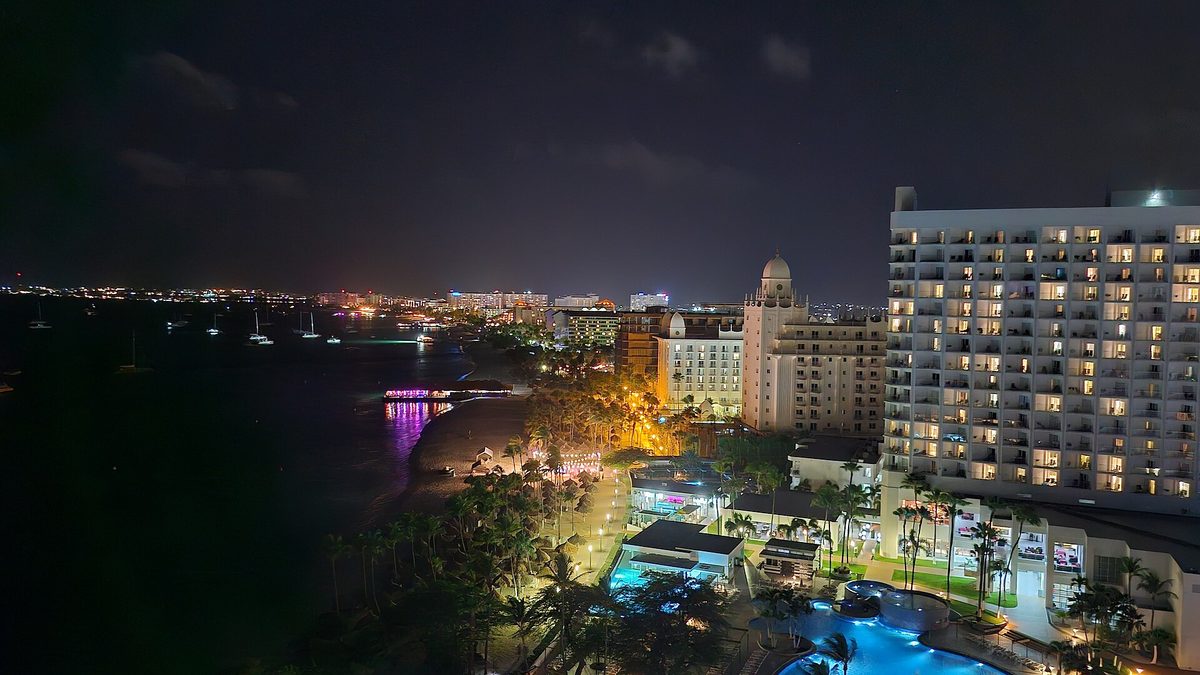
Accommodation is almost always the single biggest expense of an Aruba trip, which makes it the biggest opportunity. The mistake most first-timers make is assuming they have to stay in one of the Palm Beach high-rise towers — the Ritz, the Marriott, the Hyatt — where peak-season rooms run $300–600+ a night. You don’t. Here’s the ladder from priciest to cheapest, with the trade-offs.
Eagle Beach and the low-rise area
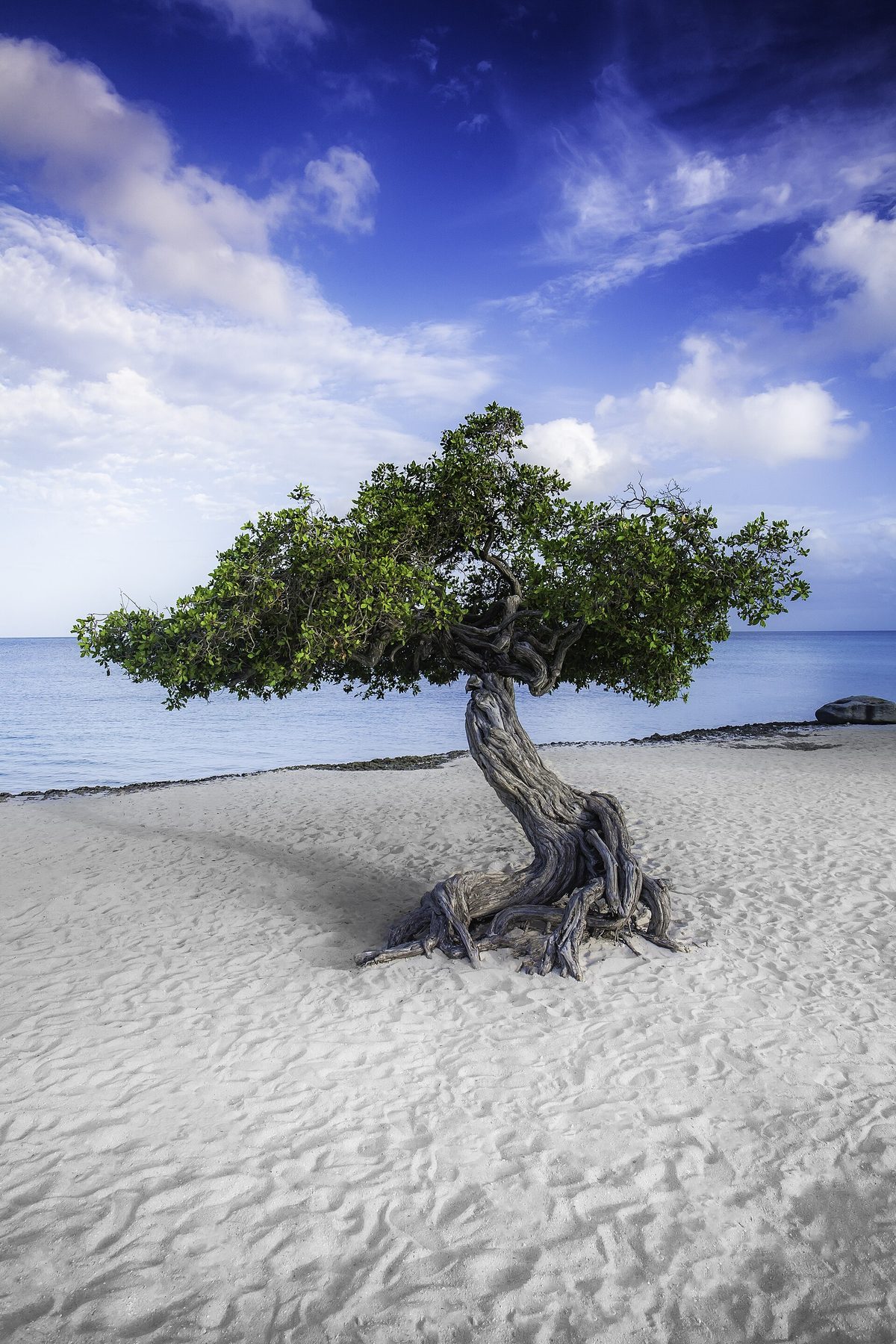
Eagle Beach is, for my money, the prettiest beach on the island — wider, calmer, and far less crowded than Palm Beach, with those famous wind-bent fofoti trees. And the hotels along it are “low-rise,” meaning smaller, lower-key properties like Amsterdam Manor, Manchebo, and the Mill Resort that cost meaningfully less than the Palm Beach towers while putting you steps from a world-class beach. You’re trading a casino and a 12-story view for a quieter, cheaper, arguably nicer stretch of sand. Easy trade. Compare the two strips in our Aruba beaches guide.
Oranjestad and Noord guesthouses
Move a few minutes inland from the beach and prices drop again. Family-run guesthouses in the residential Noord and Tanki Leendert areas near Palm Beach run roughly $70–120 a night and put you a short bus ride or 10-minute drive from the sand. Staying in or near Oranjestad, the capital, is another value play: you’re on the free downtown trolley line, walkable to restaurants and the harbor, and a quick bus to the beaches. Our Aruba accommodation guide breaks down each neighborhood.
Vacation rentals and studios with a kitchen
This is the single best budget housing move, and it does double duty. A studio or apartment rental — especially in Noord, Eagle Beach, or Oranjestad — is often cheaper per night than a hotel and comes with a kitchen, which is what unlocks the biggest food savings (next section). A private room in a rental can run as little as $70–90 a night; a full apartment with a kitchen, $120–180. For a week-long stay, having a fridge for groceries and drinks easily pays for itself. Hostels exist too — there are a handful of dorm options in Oranjestad in the $25–40 range if you’re truly counting pennies.
What about all-inclusives?
An all-inclusive can be a smart budget play if you’re the kind of traveler who’ll genuinely eat and drink most meals on-site, because it caps your daily food-and-bar spend at a known number. But Aruba has relatively few true all-inclusives compared with, say, the Dominican Republic, and they’re not always cheaper than a kitchen-equipped rental once you factor in how much eating out you’d skip anyway. Run the math both ways; see our rundown of Aruba all-inclusive resorts to compare.
Eating cheap in Aruba without eating badly
Aruba imports almost all its food, so restaurant prices on the tourist strip are genuinely high — a sit-down dinner for two with drinks can easily hit $120–180. But the island also has a thriving local food scene where you eat better and cheaper than at the resort restaurants. This is where the “groceries plus great local spots” strategy shines.
Cook breakfast and some dinners (the kitchen pays off)
If your room has a kitchen, use it. Coffee, eggs, fruit, and bread for breakfast costs a fraction of a $15–20 hotel breakfast, and grabbing groceries for a couple of simple dinners can save a family $40–80 a day. The big supermarkets are Ling & Sons and Super Food Plaza (both near Palm Beach) for selection, with PriceSmart (a Costco-style warehouse) the cheapest for bulk if you have a membership. Smaller Chinese-run minimarkets dot every neighborhood for quick, cheaper basics. Expect imported groceries to run higher than back home — bread around $3–4, milk around $6–7 a gallon — but a week’s groceries (roughly $130–200 for two) still crushes eating every meal out.
Zeerovers and the local fish shacks
If you do one budget meal in Aruba, make it Zeerovers in the fishing village of Savaneta. Local fishermen land their catch and it’s fried to order — fish and shrimp by the pound, plain sides, picnic tables over the water. A full meal with a Balashi beer runs about $10–15, and it’s genuinely some of the best food on the island, not just the cheapest. Cash only, best at weekday lunch. It’s a bit of a drive south, which is a great excuse to pair it with Baby Beach and San Nicolas on a one-day car rental.
Food trucks, pastechi, and snack trucks
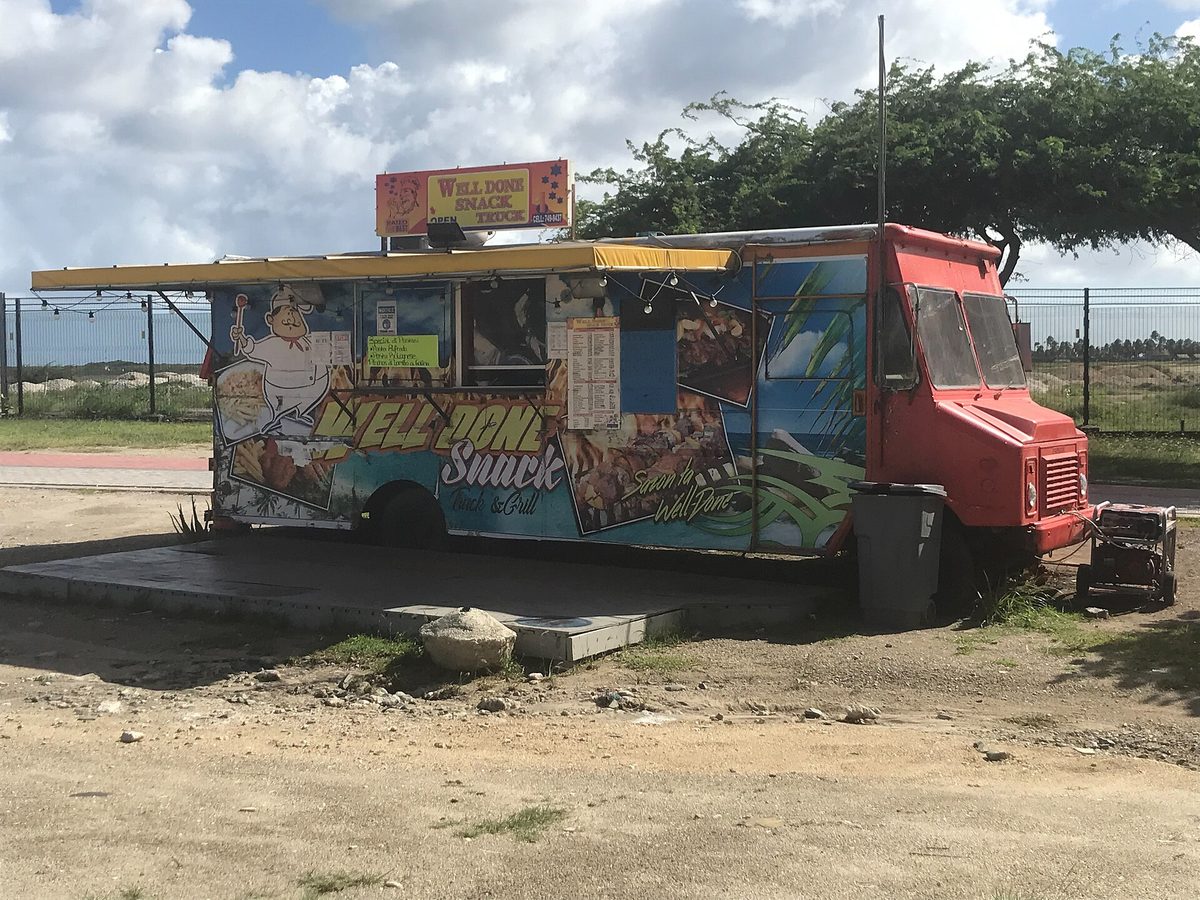
Aruba’s food trucks are a budget traveler’s best friend. A pastechi — a fried pastry stuffed with cheese, chicken, or beef — runs about $1.50–2.50 and makes a filling breakfast or snack. In the evenings, food trucks park up around Oranjestad and Palm Beach serving everything from local pan bati to burgers and fresh fruit smoothies, with most plates in the $5–15 range. It’s tasty, it’s authentic, and it’s a third of restaurant prices.
Lunch specials and happy hours
Two tricks the locals use: eat your big meal at lunch, when many sit-down restaurants offer specials well below their dinner prices, and time your drinks for happy hour, typically 5–7 p.m. (the island jokes its happiest hours run 5 to 8). A beer or rum punch that’s $10–12 at dinner might be half that during happy hour, sometimes two-for-one. For a fuller picture of where to eat across price points, our Aruba restaurants guide sorts the value spots from the splurges.
The single biggest drink hack: BYO from the supermarket
Beach bars charge $10–14 for a cocktail and $6–9 for a beer. A six-pack of that same Balashi from the supermarket is a few dollars; a bottle of local Palmera rum is under $15. Every public beach in Aruba lets you bring your own cooler, so stock up, ice it down, and watch the sunset for a tenth of the bar price. Over a week, this one habit alone can save a couple well over $200.
Free and cheap things to do in Aruba
Here’s the secret that makes the whole budget thing work: the best of Aruba is genuinely free. You do not need to buy a single excursion to have an incredible week. The expensive tours are nice, but they’re optional extras layered on top of an island that hands you world-class beaches and dramatic scenery at no charge.
Free beaches (all of them)
Every public beach in Aruba is free — no admission, no parking fee, no lounger mandate. Eagle Beach is the showstopper and my top pick. Palm Beach is livelier with more facilities. For snorkeling straight off the sand, head north to Arashi Beach, Malmok, and Boca Catalina, where the calm, clear water is full of fish. Down south, Baby Beach is a shallow, protected lagoon that’s perfect for families and beginner swimmers. Bring your own snorkel gear (pack it from home, or buy a cheap set at a supermarket) and you’ve got days of free underwater sightseeing. Our full Aruba beaches guide maps them all.
Snorkeling from shore instead of a boat
A catamaran snorkel cruise is a lovely splurge at $75–95 a head, but you can see plenty of the same fish and coral for free. Walk in at Boca Catalina or Malmok and you’ll find angelfish, parrotfish, and often a sea turtle within a few fins of the shoreline. The Tres Trapi (“three steps”) spot near Malmok is a local favorite for turtle sightings, entered right off the rocky steps. All you need is a $15 mask and snorkel.
Explore Arikok National Park on foot
Arikok National Park covers nearly a fifth of the island — cactus forests, gold-mill ruins, caves with ancient rock paintings, and rugged coastline. Entry is around $15 per person and is valid for the day. You can hike its trails on your own two feet without paying for a jeep tour; the catch is that the famous Natural Pool (Conchi) requires a 4×4 to reach, so if that’s a must-do, a shared group tour is the cheapest way in. But the park’s marked walking trails, caves, and coastal viewpoints are all doable on foot once you’re inside.
Downtown Oranjestad and San Nicolas murals
Wandering Oranjestad is free entertainment: pastel Dutch colonial buildings, Wilhelmina Park, the exterior of Fort Zoutman, the marina, and the free open-air trolley that loops the main street. Down in San Nicolas, the island’s “Sunrise City,” more than 60 huge street-art murals cover the buildings — a free outdoor gallery that’s become one of Aruba’s best photo walks. Both cost nothing but the bus fare to get there.
Free natural landmarks and wildlife
Several of Aruba’s iconic sights are free to visit: the Casibari and Ayo rock formations (giant boulders you can clamber around), the Bushiribana gold-mill ruins on the north coast, the collapsed Natural Bridge, and the California Lighthouse area for sunset (a small fee to climb the tower itself, but the views around it are free). The Donkey Sanctuary is free to enter (donations welcome), and the steep Hooiberg (“Haystack”) staircase rewards 500-plus steps with a panoramic island view — and on a clear day, the coast of Venezuela. For a bigger menu of zero-cost ideas, see our dedicated guide to Aruba’s free attractions, and for the full range of activities at every price, our best things to do in Aruba roundup.
Getting around Aruba on a budget
Transport is where small daily decisions add up fast — and where Aruba is surprisingly easy on a budget thanks to a genuinely good public bus.
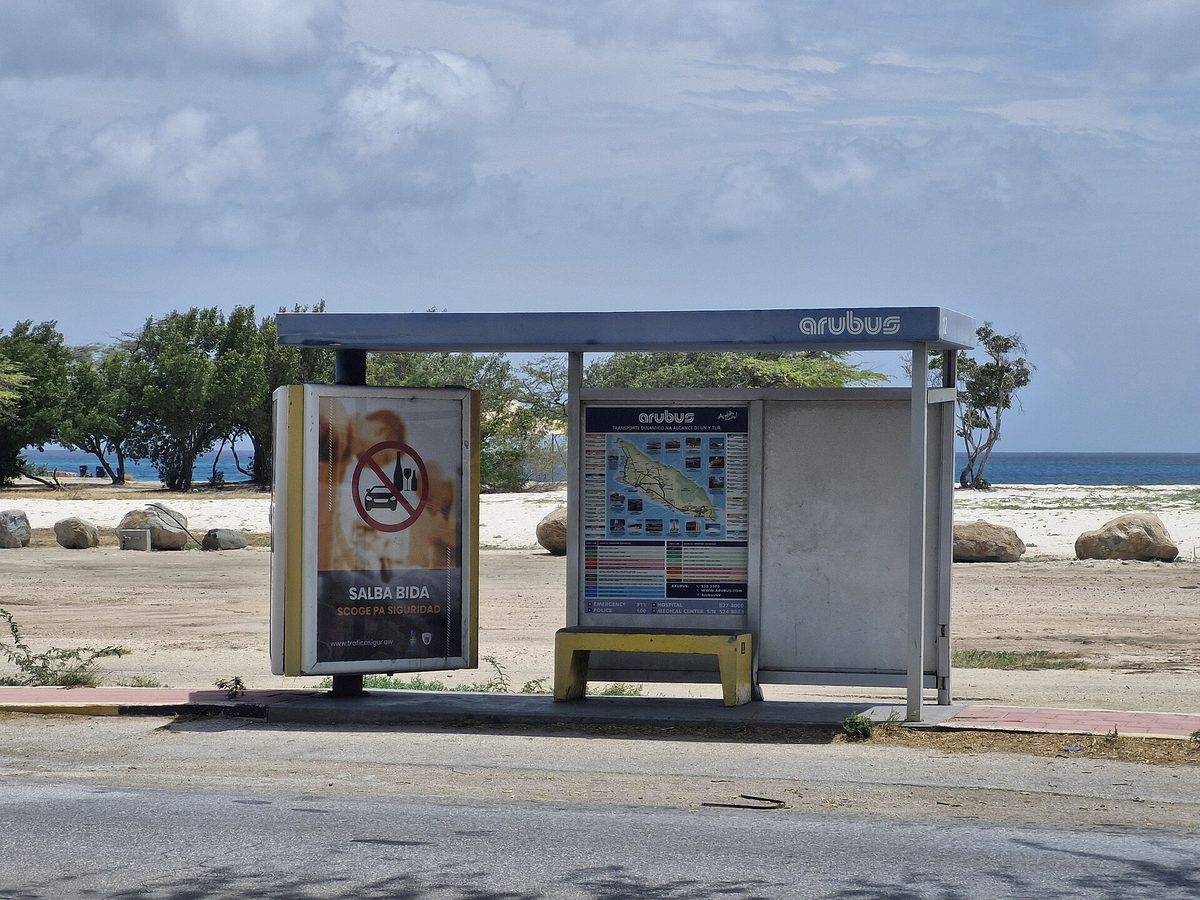
Ride Arubus (the #10 is your friend)
The public bus system, Arubus, is the budget traveler’s secret weapon. The flagship Line 10 runs the coastal route connecting Oranjestad with Eagle Beach, Palm Beach, the high-rise hotels, and up to the Arashi/lighthouse end — exactly the stretch most visitors want. A one-way fare is around $2.60 (you can pay the driver in U.S. dollars), a round trip about $5, and an unlimited day pass is around $10, which pays off the moment you make more than a couple of hops. Buses run frequently in the daytime — roughly every 20–30 minutes on weekdays — from early morning until late evening. From the airport, you’ll typically change once at the Oranjestad terminal to reach the beach hotels, but it’s a couple of dollars versus a $30+ taxi. Full details in our getting around Aruba guide.
Walk the strip and the free trolley
If you’re staying along Palm or Eagle Beach, you can walk to most restaurants, shops, and beach access points and never pay for transport at all. In Oranjestad, the free streetcar/trolley loops the main downtown drag every 25 minutes or so — zero cost, and a pleasant way to see the center.
Share a rental car for the days you actually need one
You do not need a car for the whole trip. The smart move is to skip it most days and rent for just one or two days to knock out the far-flung sights — Arikok, Baby Beach, Zeerovers, San Nicolas, the north coast — all in one efficient loop. A rental runs roughly $50–80 a day; split between two people that’s $25–40 each for a full day of freedom, far cheaper than taxiing to those distant spots. Book a local agency rather than an airport-counter big name for better rates, and decline the upsells you don’t need.
Why taxis are the budget killer
Aruba taxis don’t use meters — fares are set by the government by zone — and there’s no Uber or Lyft on the island. Rates are fair but not cheap: short hops start around $10–12 and airport-to-Palm-Beach is roughly $30–35. Used sparingly (a late night out, a group splitting one fare) they’re fine. Relied on daily, they’ll quietly wreck your budget. Default to the bus and your feet; save the taxi for when it genuinely makes sense.
Aruba on a budget: the fees and traps to avoid
Beyond the big levers, a handful of small, avoidable costs trip up budget travelers again and again. Dodge these and you keep more of your money for the stuff that matters.
- Pay in U.S. dollars, in cash, where you can. USD is accepted everywhere alongside the Aruban florin. Some tourist spots quote a poor exchange rate when you pay by card in florins — paying cash in dollars sidesteps the markup. Carry small bills.
- Watch for the automatic service charge. Many restaurants add a 10–15% service charge to the bill. Check before you tip on top, or you’ll double-tip without realizing it.
- Skip bottled water — the tap is safe. Aruba’s tap water is desalinated, high quality, and perfectly safe to drink. Bring a reusable bottle and stop buying cases of water; it’s pure savings.
- Decline the resort “amenity” and parking fees where you can by choosing properties that don’t charge them — read the fine print before booking.
- Don’t over-buy excursions in advance. Beyond one or two genuine highlights, the island’s free beaches and scenery fill days easily. Book the catamaran or the jeep tour if you really want it, but you don’t need a packed paid itinerary.
- Use ATMs over airport currency desks if you need florins at all, and avoid dynamic currency conversion (always choose to be charged in the local currency on card machines when given the option).
A few sensible habits around safety and money also save headaches — our Aruba travel tips guide rounds up the practical stuff worth knowing before you go.
A sample budget day (to show it adds up)
To make it concrete, here’s a realistic, genuinely pleasant day for two people doing Aruba the thrifty way:
- Breakfast in your rental: coffee, eggs, fruit — about $4 total from groceries.
- Morning at Eagle Beach: free. Snorkel gear you brought from home.
- Bus to Oranjestad and back on a day pass: about $20 for two.
- Lunch at a food truck — pastechi and a fresh juice: around $12 for two.
- Afternoon walking the murals or the rock formations: free.
- Supermarket drinks for a beach sunset: about $10.
- Simple dinner cooked in, or a local lunch-special spot: $15–30.
That’s roughly $60–75 for two for the day on food, drink, and transport, before your room. Add a kitchen-equipped rental at $120–150 and you’re landing comfortably in that $95–150-per-person range — on an island people swear can’t be done cheaply. For a full week-by-week cost model and sample itineraries, head back to our Aruba vacation cost pillar, and pair it with a day-by-day Aruba itinerary to plan the actual days.
Frequently asked questions about visiting Aruba on a budget
Is Aruba expensive to visit?
Aruba sits mid-to-high for the Caribbean — the resorts, fine dining, and tours are premium-priced. But it’s very manageable on a budget with the right choices. Staying in a guesthouse or rental off the Palm Beach strip, cooking some meals, eating at local spots like Zeerovers, riding Arubus, and traveling in shoulder season can bring costs to roughly $95–150 per person per day including a bed.
What is the cheapest time to visit Aruba?
September and October are the cheapest months, when hotel rates hit their annual low and crowds are thinnest. May and June are the best balance of low prices and excellent weather — typically 25–40% below peak-season rates with reliably sunny days. The pricey stretch to avoid if budget matters is mid-December through mid-April, the winter peak.
How much money do I need per day in Aruba?
A budget traveler can do Aruba on roughly $95–150 per person per day including accommodation, by staying off the strip, cooking some meals, using the bus, and filling days with free beaches. A mid-range day runs more like $200–300 with a nicer hotel, eating out, and the odd paid tour. Luxury, of course, has no ceiling.
Is it easy to get around Aruba without a car?
Yes. The Arubus public bus, especially Line 10, connects Oranjestad with Eagle Beach, Palm Beach, and the hotel strip for around $2.60 a ride or $10 for an unlimited day pass. If you’re staying beachside you can walk to most things. Rent a car for just one or two days to reach the far southern and interior sights, and you’ll save a lot versus daily taxis.
What’s the cheapest food in Aruba?
Pastechi (fried pastries) from local bakeries and food trucks cost about $1.50–2.50 each. Zeerovers in Savaneta serves fresh fried fish for around $10–15 for a full meal — the best value and arguably the best food on the island. Supermarket snacks and picnic food for the beach are far cheaper than beach-bar prices, and cooking in a rental kitchen saves the most of all.
Can you swim and snorkel in Aruba for free?
Absolutely. Every public beach is free to enter, with no admission or parking charge. You can snorkel straight off the sand at spots like Boca Catalina, Malmok, and Tres Trapi and see fish, coral, and often sea turtles — no boat tour required. Bring or buy a basic mask and snorkel and your underwater sightseeing costs nothing.
Final thoughts: Aruba rewards the savvy, not just the rich
The honeymoon brochures aren’t lying about Aruba being gorgeous — they’re just quiet about the fact that the gorgeous part is the free part. The water doesn’t charge more for luxury guests. The sunset looks the same from a $14 rooftop and from a beach towel with a supermarket beer. Spend where it genuinely improves your trip — a great local meal, one catamaran afternoon, a day with a rental car — and skip the markup everywhere else. Do that, and you’ll come home with the same tan, the same photos, and a lot more money still in the bank.
By the ArubaTourism.org team — Last updated June 2026. Prices are approximate and shift with season and inflation; always check current rates before you book.
Photo credits
- Photo: Jason Boldero / CC BY 2.0 via Wikimedia Commons — source
- Photo: Rarends297 (CC0) via Wikimedia Commons — source
- Photo: Caribiana / CC BY-SA 4.0 via Wikimedia Commons — source
- Photo: EgorovaSvetlana / CC BY-SA 4.0 via Wikimedia Commons — source
- Photo: Ginelly.Q (CC0) via Wikimedia Commons — source