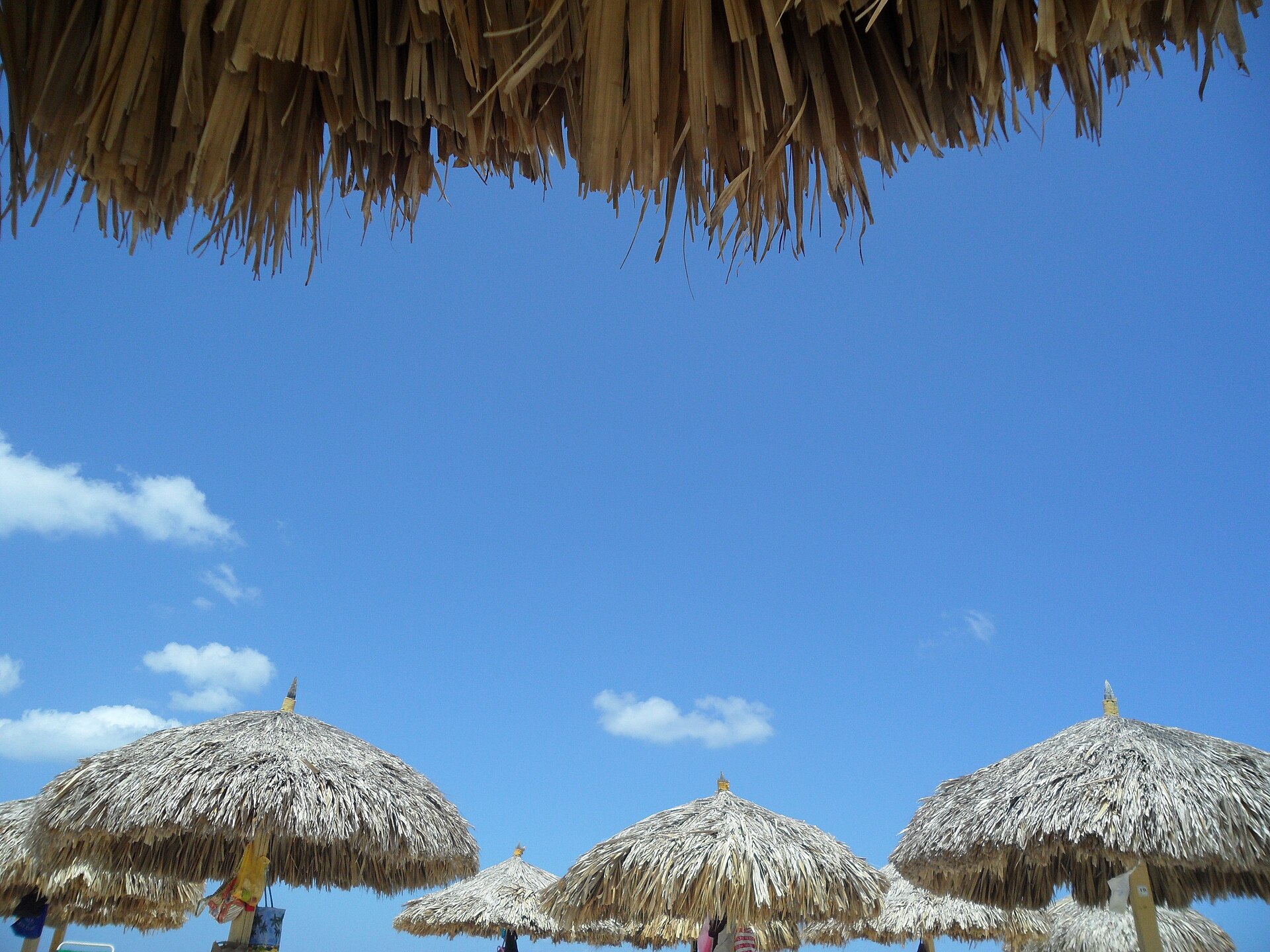
The cabin door opens and the warm trade wind hits you first, carrying salt, sun, and the faint sweetness of frangipani. Before you have even cleared the jet bridge in Oranjestad, a smiling face greets you with two soft syllables: “Bon bini.” Welcome. You smile back, a little unsure, and somewhere behind you a grandmother answers her grandchild in a language that sounds like Spanish wearing a Dutch coat and dancing to a Caribbean beat. That is your first taste of Aruba’s real soundtrack, and learning a handful of papiamento phrases is the simplest way to step inside it rather than past it.
Here is the warm truth locals will not always say out loud: you can spend a week on this island speaking only English and have a wonderful time. But the moment you answer a “how are you?” with “tur kos ta bon”, or thank a snack-shop owner with “masha danki” instead of a flat “thanks,” something shifts. The service gets warmer. The portions get bigger. You stop being a tourist passing through and become, for a moment, a guest who cared enough to try. This guide gives you the words to make that happen, with friendly pronunciation and tables you can screenshot before you fly.
By the ArubaTourism.org team — Last updated June 2026.
Quick answer: what language do they speak in Aruba?
Aruba has two official languages: Papiamento (the native, everyday tongue of almost all Arubans) and Dutch (used in government, law, and schooling). English and Spanish are also spoken widely in tourism. If you learn just five words, make them bon bini (welcome), bon dia (good morning), danki (thank you), por fabor (please), and dushi (sweet/lovely).
The languages of Aruba: a four-language island
Aruba is a constituent country within the Kingdom of the Netherlands, tucked into the southern Caribbean just off the coast of Venezuela. That position, plus centuries of trade and migration, produced one of the most multilingual societies you will ever visit. Most Arubans grow up speaking, reading, and switching between at least four languages, often without thinking about it. Understanding who speaks what, and when, helps you read the room and choose the right words.
Papiamento — the heart language
Papiamento is the mother tongue and the language of daily life: of households, markets, music, gossip, and old friends. It is what Arubans speak with each other when no explanation is needed. Roughly 80,000 people speak Aruban Papiamento as their first language, and since 2003 it has been an official language alongside Dutch and a recognized language of instruction in schools. When you hear a couple laughing at the next table or a shopkeeper greeting a regular, you are almost certainly hearing Papiamento.
Dutch — the official paperwork language
Dutch is the other official language, and it dominates the formal world: government documents, the courts, much of secondary and higher education, and official signage. Many older legal and administrative matters are handled in Dutch. As a visitor you will rarely need it, though you will spot Dutch loanwords woven right into Papiamento (the word for “thank you,” danki, comes straight from the Dutch bedankt).
English and Spanish — the tourism bridge
English is taught in schools and is the practical lingua franca of Aruba’s tourism economy. Hotel staff, restaurant servers, taxi drivers, tour guides, and most shop assistants speak it comfortably, so you are very unlikely to hit a true language wall. Spanish is also extremely common thanks to Aruba’s proximity to Venezuela and the wider Spanish-speaking Caribbean; many Arubans move between Spanish and Papiamento with ease. For practical planning around transport and arrival, our guide to getting to and around Aruba pairs nicely with the getting-around phrases below.
What exactly is Papiamento?
Papiamento is a creole language, which means it grew up out of contact between several languages whose speakers needed a common tongue. The full origin story is still debated by linguists, but the broad picture is clear and genuinely fascinating. From the mid-17th century the ABC Islands (Aruba, Bonaire, and Curaçao) fell under Dutch colonial control, and Curaçao became a major hub of Atlantic trade. People arrived speaking Portuguese, Spanish, Dutch, and many different West African languages, and they met indigenous Arawak communities who had lived on the islands for centuries. Out of that meeting, a new shared language emerged.
The result is a tongue that belongs fully to none of its sources and entirely to the islands that created it. Its backbone of everyday vocabulary leans heavily on Portuguese and Spanish. Dutch contributed administrative and household words. West African languages left their mark in certain words, in grammar, and arguably in the melodic rhythm that makes Papiamento so musical. And the indigenous Arawak language gave names to local plants, animals, and landscapes. What is remarkable is that the language survived centuries of being sidelined in favor of Dutch, carried forward through families as a quiet act of cultural pride.
“Papiamento” vs “Papiamentu”: a one-letter border
You may notice the spelling shift depending on which island you are reading about. Aruba spells it “Papiamento” (with an “o”), while Curaçao and Bonaire spell it “Papiamentu” (with a “u”). The two varieties are mutually intelligible and share the same roots, but they have drifted apart a little in spelling conventions and some vocabulary over time. Throughout this guide we use the Aruban spelling, because we are talking about the version you will hear and see written on Aruba. Do not overthink it; both are correct for their islands, and no Aruban will mind which you use.
Pronunciation basics before you try these papiamento phrases
You do not need a linguistics degree to be understood, and the single most reassuring thing to know is this: Arubans are genuinely delighted when a visitor attempts Papiamento, even imperfectly. The effort itself is the gift. That said, a few simple rules will make everything below sound far more natural. Note that the pronunciation hints in our tables are friendly approximations written for English speakers, not strict phonetic notation, so treat them as a helpful nudge rather than gospel.
- Vowels are pure, like in Spanish. a sounds like “ah,” e like “eh,” i like “ee,” o like “oh,” and u like “oo.” They do not glide the way English vowels do.
- Stress usually lands on the second-to-last syllable of a word, with plenty of exceptions, so when in doubt, lean there.
- “j” is generally pronounced like English “y” (Spanish-style), not the hard English “j.”
- “dj” sounds like the “j” in “jump,” and “ch” and “sh” sound much as they do in English.
- Doubled vowels are simply held a touch longer. Keep it relaxed and unhurried, and you will be close enough to be understood.
One more piece of etiquette that matters more than any accent: lead with a greeting. Walking into a shop, a snack (a small family restaurant), or someone’s home and opening with bon dia or bon tardi before you ask for anything is the single most respected habit a visitor can adopt. It costs nothing and it changes everything.
Greetings: the most useful papiamento phrases of all
If you learn nothing else, learn how to say hello. Aruban greetings change with the time of day, and using the right one is an instant signal that you are paying attention. The crown jewel is bon bini, the island’s signature welcome; if someone says it to you, the warmest thing you can do is say it right back.
| Papiamento | Pronunciation (approx.) | English |
|---|---|---|
| Bon bini | bohn BEE-nee | Welcome |
| Bon dia | bohn DEE-ah | Good morning |
| Bon tardi | bohn TAHR-dee | Good afternoon |
| Bon nochi | bohn NO-chee | Good evening / Good night |
| Con ta bai? | kohn tah BYE | How are you? |
| Mi ta bon, danki | mee tah bohn, DAHN-kee | I’m well, thank you |
| Tur kos ta bon | toor kohs tah bohn | Everything is good / all is well |
| Con ta yama bo? | kohn tah YAH-mah boh | What is your name? |
| Mi yama… | mee YAH-mah | My name is… |
| Ayo | AH-yo | Goodbye |
| Te aworo | teh ah-WOH-roh | See you later |
Notice tur kos ta bon (“everything is good”). It is half greeting, half philosophy, and you will hear it used as a reply, a reassurance, and a sign-off. Borrow it freely; it captures the unhurried contentment that gives Aruba its “One Happy Island” reputation. Planning a romantic trip? These greetings set a lovely tone, and our Aruba honeymoon guide covers the rest.
Courtesy and pleasantries: please, thank you, and dushi
Politeness is the easiest win in any language, and in Papiamento it is delightfully short. The word you will reach for most is danki (thank you); add masha (“very/a lot”) in front for real warmth, and you have masha danki, thank you very much.
| Papiamento | Pronunciation (approx.) | English |
|---|---|---|
| Danki | DAHN-kee | Thank you |
| Masha danki | MAH-shah DAHN-kee | Thank you very much |
| Por fabor | pohr fah-BOHR | Please |
| Di nada | dee NAH-dah | You’re welcome |
| Ku permiso | koo pehr-MEE-soh | Excuse me (to pass / take leave) |
| Despensa / Sorry | des-PEN-sah | Sorry / pardon me |
| Si | see | Yes |
| No | noh | No |
| Mi ta stima Aruba | mee tah STEE-mah ah-ROO-bah | I love Aruba |
| Dushi | DOO-shee | Sweet / lovely / delicious |
A note on dushi, the word that may sum up Aruba better than any other. Literally it means “sweet” or “tasty,” but Arubans use it the way Hawaiians use aloha: as a term of endearment, an exclamation of pleasure, and a high compliment all at once. Dushi Aruba means “Sweet Aruba.” A delicious meal is dushi. A lovely person can be dushi. When a local calls you dushi, take it as the warm affection it is, and feel free to use it back about the food, the beach, or the day.
Dining and ordering: phrases for snacks and restaurants
Food is where Papiamento gets especially fun, because Aruban cuisine has names you simply will not find anywhere else. Whether you are at a beachside snack, the famous Zeerovers fish shacks, or a white-tablecloth dinner, a few food words make ordering smoother and more delightful. For where to eat, pair these with our roundup of the best Aruba restaurants.
| Papiamento | Pronunciation (approx.) | English |
|---|---|---|
| Mi ke… , por fabor | mee keh … pohr fah-BOHR | I would like… , please |
| Con ta costa esaki? | kohn tah KOH-stah eh-SAH-kee | How much does this cost? |
| E menu, por fabor | eh meh-NOO, pohr fah-BOHR | The menu, please |
| E kuenta, por fabor | eh KWEN-tah, pohr fah-BOHR | The check, please |
| Ta dushi! / Masha dushi | tah DOO-shee | It’s delicious! / Very delicious |
| Awa | AH-wah | Water |
| Serbes / Bièr | sehr-BEHS | Beer |
| Pika | PEE-kah | Spicy / hot pepper |
| Pan bati | pahn BAH-tee | Traditional Aruban cornbread |
| Keshi yena | KEH-shee YEH-nah | Stuffed Edam cheese (iconic dish) |
| Mi tin alergia di… | mee teen ah-lehr-HEE-ah dee | I’m allergic to… |
If you order one thing by name, make it keshi yena: a hollowed Edam cheese shell stuffed with spiced chicken or beef, olives, raisins, and vegetables, then baked until gooey. It is one of the most distinctly Aruban things on any menu. Calling a meal masha dushi as you finish is a compliment every cook loves to hear. A great meal pairs beautifully with a night out, so see our Aruba nightlife guide for what comes after dinner.
Getting around: directions and transport phrases
Aruba is small and easy to navigate, but knowing a few direction and transport words helps when you are chatting with a taxi driver, asking a local for a landmark, or hopping the Arubus. These pair naturally with planning how you will move around the island.
| Papiamento | Pronunciation (approx.) | English |
|---|---|---|
| Unda ta e…? | OON-dah tah eh | Where is the…? |
| Drechi | DREH-chee | Right |
| Robez | roh-BEHS | Left |
| Stret / Dilanti | streht / dee-LAHN-tee | Straight ahead |
| Ta keda cerca? | tah KEH-dah SEHR-kah | Is it nearby? |
| Otobus / Bus | OH-toh-boos | Bus |
| Taxi | TAHK-see | Taxi |
| Aeropuerto | ah-eh-roh-PWEHR-toh | Airport |
| Centro / Playa | SEN-troh | Downtown (Oranjestad) |
| Kico ora e bus ta sali? | KEE-koh OH-rah eh boos tah SAH-lee | What time does the bus leave? |
Locals often call downtown Oranjestad simply playa (literally “beach”), which can confuse first-timers; if a driver says they are heading to playa, they usually mean the capital. For the full transport picture, from the airport to the Arubus to car rentals, see getting to and around Aruba, and for ideas on where to base yourself, our where to stay in Aruba guide.
Shopping and numbers: haggling, prices, and counting
Whether you are browsing the markets of Oranjestad, picking up groceries, or buying a souvenir, a little shopping vocabulary goes a long way. Aruba uses the Aruban florin, though US dollars are widely accepted, so you will often hear prices quoted in both. Knowing your numbers helps you confirm a price or count change with confidence.
| Papiamento | Pronunciation (approx.) | English |
|---|---|---|
| Con ta costa esaki? | kohn tah KOH-stah eh-SAH-kee | How much does this cost? |
| Tin algu mas barata? | teen AHL-goo mahs bah-RAH-tah | Is there anything cheaper? |
| Mi ke compra esaki | mee keh KOHM-prah eh-SAH-kee | I’d like to buy this |
| Ta muchu caru | tah MOO-choo KAH-roo | That’s too expensive |
| Mi ta solo wak | mee tah SOH-loh wahk | I’m just looking |
And the numbers you will use most when prices come up:
| Papiamento | Pronunciation (approx.) | English |
|---|---|---|
| Un | oon | One |
| Dos | dohs | Two |
| Tres | trehs | Three |
| Cuater | KWAH-tehr | Four |
| Cinco | SEEN-koh | Five |
| Seis | says | Six |
| Shete | SHEH-teh | Seven |
| Ocho | OH-choh | Eight |
| Nuebe | NWEH-beh | Nine |
| Dies | dee-EHS | Ten |
Haggling is mild on Aruba; outside open-air markets, most prices are fixed, so a friendly tin algu mas barata? is more icebreaker than negotiation. For souvenir ideas and where to find them between activities, browse our list of things to do in Aruba.
Emergencies: phrases you hope never to need
Aruba is one of the safest destinations in the Caribbean, but it is always wise to carry a few emergency phrases. In a real crisis, almost everyone in tourism speaks English and the island’s emergency number connects you to help, but these words can save precious seconds when you need a local’s attention fast.
| Papiamento | Pronunciation (approx.) | English |
|---|---|---|
| Yuda mi! | YOO-dah mee | Help me! |
| Mi mester un dokter | mee MES-tehr oon DOHK-tehr | I need a doctor |
| Yama e polis, por fabor | YAH-mah eh poh-LEES, pohr fah-BOHR | Call the police, please |
| Unda ta e hospital? | OON-dah tah eh ohs-pee-TAHL | Where is the hospital? |
| Mi a perde mi… | mee ah PEHR-deh mee | I’ve lost my… |
| Mi ta sinti mi malu | mee tah SEEN-tee mee MAH-loo | I feel sick |
| Yama un ambulance | YAH-mah oon AHM-boo-lahns | Call an ambulance |
Save your accommodation’s address and the local emergency number in your phone before you head out for the day. For broader peace-of-mind planning, see our wider hub of Aruba travel tips and essentials, which covers safety, money, and more.
Slang and terms of endearment you’ll hear everywhere
Some Papiamento words are so woven into daily life that you will meet them whether you go looking or not. Recognizing them turns background noise into meaning, and using a couple yourself is the fastest way to earn a grin.
| Papiamento | Pronunciation (approx.) | English / usage |
|---|---|---|
| Dushi | DOO-shee | Sweet, lovely, delicious; also a term of endearment |
| Bon bini | bohn BEE-nee | Welcome; also the name of a famous Oranjestad street festival |
| Tur kos ta bon | toor kohs tah bohn | Everything’s good — Aruba’s unofficial motto |
| Pabien | pah-bee-EN | Congratulations |
| Ban! | bahn | Let’s go! |
| Dushi bida | DOO-shee BEE-dah | The sweet life / good living |
| Mi amor | mee ah-MOHR | My love (affectionate) |
| Dikon? | dee-KOHN | Why? |
Dushi deserves its own paragraph because it is the beating heart of Aruban expression. It can describe a plate of food, a sunset, a person, or a whole way of life (dushi bida, the sweet life). Do not be surprised when a vendor or server calls you dushi; it is friendly, not forward. Sprinkle it into your own sentences about the island and you will sound far more local than your accent suggests. Travelling with little ones who will pick these words up faster than you? Our Aruba with kids guide is full of family-friendly ideas where they can practice.
Cultural etiquette: why a few words go a long way
Here is the secret that makes this whole guide worth your time. In Aruba, attempting Papiamento is never about fluency, and locals do not expect you to manage more than a greeting and a thank-you. What it signals is respect, curiosity, and the willingness to meet the island on its own terms rather than treating it as a backdrop. That small gesture is disproportionately rewarded.
A few etiquette pointers will help your words land well:
- Greet before you ask. Open every interaction, in a shop, a restaurant, or a guesthouse, with bon dia or bon tardi before getting to business. Skipping the greeting can read as brusque; leading with it reads as warm.
- Mirror what you hear. If someone greets you with bon bini, say it back. If they answer “how are you?” with tur kos ta bon, borrow the phrase yourself next time.
- Embrace imperfection out loud. A laughing “I’m still learning!” after a mangled phrase usually earns you a friendly mini-lesson rather than a correction.
- Use danki generously. Thanking people in their own language, especially with masha danki, is the simplest goodwill you can offer.
The reflex Arubans share is hospitality, and your reflex to try their language meets it halfway. That is the moment the trip changes character: warmer service, longer conversations, the feeling of being let in. Whether you are exploring Arikok National Park, relaxing on the island’s famous Aruba beaches, or simply timing your trip with our best time to visit Aruba guide, the same handful of words will open doors everywhere you go.
Frequently asked questions about the languages of Aruba
What language do they speak in Aruba?
Aruba has two official languages: Papiamento and Dutch. Papiamento is the native, everyday language spoken by almost all Arubans, while Dutch is used for government, law, and formal schooling. English and Spanish are also spoken very widely, especially in tourism, so most visitors can communicate comfortably without learning a word in advance.
Do they speak English in Aruba?
Yes, English is spoken widely across Aruba and is taught in schools. Hotel staff, restaurant servers, taxi drivers, tour guides, and most shop assistants speak it comfortably, so you are very unlikely to hit a language barrier. Learning a few Papiamento phrases is appreciated and adds warmth, but English will carry you through almost any situation on the island.
Is Papiamento hard to learn?
For English speakers, Papiamento is approachable at the phrase level, and its pure, Spanish-style vowels make greetings easy to pronounce. Reaching real conversational ability can take a few months of practice, since dedicated courses are less common than for Spanish or French. For a vacation, though, mastering a dozen friendly phrases takes only minutes and goes a long way.
How do you say thank you in Papiamento?
“Thank you” in Papiamento is danki, pronounced DAHN-kee, a word borrowed from the Dutch bedankt. For “thank you very much,” add masha (“a lot” or “very”) in front to get masha danki. The reply, “you’re welcome,” is di nada. Using masha danki as you leave a shop or restaurant is one of the simplest ways to charm a local.
What does “dushi” mean in Aruba?
Dushi literally means “sweet,” “tasty,” or “lovely,” but Arubans use it the way Hawaiians use aloha. It works as a term of endearment, a compliment, and an exclamation of pleasure all at once. A delicious meal is dushi, a lovely day is dushi, and if someone calls you dushi, it is a warm, friendly gesture.
Is Papiamento the same as Papiamentu?
They are the same language with a one-letter spelling difference tied to geography. Aruba spells it “Papiamento” (with an “o”), while Curaçao and Bonaire spell it “Papiamentu” (with a “u”). The two varieties are mutually intelligible but have drifted slightly in spelling and vocabulary over time. On Aruba, you will see and hear the Aruban spelling, which is what this guide uses throughout.
Why is Papiamento spoken in Aruba?
Papiamento grew out of centuries of contact among Portuguese, Spanish, Dutch, West African, and indigenous Arawak speakers across the ABC Islands during the colonial era. This creole became the shared everyday tongue and was passed down through families even when Dutch dominated official life. In 2003 it was recognized as an official language of Aruba alongside Dutch.
Bon bini, and happy practicing
You do not need to be fluent to feel the difference a few words make. Tuck this guide into your phone, lead with bon dia, thank people with masha danki, and call the good things dushi. Do that, and Aruba will feel less like a place you visited and more like a place that welcomed you. Bon bini, dushi. Tur kos ta bon.
Photo credits
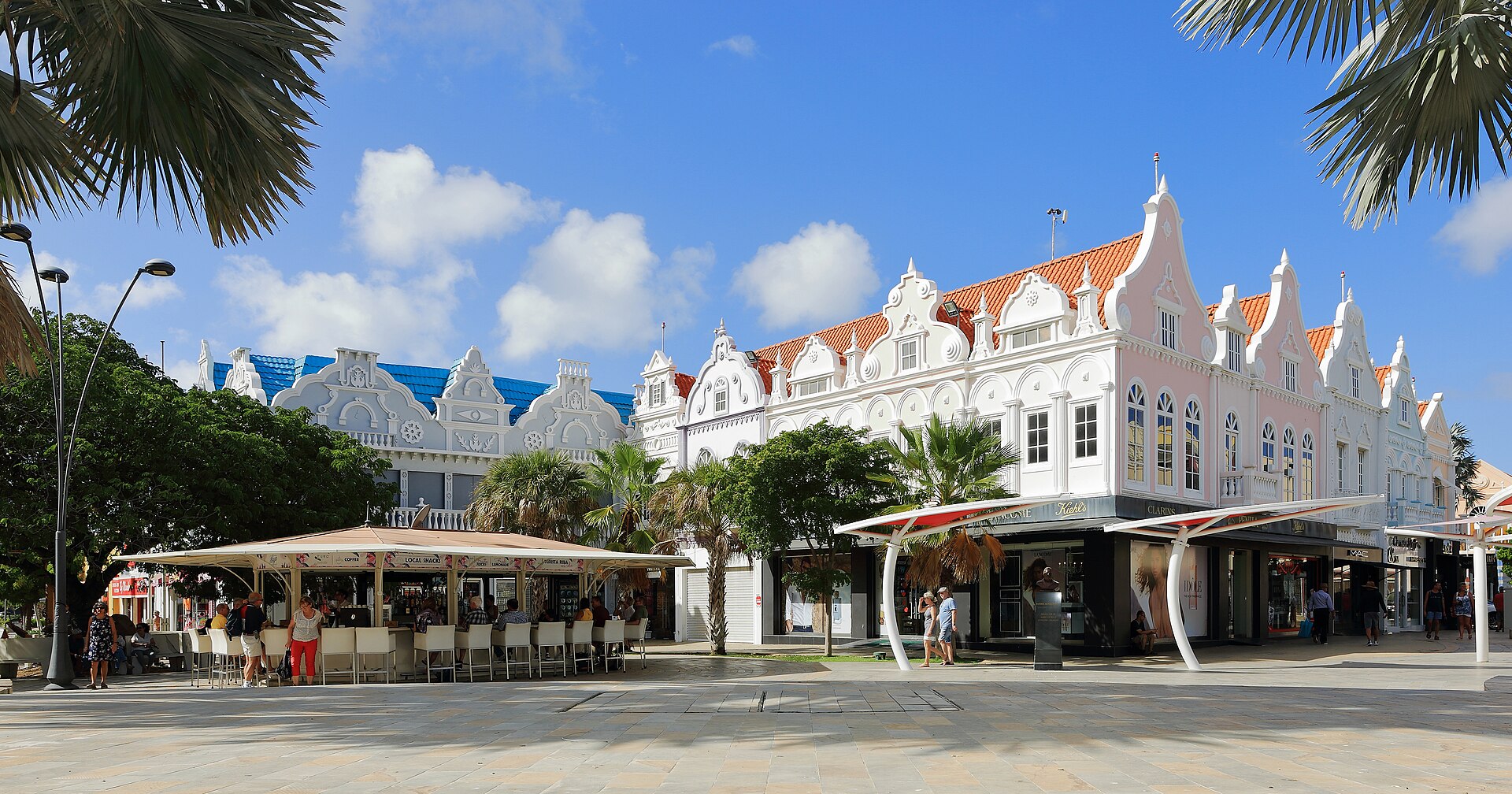
- Colorful Dutch-colonial buildings on a plaza in Oranjestad, Aruba, where a few papiamento phrases earn warm welcomes — Photo: Martin Falbisoner / CC BY-SA 4.0 via Wikimedia Commons
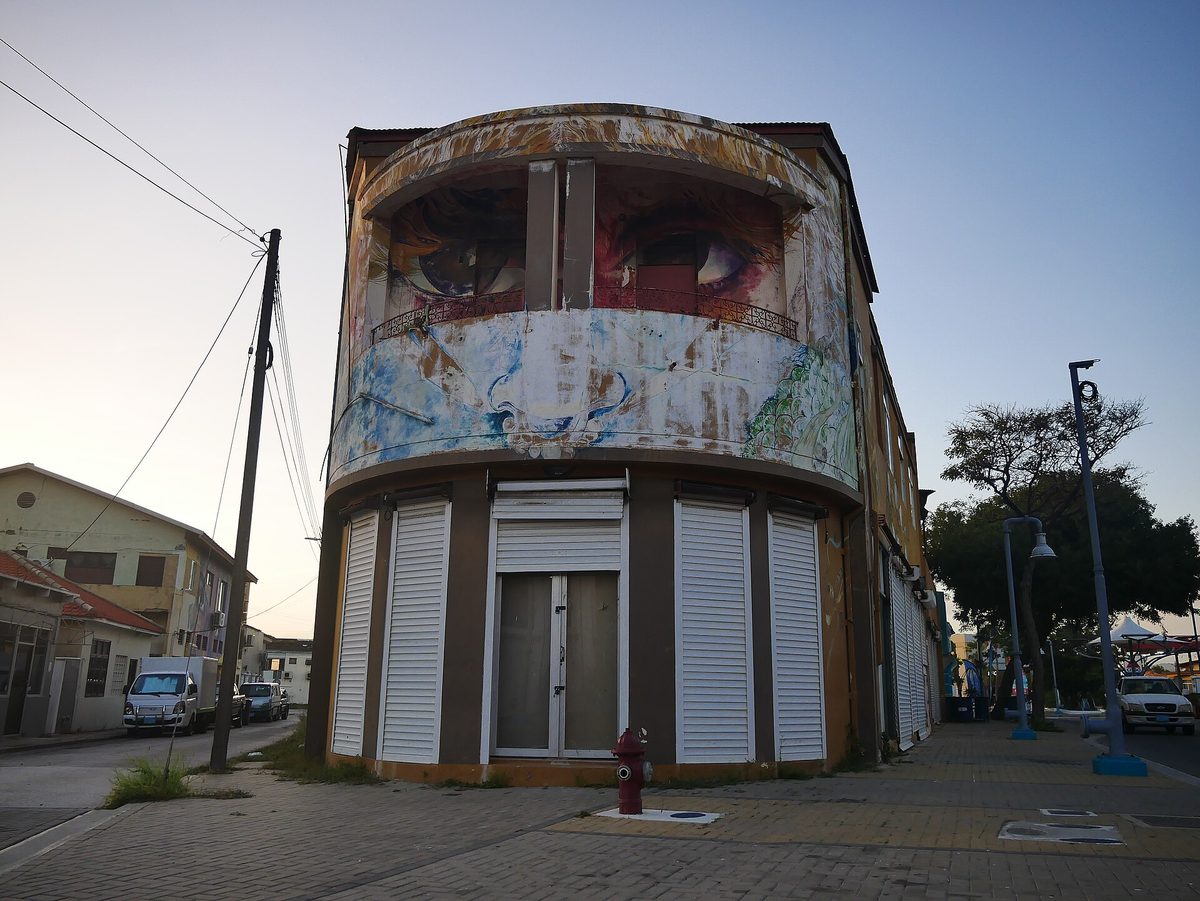
- Colorful street mural on a building in San Nicolas, Aruba’s art district — Photo: Ginelly.Q (CC0) via Wikimedia Commons
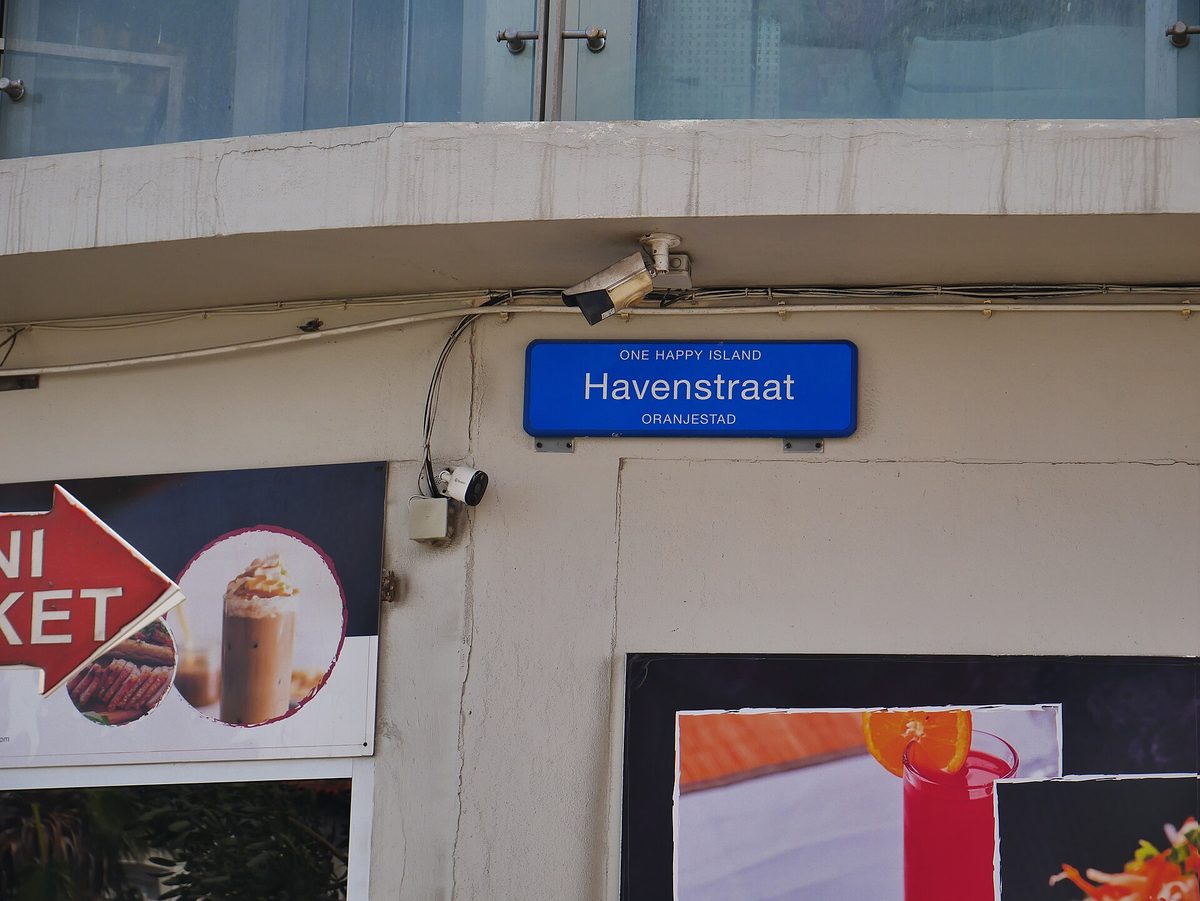
- A blue Havenstraat street sign in downtown Oranjestad, Aruba, reading One Happy Island — Photo: Ginelly.Q (CC0) via Wikimedia Commons
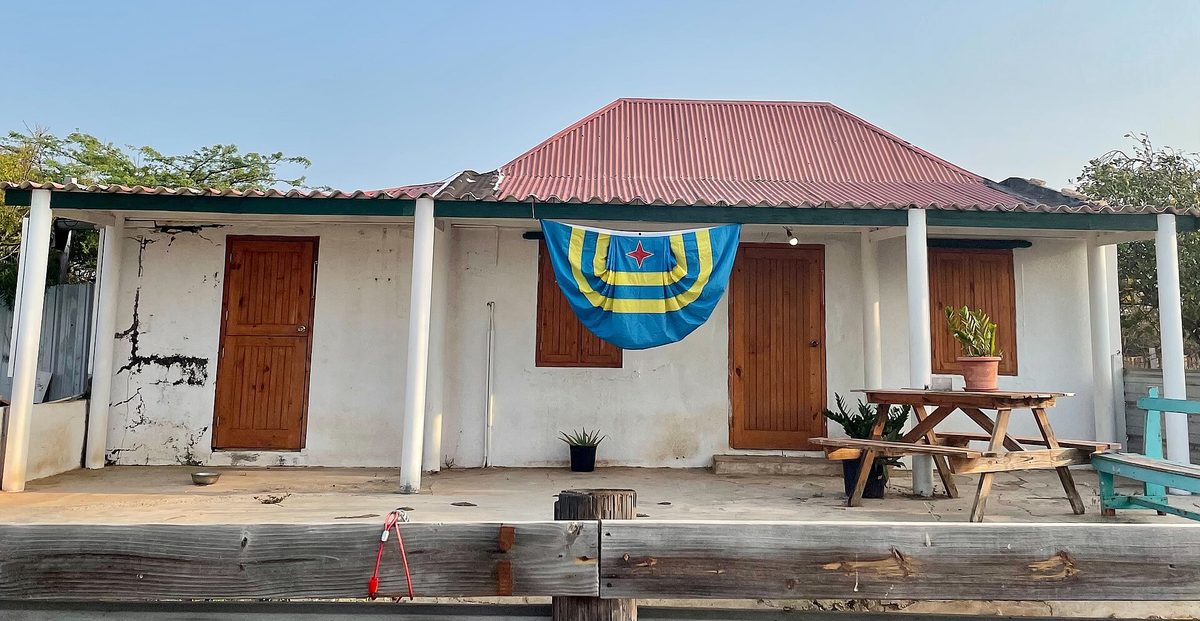
- The flag of Aruba displayed on a traditional cunucu house — Photo: Caribiana / CC BY-SA 4.0 via Wikimedia Commons
- Thatched palapa umbrellas under a bright blue sky at a beach in Aruba — Photo: EgorovaSvetlana / CC BY-SA 4.0 via Wikimedia Commons