The first time I drove into Arikok National Park, I’d just spent three days on the soft, calm side of Aruba — Palm Beach, frozen drinks, the gentlest turquoise water you can imagine. Then I pointed a rented Jeep at the island’s windward coast, and within twenty minutes the postcard fell away. Suddenly it was all cactus, wind-bent divi-divi trees, black volcanic rock and surf exploding against cliffs. It felt like a different island entirely. That contrast is the whole point of this place, and it’s why I tell everyone who visits Aruba to give it a day.
Arikok National Park covers roughly 20% of Aruba — about 7,900 acres of desert, caves, wild beaches and the island’s highest hills. It’s open daily, costs around US$22 per adult to enter (kids under 18 free), and the headline sights are Conchi (the Natural Pool), the rock-art caves, the Boca Prins dunes and the rugged northeast coastline. You can self-drive with a 4×4, book a guided UTV or Jeep safari, or hike.
I’ve now been through Arikok in a Jeep, on a guided UTV safari, and on foot, in both the dry season and the sticky shoulder months. This guide is for anyone trying to decide whether the park is worth it (it is), how to actually get around inside it (this trips a lot of people up), what to prioritize if you only have a few hours, and how Arikok fits alongside the rest of Aruba’s natural wonders and things to do. I’ll be candid about what’s spectacular, what’s overhyped, and what’s genuinely worth skipping.
Arikok National Park at a glance
Here’s the quick version — the highlights I’d steer a first-timer toward, who each one suits, and roughly how long to budget. Use it to build a rough plan before you read the detail below.
The park’s coastline is also where several of Aruba’s hidden beaches are, if you have the 4×4 to reach them.
| Highlight | Best for | Getting there | Time needed |
|---|---|---|---|
| Conchi (Natural Pool) | Adventurous swimmers | 4×4, guided tour, hike or horseback | 2–4 hrs round trip |
| Fontein & Quadirikiri Caves | Families, history lovers | Any car to the cave car parks | 45–60 min |
| Boca Prins dunes & cove | Photographers, scenery | 4×4 recommended | 30–45 min |
| Dos Playa | Surfers, wild-beach seekers | 4×4 or hike | 30–60 min |
| Cunucu Arikok & hiking trails | Hikers, early risers | Park at San Fuego visitor center | 1–3 hrs |
| Miralamar gold-mine ruins | History buffs, easy hike | Short trail from the interior road | 1–2 hrs |

What is Arikok National Park? The lay of the land
Aruba is tiny — about 20 miles long — and for most visitors it’s defined by the resort strip on the leeward (western) side. Arikok is the antidote. It sprawls across the rugged eastern and northeastern third of the island, a protected wilderness that the local foundation Fundacion Parke Nacional Aruba (FPNA) has managed since the park was formally established in 2000. Inside its boundaries you’ll find roughly 7,907 acres of cactus desert, limestone terraces, lava formations, sea caves, hidden coves and the island’s tallest hills.
It helps to picture Arikok in three broad zones, because where you can drive (and what you’ll see) changes a lot between them:
The interior & the hills
This is the part most people picture: a high, dry plateau of candle cactus and aloe, threaded with dirt roads and hiking trails. Mount Jamanota, Aruba’s highest point at 188 meters (about 617 feet), rises here — you can drive most of the way up for a panorama that takes in nearly the whole island. Nearby Seroe Arikok preserves a restored cunucu (countryside) house and old plantation walls that show how Arubans farmed this unforgiving land.
The northeast coast
The windward shoreline is Arikok at its most dramatic and least swimmable. Big Atlantic swell pounds in here, carving out coves like Boca Prins (famous for its sand dunes) and Dos Playa, and it’s where you’ll find the Conchi Natural Pool, the park’s single most famous spot. The roads out here are rough; this is genuine 4×4 territory.
The caves & the south
Toward the San Nicolas end, limestone cliffs hide Aruba’s accessible caves — Fontein, Quadirikiri and the small Huliba (“Tunnel of Love”) cave. This corner is the easiest to reach in a normal car, which makes it the smart choice if you didn’t rent a 4×4.
Planning your visit: hours, entrance fee and tickets
None of the logistics here are complicated, but a few of them catch people out, so let’s get the practical stuff sorted first.
Opening hours
Arikok is open daily, roughly 8:00 a.m. to 4:00 p.m., and in practice the gates close to new entries a little before that — the main San Fuego entrance generally stops admitting visitors around 3:30 p.m., and the Vader Piet entrance on the San Nicolas side closes a touch earlier still. The park is closed only on January 1st. These hours shift now and then, so confirm the current times on the official park website before you go.
My strong advice: arrive at opening. There is almost no shade in Arikok, the sun is brutal by mid-morning, and the light for photos is far kinder early. Going at 8 a.m. also means you’ll have the Natural Pool and the dunes closer to yourself before the tour groups roll in around 10.
Entrance fee and the conservation pass
Entry is by a conservation pass that costs around US$22 per adult (18 and over), with children under 18 admitted free as of early 2026. That fee goes directly toward maintaining trails, protecting wildlife and running the visitor center — it’s genuinely worth paying. A heads-up: the price has crept up over the years (it was about US$11 not long ago), so don’t be surprised if you see older figures floating around online. Always check the current rate before your trip, and factor it into your overall Aruba vacation budget.
You can buy the pass online in advance or in person at the San Fuego visitor center. I’d buy online if I knew my date — it saves a few minutes at the gate. Keep the QR code on your phone; they scan it at the entrance. The same pass is valid all day, so you can leave and re-enter.
The two entrances
Arikok has two gates, and picking the right one saves driving time:
San Fuego (main entrance): near Santa Cruz, roughly in the middle of the island. This is where the visitor center is — restrooms, water, exhibits, trail maps and rangers who’ll tell you current road and surf conditions. Start here if you want to hike or if it’s your first visit.
Vader Piet: on the southeast side near San Nicolas, closest to the caves (Fontein, Quadirikiri) and the windmill landmark. Handy if you’re staying in the south or doing a clockwise coastal loop.

How to get to (and around) Arikok National Park
This is the single thing people get wrong, so I want to be clear. Getting to the park is easy; getting around inside it is where your choice of transport makes or breaks the day. The interior coastal tracks are rocky, steep in places, and genuinely require a high-clearance 4×4 — a regular rental sedan will reach the visitor center and the cave car parks, but it will not get you to the Natural Pool, Boca Prins or Dos Playa. Here’s how I’d weigh the options.
Best for most people: rent a 4×4 or Jeep
If you want freedom to roam Arikok at your own pace, rent a proper 4×4 — a Jeep Wrangler or similar with real ground clearance, not a soft crossover. With one, you can reach every corner of the park, linger as long as you like at the Natural Pool, and combine Arikok with the north-coast beaches and landmarks like the California Lighthouse on the same day. Expect to pay a premium over a standard car; I cover the trade-offs in the guide to getting to and around Aruba. Two cautions: drive slowly (the tracks chew up tires and undercarriages), and never attempt the coastal roads in anything less than a true 4×4, no matter how confident you feel.
Best for zero hassle: a guided UTV, ATV or Jeep safari
If you’d rather not navigate rough roads yourself, a guided safari is the easy answer and, honestly, a lot of fun. Operators like De Palm Tours and ABC Tours run half-day trips by open-air 4×4 truck, small-group Jeep convoys, or self-drive UTV/ATV caravans that you pilot in a line behind a guide. The guide handles the route, points out wildlife and rock art, and usually builds in a swim stop at the Natural Pool. It’s the most popular way visitors see Arikok, and it’s the one I’d pick for a cruise day or if off-roading makes you nervous. Tours typically fold the park fee into the price — confirm when you book. Compare the on-the-water version in our Aruba water sports and boat tours guide if you’d rather see the coast from the sea.
For the adventurous: hike or ride in
You can skip a vehicle entirely and hike to the Natural Pool and the coast from the visitor center, or join a horseback tour that crosses the interior to Daimari Beach. Both are wonderful if you’re fit and start early — but the hike to Conchi is around 3.5 miles (5.5 km) each way over exposed, rocky ground with no shade and no water sold inside, so it is not a casual stroll. More on the trails below.
What I wouldn’t rely on: taxis and buses
There’s no public bus into Arikok, and taxis can drop you at the visitor center but can’t take you off-road to the marquee sights — so a taxi leaves you stranded at the edge of the best parts. Don’t plan your visit around either.
The must-see highlights inside Arikok
You could spend a full day here and not see it all. If you’re trying to prioritize, these are the spots I’d rank highest, roughly in the order I’d tackle them on a self-drive loop.
Conchi, the Natural Pool (the one everyone wants)
Conchi — Papiamento for “bowl,” and sometimes called Cura di Tortuga — is a natural swimming hole on the wild northeast coast, a circle of calm water ringed by a wall of jagged volcanic rock that holds back the open Atlantic. From the parking area you climb down 100-plus stone steps to reach it, and on a calm day you can swim, snorkel over the rocks and watch waves burst against the far side of the bowl while you float in still water. It’s a genuinely special place and the photo you’ve probably already seen of Aruba.
Two honest caveats. First, getting there is the adventure: it’s 4×4, guided tour, a long hot hike, or horseback — no ordinary car reaches it. Second, it’s weather-dependent. When the surf is up, waves wash over the rim, the rocks get dangerously slippery, and rangers may close it for safety. Check conditions at the visitor center first, wear water shoes, and don’t push it if the sea looks angry. Most people stay 30 to 45 minutes — long enough for a swim and photos. If the Natural Pool is closed, don’t despair; the rest of the park is still very much worth it.
Fontein Cave and its rock art
Fontein is the most interesting of Aruba’s caves because of what’s on the ceiling: reddish-brown rock drawings made by the Caquetio (Arawak) people, the island’s original inhabitants, hundreds of years ago. A park guide is usually stationed at the entrance to walk you through the chamber and point out the figures, which are easy to miss on your own. The cave is shallow, lit by daylight near the mouth, and an easy stop — reachable in a regular car — making it perfect for families and history lovers. You’ll often spot small bats roosting deeper in.
Quadirikiri and the “Tunnel of Love”
A short drive from Fontein, Quadirikiri Cave is the more theatrical of the two: two large chambers with natural skylights where the roof has collapsed, sending dramatic shafts of sunlight down through clouds of bats. You can walk fairly deep inside. Nearby, the tiny Huliba cave — nicknamed the “Tunnel of Love” for its heart-shaped entrance — is a narrow scramble that’s been opened and closed over the years, so ask a ranger whether it’s currently accessible. Bring a flashlight (your phone works) and shoes you don’t mind getting dusty.

Boca Prins and the sand dunes
Boca Prins surprised me. Tucked on the windward coast is a small rocky cove framed by a set of genuine wind-sculpted sand dunes — pale, soft and weirdly out of place against the dark volcanic shoreline. People sandboard and slide down them, and the cove itself is a wild, photogenic spot to watch the surf hammer in. Do not swim here — the currents are dangerous — but as a scenery-and-photos stop it’s one of my favorites. There’s sometimes a small snack shack near the dunes; don’t count on it, and bring your own water.
Dos Playa and the turtle beaches
Dos Playa (“two beaches”) is a pair of stunning, undeveloped coves backed by cliffs, popular with local surfers and bodyboarders who know how to read the powerful break. It’s gorgeous to look at and to walk, but again, the water is for experienced surfers, not casual swimmers — strong rip currents make it unsafe for swimming. Along this stretch, including nearby Daimari, sea turtles come ashore to nest; if you visit between roughly March and November you may see nests roped off, and you should never disturb the marked areas. For calm, swimmable sand, save it for the west-coast beaches — Arikok’s coast is about drama, not lounging.
Miralamar gold-mine ruins and Mount Jamanota
Inland, two stops reward a little effort. The Miralamar trail (a manageable out-and-back of roughly a mile) leads to the stone ruins of what was once Aruba’s largest gold mine — a reminder that this desert briefly drew prospectors in the 1800s. And a drive up Mount Jamanota, the island’s highest point, delivers a sweeping view across the cactus plains to the sea on both sides. Neither is crowded, and both make you feel like you’ve earned the panorama.
Hiking in Aruba: the best Arikok trails
People don’t think of Aruba as a hiking destination, but hiking in Aruba is at its best inside Arikok, where a network of marked trails fans out from the visitor center across the cactus plateau and down to the coast. The terrain is dry, rocky and exposed, so the rules are simple and non-negotiable: start at opening, carry far more water than you think you need, wear real shoes and a hat, and tell someone your plan. Nothing is sold on the trails. Here are the routes I’d point you to by ability.
Cunucu Arikok loop (easy, great intro)
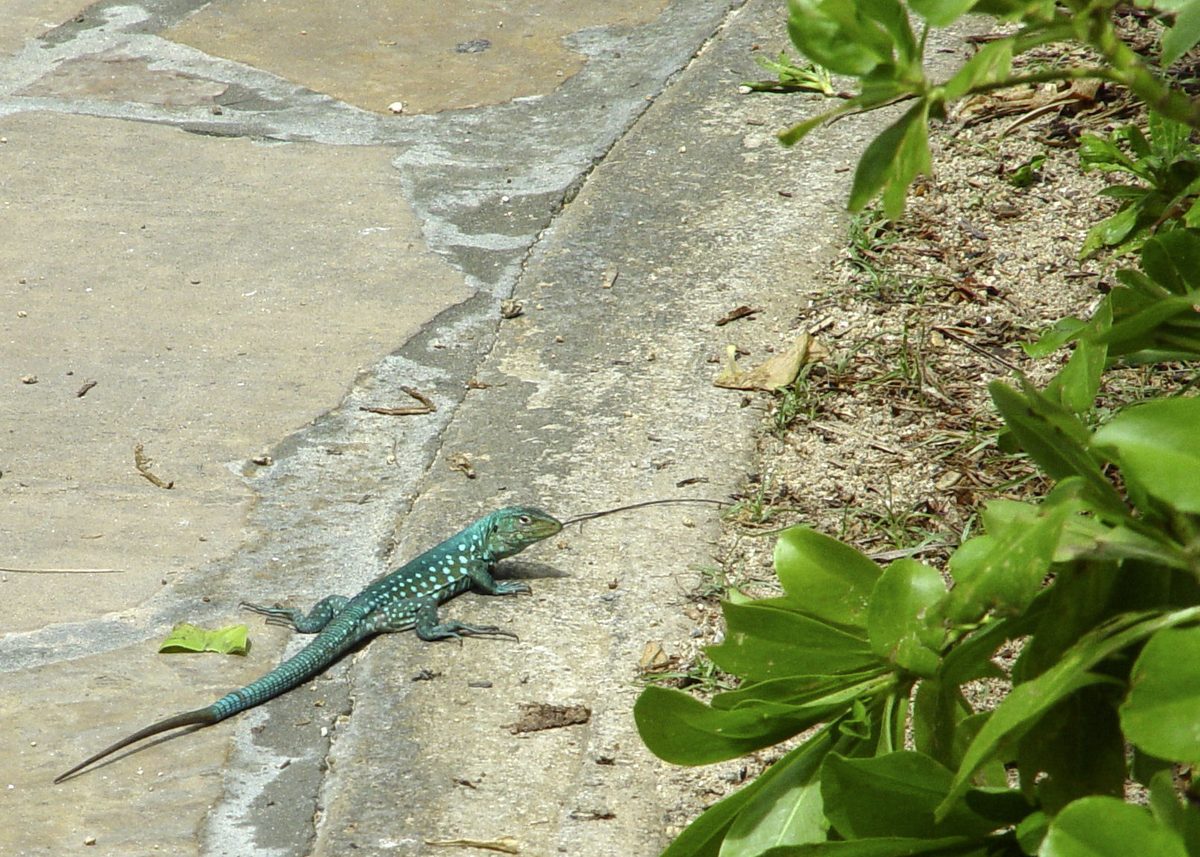
A gentle loop near the visitor center that’s perfect for a first taste of the landscape. You’ll pass the restored cunucu house, old plantation walls, towering candle cactus and, almost certainly, the park’s free-roaming goats and bright-blue whiptail lizards. It’s short, well-marked and doable with kids who are comfortable walking on uneven ground.
Miralamar trail (easy–moderate, history payoff)
About a mile out to the gold-mine ruins through lush (by Aruban standards) vegetation and up a low hill. The reward is the ruins and the views; the effort is modest. A favorite for travelers who want a goal at the end of their walk.
Rooi Tambu and the canyon trails (moderate)
Rooi Tambu follows a dry riverbed (a rooi) down toward the coast and can be linked with other interior paths for a longer half-day outing. It’s quieter, wilder, and a good shout if you want to feel genuinely away from the resorts.
To the Natural Pool and Mount Jamanota (challenging)
The big ones. Hiking all the way to Conchi is roughly 3.5 miles each way over rough, shadeless terrain — reserve it for fit, well-prepared walkers and an early start, and bank on three to four hours round trip. Climbing Mount Jamanota on foot is shorter but steep. For either, I’d genuinely rather have a 4×4 do the hard miles and save my legs for exploring once I arrive — but if you love a desert hike, these deliver.
Wildlife and plants: what you’ll actually see
Arikok protects species that exist nowhere else on Earth, and part of the fun is spotting them. You won’t see big game — this is a desert — but if you slow down and look, the park is alive.
The reptiles
The one you’ll remember is the Aruban whiptail lizard (locally kododo blauw): the males turn a startling electric blue and skitter across the trails everywhere, especially near the cunucu house where they’ve learned visitors mean crumbs (please don’t feed them). The park is also the last refuge of the endangered, endemic Aruban rattlesnake (cascabel) — shy, rare, and something you’re unlikely to encounter, but give any snake a wide berth. You may also meet harmless Aruban whiptails’ larger cousins and the occasional boa.
The birds
Aruba’s national bird, the burrowing owl (shoco), nests in the ground here and is most active around dawn and dusk — another reason to come early. Watch too for the bright green Aruban parakeet (prikichi), troupials, bananaquits and, out on the coast, brown pelicans and the odd frigatebird. Birders should also pair Arikok with the wetland sanctuaries elsewhere on the island (more on those below).
The free-roamers and the cacti
Goats and donkeys wander the park — descendants of the animals Aruba’s farmers once kept — and they’re harmless, if cheeky. Plant-wise, Arikok is a living catalog of desert flora: more than 70 species of cactus, including the tall kadushi (candle cactus) that locals still cook into soup, the prickly bushi used as living fencing, wild aloe (Aruba’s heritage crop), and the iconic wind-bent divi-divi trees that always point southwest, bent by the relentless trade winds. It’s a different kind of beautiful than the beaches — stark, sculptural and quiet.
Beyond Arikok: Aruba’s other natural wonders
Arikok is the headliner, but “Aruba’s natural wonders” stretches well beyond the park gates — and several of these spots sit just outside Arikok or on the way back to your hotel, so they’re easy to fold into the same day or the next. Here’s how I’d think about the rest of the island’s nature and wildlife attractions.
The Natural Bridge (and Baby Bridge)
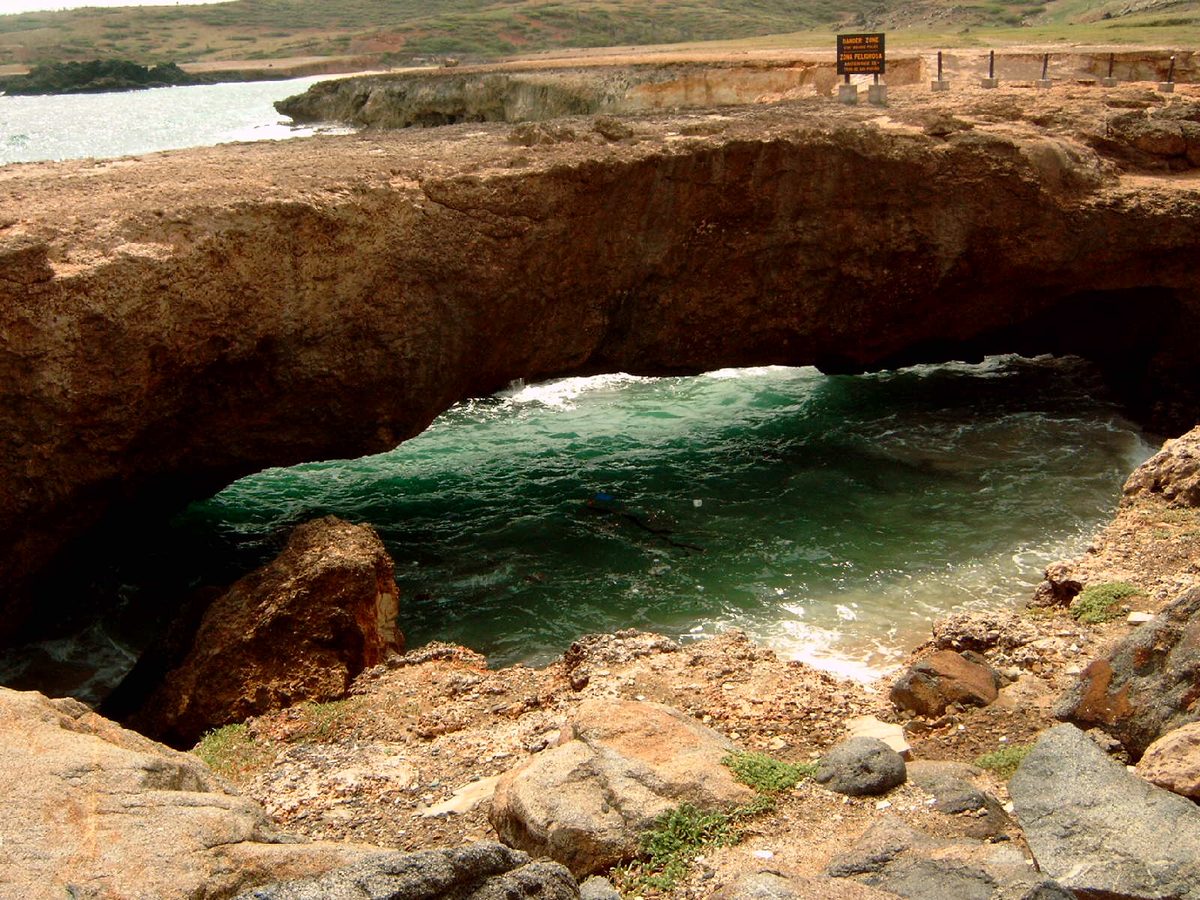
Just north of Arikok, the coral-rock Natural Bridge was Aruba’s most photographed landmark until it collapsed in 2005. What remains is still worth a quick stop: the smaller “Baby” Natural Bridge beside it, a little cafe and gift shop, and the same wild surf-battered coastline. It’s free, it’s fast, and it pairs naturally with an Arikok day.
Casibari and Ayo Rock Formations
Inland near Hooiberg (the haystack-shaped hill), the Casibari and Ayo rock formations are clusters of giant tumbled boulders you can scramble up for island views, with ancient Arawak petroglyphs at Ayo. Geologists still debate how these monoliths ended up here on an otherwise flat island, which only adds to the appeal. Easy, family-friendly, and reachable in any car.
The animal sanctuaries and farms
Aruba has a cluster of hands-on wildlife attractions that kids in particular love, all reachable without a 4×4:
The Aruba Ostrich Farm, on the road toward the Natural Bridge, runs guided tours where you can feed and learn about ostriches and emus — an unexpected desert oddity. The Butterfly Farm near Palm Beach is a serene walk-through enclosure where the staff explain the full life cycle and butterflies land right on you. The Aruba Donkey Sanctuary in Bringamosa cares for the island’s once-wild donkeys and is free to visit (donations welcome). Philip’s Animal Garden is a rescue and rehabilitation center sheltering everything from kangaroos to monkeys. I’ll be covering each of these in its own in-depth guide as part of this nature hub.
Birdwatching at Bubali
For birders, the Bubali Bird Sanctuary — a pair of former salt ponds turned wetland near Palm Beach — draws herons, egrets, cormorants and migratory species, with a viewing tower overlooking it all. It’s a completely different ecosystem from Arikok’s desert and a peaceful early-morning stop.
Aruba Aloe
Finally, the plant that’s been part of Aruba’s identity for 170 years. At the Aruba Aloe factory and museum in Hato you can tour the fields and production line and see how the island turned a hardy desert succulent — the same wild aloe you’ll spot growing in Arikok — into a heritage export. It’s a tidy, air-conditioned counterpoint to a hot morning in the park.
Arikok by type of traveler
How you should “do” Arikok depends a lot on who you’re traveling with. A few tailored takes:
Couples
Rent a 4×4, pack a picnic, and make the Natural Pool your centerpiece — an early swim in that volcanic bowl with the coast to yourselves is as romantic as Aruba gets away from a restaurant table. Add Boca Prins for photos and Jamanota for the view. It slots neatly into a wider Aruba itinerary built around a mix of beach days and adventure.
Families
Skip the rough 4×4 tracks unless your kids are good with bumps and heat. Instead, build the day around the caves (Fontein and Quadirikiri are genuinely thrilling for kids and reachable in a normal car), the Cunucu loop for lizards and goats, and then the nearby ostrich and butterfly farms. Lots of water, lots of sunscreen, and an early start before the heat.
Adventure seekers
This is your playground. Self-drive UTV or Jeep the full coastal loop, hike to Conchi, climb Jamanota, and chase the wildest coastline and water the island has. Just respect the surf warnings — the northeast coast is genuinely dangerous to swim.
Cruise-ship day-trippers
With only a few hours, don’t try to self-drive. Book a guided half-day safari straight from the port; it handles transport, fees and the Natural Pool stop, and gets you back to the ship on time. It’s the highest-value way to see Arikok on a tight clock.
When to go and how long you need
Arikok is a year-round destination — Aruba sits below the hurricane belt and stays warm and dry — but a few timing decisions will make your visit much better.
Time of day matters more than time of year
I can’t say this enough: go at opening. The park is hot and shadeless, the wildlife (owls, lizards, birds) is most active in the cool early hours, the Natural Pool and dunes are emptiest before mid-morning, and the photography light is far better. By noon the plateau is an oven. If you’re not a morning person, this is the one day of your trip to make an exception.
Season
The driest, breeziest months run roughly January through August; the short “green” season later in the year brings the occasional brief shower that softens the landscape but can make dirt tracks slick. Sea-turtle nesting runs about March to November, so a visit in that window may let you see roped-off nests on Dos Playa and Daimari (admire from a distance, never disturb). For the full breakdown of seasons, crowds and weather, see our guide to the best time to visit Aruba.
How long to budget
Give Arikok at least a half day, and a full day if you want to combine the Natural Pool, caves, dunes and a hike without rushing. A guided safari is typically four to five hours door to door. If you only have a couple of hours, focus on the caves and one coastal viewpoint and accept you’ll want to come back. When you’re slotting it into the bigger picture — alongside beach days, dining and where you’re based — our Aruba itinerary guide and where to stay in Aruba overview will help you balance the days.
What to bring and how to stay safe
Arikok is wild on purpose. A little preparation turns a potentially miserable, sunburned slog into a brilliant day. My packing list, learned partly the hard way:
- Water — more than you think. At least a liter or two per person. Almost nothing is sold inside the park, and dehydration is the number-one problem rangers see.
- Sun protection: reef-safe sunscreen, a hat, sunglasses and a light long-sleeve layer. There is essentially no shade.
- Proper footwear: closed-toe shoes or sturdy sandals with grip. The lava rock is sharp and the steps at Conchi are slick. Flip-flops will betray you.
- Water shoes for the Natural Pool’s rocky entry, plus a quick-dry towel.
- A full tank of gas if self-driving — there are no fuel stops inside, and the coastal loop burns more than you’d expect.
- A flashlight (phone is fine) for the caves, and a downloaded offline map — cell signal is patchy out there.
On safety: respect every surf and closure warning — the northeast coast’s currents are no joke and have caught out strong swimmers. Don’t attempt 4×4-only roads in a regular car (you’ll get stranded and the rental won’t be covered). Watch your footing on wet rock. And take everything out with you — this is a conservation area, so leave no trace, stay on marked trails, and never touch the rock art or disturb wildlife and nests. Treat the park gently and it stays this good for the next person.
Frequently asked questions about Arikok National Park
Is Arikok National Park worth visiting?
Yes — if you want to see the real, wild Aruba beyond the resort beaches, Arikok is the single best thing to do on the island. The caves, the Natural Pool and the dramatic windward coast show a side of Aruba most visitors miss. If you only do one non-beach activity on your trip, make it this.
How much does it cost to enter Arikok National Park?
Entry is via a conservation pass costing around US$22 per adult (18 and over), with children under 18 free, as of early 2026. The fee funds conservation and the visitor center. Prices have risen over the years and can change, so confirm the current rate and buy online in advance if you can.
Do you need a 4×4 to visit Arikok National Park?
To reach the Natural Pool, Boca Prins and Dos Playa, yes — the interior coastal tracks genuinely require a high-clearance 4×4. A normal rental car can reach the visitor center and the cave car parks (Fontein, Quadirikiri) but not the off-road sights. If you don’t have a 4×4, take a guided safari instead.
Can you swim in the Natural Pool?
Yes, when conditions are calm. Conchi is a rock-enclosed pool that shelters swimmers from the open Atlantic, and you can swim and snorkel there. But when the surf is high, waves wash over the rim and rangers may close it for safety. Wear water shoes, mind the slippery rocks, and always check conditions first.
How long do you need at Arikok National Park?
Budget at least a half day, or a full day to combine the Natural Pool, caves, dunes and a short hike without rushing. Guided safaris usually run four to five hours. With only a couple of hours, focus on the easily reached caves and one coastal viewpoint.
Can you drive through Arikok yourself?
Absolutely — self-driving is one of the best ways to experience the park, giving you freedom to linger. Just bring the right vehicle: a true 4×4 for the coastal tracks, or any car if you’re only visiting the visitor center and caves. Drive slowly, carry water and start early.
Is the Natural Pool inside Arikok National Park?
Yes. Conchi (the Natural Pool) sits on the northeast coast within the park’s North Conservation Zone, so your park conservation pass covers access. You reach it by 4×4, guided tour, a roughly 3.5-mile hike, or horseback — there’s no shortcut by regular car.
What animals will I see in Arikok?
Most commonly the electric-blue Aruban whiptail lizard, free-roaming goats and donkeys, parakeets and, if you’re early, the burrowing owl (Aruba’s national bird). The park also protects the rare, endemic Aruban rattlesnake, which you’re very unlikely to see. Offshore, sea turtles nest on the wild beaches in season.
What’s the best time of day to go?
First thing in the morning, right at the 8 a.m. opening. It’s cooler, the wildlife is active, the Natural Pool and dunes are quietest before the tour groups arrive, and the light is best for photos. The exposed plateau gets punishingly hot by midday.
Final thoughts: give Arikok a day
That drive from Palm Beach into the cactus still gets me every time. Arikok is the part of Aruba that reminds you this is a real, rugged island in the southern Caribbean and not just a strip of resorts — a place of caves and rock art, a swimming hole carved from lava, owls in the ground and lizards the color of the sea. It asks a little more of you than a beach day: an early alarm, the right shoes, enough water, and a 4×4 or a good guide. Give it that, and it gives back the most memorable day of your trip. Pair it with the island’s other top things to do, refuel afterward at one of our favorite Aruba restaurants, and you’ll go home understanding why locals are so fiercely proud of this wild fifth of their island.
Photo credits
Images via Wikimedia Commons unless noted. See each image’s source page for full license details. Arikok desert landscape and coastline; the cliffs at Quadirikiri Cave; Boca Prins sand dunes; Aruban whiptail lizard; and Aruba’s Natural Bridge area. Each photographer is credited on the image’s Wikimedia Commons file page, and all images are used under their respective Creative Commons or public-domain licenses.